A recruiter sent you an assessment link, and somewhere in the email or the login screen you saw the word Berke, or the word Criteria, or both. These are two different pre-employment tests from two different publishers, built on opposite design principles, so knowing which one you face changes what you should practice tonight. The CCAT here is the Criteria Cognitive Aptitude Test used in workplace hiring, not the Canadian Cognitive Abilities Test given to schoolchildren that shares the same initials. The short answer: the CCAT is one fixed, brutally fast cognitive test, 50 questions in 15 minutes, producing a single raw score and percentile. Berke is a configurable battery that blends a personality profile with a few problem-solving modules, and its length changes from job to job because the employer decides which pieces run.
**Quick takeaways**
- The CCAT is always the same test: 50 questions, 15 minutes, verbal, math and logic, and spatial reasoning, no calculator.
- Berke is assembled per role. HighMatch, which publishes it, says the assessment "can vary from 10 minutes to 60 minutes" depending on the employer.
- The CCAT is purely cognitive. Berke measures 7 personality traits alongside 4 problem-solving areas, so half of it is not something you can study for.
- The CCAT hands your employer a raw score and a percentile. Berke hands them a job-fit picture and an interview guide, so there is often no single number to clear.
- The two overlap on spatial visualization and vocabulary, so real CCAT practice carries over to Berke's cognitive half, not the other way around.
- If your test is 15 minutes with a hard stop and no calculator, it is the CCAT.
## CCAT vs Berke Assessment at a glance
Both are pre-employment tests, but only one of them is a pure speed-and-reasoning exam.
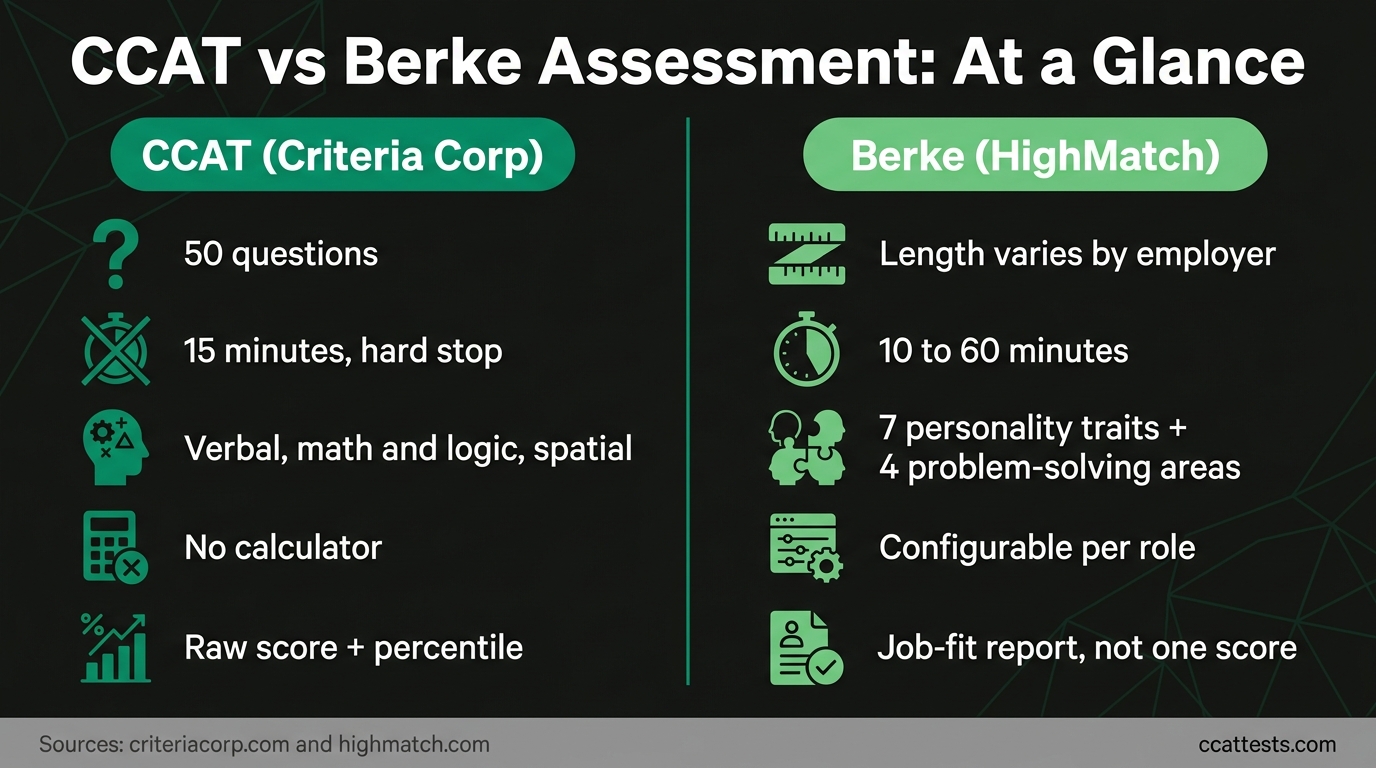
| | CCAT (Criteria Corp) | Berke Assessment (HighMatch) |
|---|---|---|
| What it is | A single fixed cognitive aptitude test | A configurable assessment the employer assembles per role |
| Questions | 50, the same for everyone | Varies with the modules the employer switches on |
| Time | 15 minutes, hard stop | 10 to 60 minutes depending on configuration |
| Cognitive content | Verbal, math and logic, spatial reasoning | Logical problem solving, vocabulary, rapid problem solving, spatial visualization |
| Personality content | None | 7 traits: adaptability, optimism, structure, assertiveness, responsiveness, intensity, sociability |
| Optional extras | None | Typing skills, integrity and attitudinal measures |
| Calculator | Not allowed | Set by the employer's configuration |
| Result the employer sees | Raw score out of 50 plus a percentile | Job-fit comparison, participant report, interview guide |
| Can you study for it | Yes, and it works | Only the problem-solving half |
The row that matters most is the second-to-last one. The CCAT produces a number you can be above or below. Berke produces a profile a hiring manager reads next to a role definition. That one difference explains almost everything below.
## What each test actually measures
The CCAT measures general cognitive ability under time pressure, and nothing else. [Criteria Corp](https://www.criteriacorp.com/candidates/ccat-prep) states the test has 50 questions, gives you 15 minutes, and mixes 3 kinds of questions: verbal, math and logic, and spatial reasoning. No personality component, no typing test, no skills module. Everyone sees the same test regardless of the job they applied for.
Berke splits into two halves. On the cognitive side, [HighMatch](https://www.highmatch.com/berke-assessment/berke-assessment-measures/) lists four problem-solving abilities: logical problem solving, vocabulary, rapid problem solving, and spatial visualization. On the personality side it lists seven traits: adaptability, optimism, structure, assertiveness, responsiveness, intensity, and sociability. Employers can bolt on a typing test or integrity and attitudinal measures if the role calls for it.
That structure has a consequence people miss. A Berke result is not one score, it is a shape. You can be strong on rapid problem solving and still read as a poor fit because the role profile wants high structure and you scored low on it. The CCAT has no equivalent concept. It cannot tell an employer you are too flexible or too reserved for a job, because it never asked. Criteria Corp does publish a separate personality instrument, covered in [the Criteria Corp test suite explained](/blog/criteria-corp-test-suite-explained), but it is a different test you would sit separately.
## Timing: a hard 15 minutes vs a length your employer chose
The CCAT gives you 18 seconds per question, and that number is the whole story.
Fifty questions across 15 minutes works out to 18 seconds each if you want to see every one, and almost nobody manages it. Criteria Corp reports that less than 1% of candidates answer all 50 questions, and that the average test-taker gets 24 right. Running out of time is the normal outcome, not a failure, which we unpack in [is it normal to not finish the CCAT](/blog/is-it-normal-to-not-finish-the-ccat).
There is no single Berke clock. HighMatch says the length "can vary from 10 minutes to 60 minutes" depending on what the employer needs. A small business hiring a warehouse lead and a software company hiring an engineering manager can both send you "the Berke assessment" and hand you two experiences sharing little but a login page.
So the pacing advice inverts. On the CCAT you budget aggressively, skip anything that stalls you, and keep moving. On Berke's personality section, rushing is the real risk: those items ask how you work, and answering dozens of them on autopilot produces an inconsistent profile that reads as unreliable.
## What the results look like, and why "passing" means different things
Neither test has a universal pass mark, but they fail you in completely different ways.
On the CCAT the employer receives your raw score (how many of the 50 you got right) and your percentile against everyone else who has taken it. A company can and often does set a cutoff, and you either clear it or you do not. We break that down in [how the CCAT is scored, raw scores vs percentiles](/blog/how-is-the-ccat-scored-raw-scores-vs-percentiles).
Berke's outputs are built for a conversation rather than a filter. HighMatch describes candidate reports, job-fit comparisons against a role profile, and interview guides that hand the hiring manager follow-up questions. So a Berke result frequently does not eliminate you outright, it shapes what you get asked next. If you answered the personality section one way and then describe yourself the opposite way in the live interview, that is where the mismatch surfaces.
Keep that in mind before you go hunting for "Berke assessment test answers." There is no answer key to a personality inventory, and the cognitive half is generated per configuration, so what gets sold as answers is usually generic aptitude practice with a Berke label on it.
## Where the two overlap, and what your CCAT practice transfers to
Two areas overlap directly: spatial reasoning and vocabulary.
Both tests ask you to rotate, fold, or complete shapes mentally, and both ask you to work with word relationships. The transfer runs one way better than the other. Solid CCAT practice at 18 seconds a question makes Berke's problem-solving modules feel slow, because you trained under the harder clock. Generic Berke practice does not prepare you for the CCAT, because it rarely reproduces the CCAT's pace or its specific spatial and abstract question styles.
A worked example of what that transfer feels like. A spatial visualization item shows an unfolded net of a cube with four symbols on its faces and asks which of five folded cubes it could produce. On a Berke module you may have time to fold the net mentally twice and double-check a face. On the CCAT you get one pass. The technique that saves you is elimination rather than construction: find the one pair of symbols that can never sit on adjacent faces, then cross off every option showing them adjacent. You often reach the answer without completing the fold at all. That habit is trained, not innate, and it is exactly what [CCAT spatial reasoning practice questions](/blog/ccat-spatial-reasoning-practice-questions) drill. The same holds on the verbal side, where both tests reward pattern recognition in word relationships rather than a bigger dictionary, the case we make in [CCAT verbal analogies](/blog/ccat-verbal-analogies).
What does not transfer is the personality half. Nothing you practise makes you score "better" on adaptability, and guessing at a target profile is how candidates end up with contradictory answers that stand out.
## If you got sent both: a practical game plan
Split your effort deliberately, because only one of these two rewards studying.
Spend your prep hours on the CCAT. It is the one where practice changes the result, the one with a hard cutoff, and the one where 18 seconds a question punishes anyone who has never seen the format. Two or three timed full-length runs teach you more than a week of casual reading.
Spend your Berke effort on consistency instead. Answer the personality items quickly and honestly, hold a clear picture of how you actually work, and do not swing your answers toward what you think the job wants. Then reread the job description before your next interview, because the interview guide the hiring manager is holding was generated from your own answers. If your pipeline pairs the CCAT with a behavioral profile from a different publisher, the mechanics are close to [CCAT vs the PI Behavioral Assessment](/blog/ccat-vs-pi-behavioral-assessment), and the wider landscape is mapped in [CCAT vs other aptitude tests](/blog/ccat-vs-other-aptitude-tests).
One honest note on paid prep. The page ranking first for Berke queries today is a JobTestPrep product page, and a comparable CCAT pack there costs several times what it does here. Their material is not bad. It does mean you should find out where you actually stand before spending anything, which is why our free tier exists.
## FAQ
### What is a Berke assessment?
The Berke Assessment is a pre-employment test that measures personality traits and problem-solving abilities in one sitting. It is published under the HighMatch brand and is configurable, so the employer picks which modules a candidate sees. HighMatch describes it as built by an in-house team of workplace psychologists and aimed particularly at small and medium sized businesses.
### What is a Berke, and who makes it?
Berke is both the name of the assessment and its original publisher, Berke Group, LLC, which still appears as the vendor on applicant tracking marketplaces such as the iCIMS listing. Today the assessment's official product pages live on highmatch.com. If your invite says HighMatch and you were expecting Berke, you are in the right place.
### Is the Berke assessment hard?
The cognitive modules are moderately difficult and the personality section is not difficult at all, just long. What makes Berke feel hard is uncertainty rather than content: because the employer configures it, you cannot know in advance how many sections you get or how long you will sit there.
### Which is harder, the CCAT or Berke?
For most people the CCAT, and the reason is pacing rather than question difficulty. Criteria Corp reports the average test-taker answers 24 of 50 correctly and fewer than 1% finish all 50, so the test is built such that almost nobody completes it. Berke's cognitive modules give you more breathing room, and its personality half has no right answers to miss.
### Do CCAT practice questions help with the Berke Assessment?
Yes, for the problem-solving half. Both tests use spatial visualization and vocabulary-style reasoning, so timed CCAT practice sharpens the exact skills Berke's cognitive modules measure, at a faster tempo than Berke asks for. It does nothing for the personality section, and it should not.
### Are there Berke assessment test answers floating around?
No, and anything advertised as an answer key is worth ignoring. The personality section has no correct answers by design, and the cognitive modules vary by employer configuration, so a fixed answer list cannot exist.
### How do I pass the Berke Assessment?
There is no pass mark to clear, so aim at two things instead. On the problem-solving modules, work accurately at a steady pace and use elimination on spatial items rather than constructing the full answer. On the personality items, answer quickly and consistently, because a profile that contradicts itself hurts you more than one that simply is not a perfect fit.
### What are the main types of pre-employment tests, and where do these two sit?
Employers generally draw from four families: cognitive ability tests, personality and behavioral assessments, skills or job-knowledge tests, and integrity tests. The CCAT sits in the first family and only the first. Berke deliberately spans several in one sitting, which is why the two are not really substitutes even when companies use them for the same hiring decision.
## Related on CCAT Tests
- **Comparison.** [CCAT vs other aptitude tests](/blog/ccat-vs-other-aptitude-tests). Where the CCAT sits against Wonderlic, SHL, and the rest, side by side.
- **Behavioral pairing.** [CCAT vs the PI Behavioral Assessment](/blog/ccat-vs-pi-behavioral-assessment). What happens when a cognitive test is paired with a personality profile.
- **Publisher.** [The Criteria Corp test suite explained](/blog/criteria-corp-test-suite-explained). Every test Criteria Corp publishes, and which one you are actually taking.
- **Practice by type.** [CCAT spatial reasoning practice questions](/blog/ccat-spatial-reasoning-practice-questions). The overlap area between the two tests, drilled properly.
- **Pillar.** [The CCAT test preparation guide](/ccat-test-preparation-guide). The hub for everything on preparing for the CCAT.
- **Practice.** [Free CCAT practice tests](/free-ccat-practice-tests). Find your weakest category before you pay for anything.
## Try CCAT Tests
**Practise the test you are actually taking, not a generic aptitude quiz**
Generic prep fails on the CCAT because the CCAT's spatial and abstract questions look nothing like the filler most sites recycle across a dozen exams. Our question bank is built specifically for the CCAT, images included, and run at the real 15-minute pace, so what you practise is what you sit. The free tier is a genuinely usable practice experience across all three question types rather than a three-question teaser, and paid plans are one-time, [see pricing](https://ccattests.com/pricing), adding heat-map analytics that show exactly which question types are leaking your points. The same material backs our companion Udemy course, which has over 1,200 students and a 4.5 out of 5 rating. And if the Berke is one stop in a process that also throws personality and situational assessments at you, [the broader PrepClubs platform](https://prepclubs.com) covers that whole gauntlet with 21 pre-employment tests, more than 3,700 students, and a money-back guarantee.
[Start your free CCAT practice](/free-ccat-practice-tests)
CCAT is a registered trademark of Criteria Corp. Berke and HighMatch are trademarks of their respective owners. ccattests.com is an independent study resource and is not affiliated with, endorsed by, or sponsored by Criteria Corp.