A recruiter sent you a CCAT link, you clicked a free sample, and the shape questions made you stop cold. That is the normal reaction, and no, you do not need to buy a prep course to fix it. Spatial questions are the most trainable part of the CCAT because they run on a small set of repeating rules, and you can drill those rules for nothing. Below: a 10-day free plan, a worked example, paper drills, and a self-scoring method. One quick disambiguation before you start: this is the Criteria Cognitive Aptitude Test used in workplace hiring, not the Canadian Cognitive Abilities Test given to schoolchildren that shares the same initials.
**Quick takeaways**
- You can practice CCAT spatial questions free. Money buys realistic imagery and diagnostics, not the rules.
- Criteria Corp says the section has you "rotate or flip images in your head, recognize patterns, and identify outliers."
- Three sub-types cover almost everything: next in series, odd one out, and matrices.
- Twenty minutes a day for ten days beats a four-hour weekend cram, because pattern recognition is a reflex built by repetition.
- Criteria Corp reports the average test taker gets 24 of 50 right and fewer than 1 percent finish, so your target is not perfection.
- Log four things per missed question (sub-type, rule, seconds, reason) and you approximate most of a paid dashboard.
- Free runs out when your accuracy is fine but your speed is not. That is a materials problem, not an ability problem.
## What CCAT spatial questions actually test
Spatial questions are the shape-and-pattern items, and the publisher is direct about them. [Criteria Corp](https://www.criteriacorp.com/candidates/ccat-prep), the company that writes and scores the CCAT and the only authority on its format, says the test "will evaluate your spatial reasoning skills by having you rotate or flip images in your head, recognize patterns, and identify outliers." No 3D modeling, no geometry, no drawing. Criteria Corp also explains why an employer cares about shapes: the items read your aptitude for learning and using new information. They are checking how fast you find a rule you were never told.
They come in three sub-types:
- **Next in series.** Figures form a sequence with one slot missing. Find the rule, continue it.
- **Odd one out.** Several figures share a hidden rule and one breaks it. Find the rule first, then the breaker.
- **Matrices.** A grid with one cell missing, rules running across the rows and down the columns at once.
Criteria Corp publishes the format (50 questions, 15 minutes, three question types, no calculators) but no per-type breakdown, so any exact count is an estimate. The prep industry converges on about 11 of 50, and the two pages ranking above this one both print that number. Plan for roughly one in five.
Pace is what should shape your practice. Fifty questions in fifteen minutes is 18 seconds each, and a spatial item is worth the same single point as an easy vocabulary word. Two more Criteria Corp numbers take the pressure off: fewer than 1 percent of candidates answer all 50, and the average test taker gets 24 right. You are not trying to finish. You are trying to stop leaking points.
## What is genuinely free, and what is not
A prep course bundles four things, and only two of them are genuinely hard to get for nothing.
| What the course sells | Free elsewhere? | Verdict |
|---|---|---|
| The pattern rules | Yes | Widely available, including below |
| A study schedule | Yes | Just a decision about what to do on which day |
| A CCAT-style bank with rendered images | Rarely | The real scarcity |
| Diagnostics showing where points leak | Rarely | The paywalled layer, but you can hand-build a rough version |
Free material for the first two is everywhere, but it is uneven, and giving the wrong resource the wrong job wastes a week.
| Free resource | Best used for | Where it falls short |
|---|---|---|
| A timed CCAT-style test with a free tier | Your only honest read on real pace | Limited volume before a paid tier |
| Criteria Corp's candidate prep page | The official description, one sample per type | Almost no practice volume |
| Generic free spatial and abstract tests | Cheap repetition, lots of it | Different style, slower timing, wrong question mix |
| A spatial reasoning PDF download | Portable rule practice | No clock, and print puzzles run simpler than the screen |
| Drills you build yourself on paper | Unlimited rotation and mirror reps | You know the answer, so it trains the eye, not the decision |
Two warnings. Generic aptitude sites recycle the same filler puzzles across a dozen tests, so treat them the way a runner treats a treadmill: real volume, wrong surface. And the PDF everyone searches for is a study aid, not a rehearsal. A PDF cannot make you answer in 18 seconds, which is the exact skill being measured.
## A 10-day spatial drill plan you can run for nothing
Twenty minutes a day, ten days, no purchase. One principle runs through it: accuracy first, speed second. Chasing speed from day one locks in bad habits and plateaus.
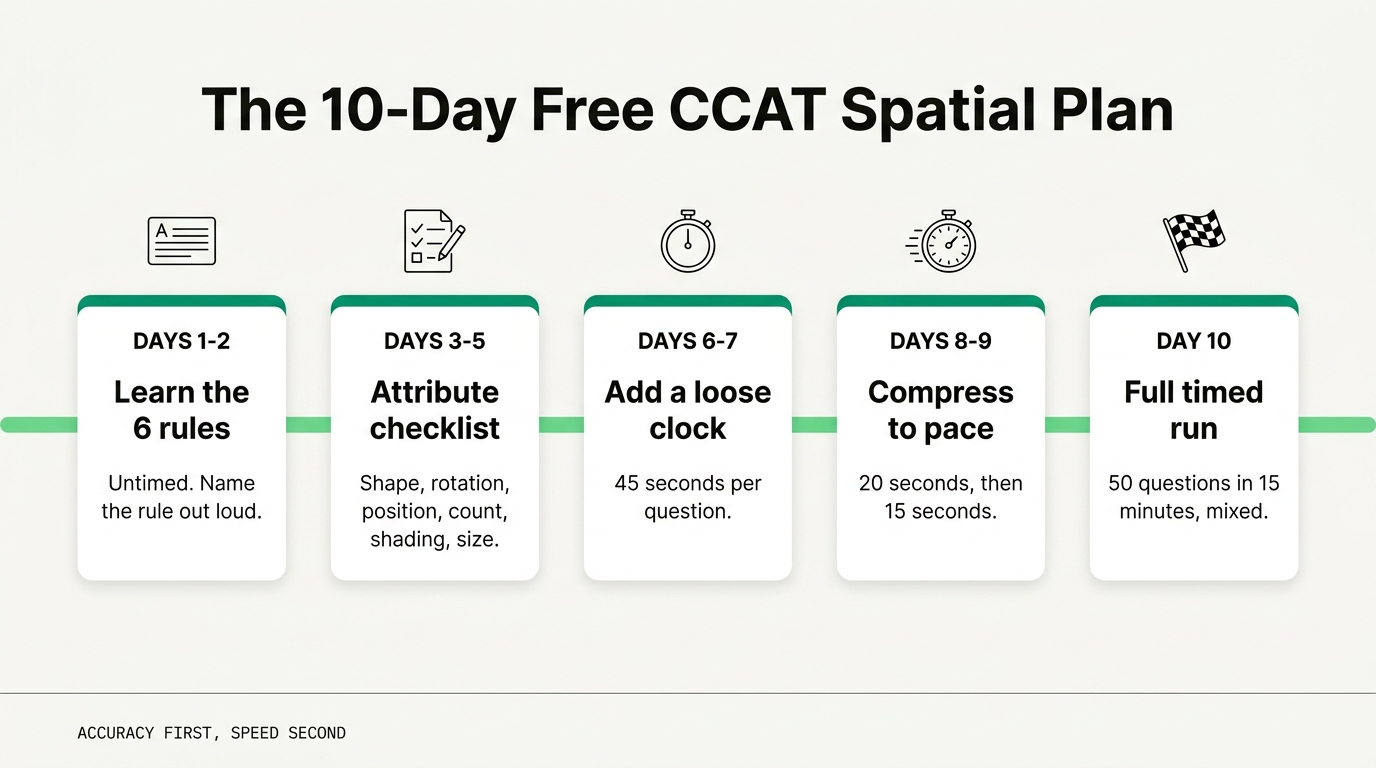
**Days 1 to 2: learn the rules cold.** Six rules drive almost every question: rotation, reflection, movement, adding or removing elements, shading change, and size change. Write them on an index card, then work 15 to 20 untimed questions and name the rule out loud before you answer. Getting it right is not the goal yet. Naming the driver is.
**Days 3 to 5: build the attribute habit.** The biggest mistake is trying to see the whole pattern at once. Check one attribute at a time in a fixed order: shape, rotation, position, count, shading, size. Twenty questions per session, untimed, checklist top to bottom every time.
**Days 6 to 7: add a loose clock.** Same drills at 45 seconds per question, more than double the real budget. If accuracy collapses the moment a timer appears, stay here an extra day.
**Days 8 to 9: compress to test pace.** Tighten to 20 seconds, then 15. Fifteen is harsher than the real average on purpose, so test pace feels roomy. Expect accuracy to dip, then watch whether it recovers within two sessions. That recovery is the skill.
**Day 10: one full timed run.** Fifty questions in 15 minutes, mixed sections rather than spatial only, because the real difficulty is switching between a word analogy and a rotating arrow with no warning. Then score yourself with the error log below.
## One question, worked the slow way
Here is the checklist running on the odd-one-out sample Criteria Corp publishes on its own candidate prep page: five answer choices, each holding three small shapes, and you name the one that does not belong.
Run the attributes in order instead of staring at the whole row. **Shape:** four of the five choices contain a circle, a triangle and a square. Choice B has a circle and two squares, no triangle. Stop there. You have the rule and the breaker, and you never needed rotation, position, count or shading.
Shape composition is the cheapest check, so it goes first, and here it settles the answer in about four seconds. Untrained test takers do the opposite: they absorb the whole figure and burn 40 seconds on an item worth one point.
## Build your own drills with a pen and paper
You can manufacture unlimited rotation and reflection reps in two minutes, and almost no prep page mentions it. You know the answer in advance, so these do not replace real questions. They train the mental move itself.
- **Rotation.** Draw an asymmetric squiggle inside a square, then redraw it at 90, 180 and 270 degrees. Check by turning the page.
- **Mirror.** Flip that squiggle across a vertical line, then a horizontal one. Mirrors are where most people lose odd-one-out questions, because a mirrored figure looks like a rotated one at a glance and is not.
- **Count and shade.** Draw four boxes holding 2, 4, 6 and 5 dots, and learn to spot the odd count in under two seconds without counting one by one.
- **Matrix.** Draw a 3x3 grid, pick one rule for rows and one for columns, fill eight cells, leave one blank, and solve your own puzzle an hour later.
Fifteen minutes of this in a queue is real training, and the cheapest way to build the rotation reflex before you spend limited free CCAT-style questions.
## Score yourself without a dashboard
Paid tools give you a heat map of where your points leak. Four notebook columns approximate it. For every question you miss or answer too slowly, log the **sub-type**, the **rule** actually driving it, the **seconds** you took, and the **reason** you lost it: missed the rule, spotted it too late, misread the options, or ran out of time.
Then read the columns, not the rows. Say you run three sets of 11 spatial questions across days 8 to 10 and miss nine. If seven are matrices, you have a matrix problem rather than a spatial problem, and one session on rows and columns separately fixes most of it. If the reason column says "spotted it too late" eight times out of nine, your rule knowledge is fine and you are not running the checklist fast enough. If misses spread evenly with no pattern, go back to days 1 and 2.
What a hand-built log cannot do is compare you against how other candidates handled the same items, or flag the ones you got right by luck.
## When free stops being enough
Free covers the rules, the reps and the schedule. It runs out in three situations.
**Your accuracy is fine but your speed is not.** The most common wall, and almost always a materials problem: generic free puzzles are drawn and timed differently, so they build a pace that does not survive contact with the real thing.
**You cannot tell which section is costing you.** After a mixed full-length run, most people know their score but not where it went.
**You are retaking after a real attempt.** If a company already screened you out on a CCAT score, guessing at your weak spot is an expensive way to spend a second chance.
That gap is what CCAT Tests was built for. The free tier is a real practice experience rather than three sample questions and a signup wall: timed, CCAT-style questions across all three domains, with rendered spatial imagery instead of shapes described in words. Paid tiers add the full spatial and abstract-reasoning image bank plus a heat-map breakdown of which question types drain your clock, the class of insight enterprise analytics tools charge hundreds of dollars a month for, here as a one-time purchase. A comparable CCAT pack from a large established brand such as JobTestPrep runs roughly three times our full price.
## FAQ
### Can I practice CCAT spatial questions for free?
Yes. The pattern rules, the three sub-types and a workable schedule are all freely available, and you can build unlimited rotation and mirror drills on paper. What is hard to find free is a bank of CCAT-style spatial images under a real 15-minute clock.
### Is there a free test for spatial reasoning?
There are many, but be careful which job you give them. Generic free spatial tests are good for cheap repetition in week one and unreliable as a readiness check, because they are drawn and timed differently from the CCAT. Do volume there and your final check on a [free CCAT practice test](/free-ccat-practice-tests) that mirrors the real format.
### How many spatial questions are on the CCAT?
Criteria Corp does not publish a count per question type, so any exact figure is an estimate. The common prep-industry estimate is about 11 of the 50, usually split into roughly four next-in-series, four odd-one-out and three matrices.
### Is there a CCAT spatial reasoning practice PDF?
Several sites offer a free PDF download, and they are fine for learning the rules away from a screen. They are the wrong tool for the skill that decides your score, because a PDF cannot enforce an 18-second average or replicate switching between question types mid-test. Download one for the rules, then rehearse on a clock.
### How can I learn spatial reasoning?
Learn the six rules that generate the questions, then check one attribute at a time instead of trying to see the whole pattern at once. Do it untimed until the checklist is automatic, then add a clock. Most people improve fastest in week one because they are learning a method, not raising an ability.
### Is spatial reasoning part of IQ?
Spatial ability is one of the components commonly measured in traditional IQ testing, which is why the CCAT gets compared to one. The CCAT itself is built to predict job performance and trainability, not to produce an IQ number. We cover the distinction in [is the CCAT an IQ test](/blog/is-the-ccat-an-iq-test).
### How long does it take to get better at CCAT spatial questions?
Most of the gain from the rules and the checklist shows up within about a week of short daily sessions, and speed usually takes another week of timed repetition. Ten days at twenty minutes a day is a realistic window rather than a weekend cram.
### Do I have to answer the spatial questions?
Your CCAT score is the number of questions you get right, and Criteria Corp confirms there is no penalty for a wrong answer, so a fast guess beats a long stall. If a shape question has not cracked after roughly 25 seconds, guess and move on.
## Related on CCAT Tests
- **Practice.** [10 CCAT spatial reasoning practice questions explained](/blog/ccat-spatial-reasoning-practice-questions). Worked examples for every sub-type.
- **Rules.** [CCAT abstract reasoning: solve pattern questions fast](/blog/ccat-abstract-reasoning). The six pattern rules in detail.
- **Free.** [Free CCAT resources worth using before you pay](/blog/free-ccat-resources-before-you-pay). The wider free stack across all three sections.
- **Plan.** [The one-week CCAT study plan](/blog/one-week-ccat-study-plan). Where these ten days fit if your test is sooner.
- **Pillar.** [Free CCAT practice tests](/free-ccat-practice-tests). Timed, CCAT-style questions including rendered spatial imagery.
## Try CCAT Tests
**Free reps first, then find out where the points are going.**
Everything above works without spending a cent, and you should run it that way first. When you want to know whether spatial is genuinely your weak section or just the one that feels worst, the free tier gives you timed CCAT-style questions across all three domains, spatial images included, with no card required. It is the same method we teach in our Udemy course, which has more than 1,200 students and a 4.5 out of 5 rating.
If the CCAT is one hurdle in a hiring process that also throws personality, situational or other cognitive assessments at you, prepping the whole gauntlet in one place saves a lot of scattered evenings. [The broader paid platform for that is PrepClubs](https://prepclubs.com), covering 21 pre-employment tests with more than 1,600 students and a pass guarantee.
[Start your free CCAT practice](/free-ccat-practice-tests)