You are up for a director, VP, or C-suite role, someone told you to take a CCAT, and you want one straight answer: what score do executives actually need? The honest version is that leadership-track roles tend to expect above-average scores, commonly cited in the low-to-mid 30s and up, but no company publishes a fixed executive cutoff and each employer sets its own bar. This page pulls the scattered third-party estimates into one honest table by leadership tier and shows you how to set a target and close the gap. Quick disambiguation first: this is the Criteria Cognitive Aptitude Test, the workplace hiring test, not the Canadian Cognitive Abilities Test used in schools. Same acronym, different test.
Quick takeaways
- Executive-track roles tend to expect above-average CCAT scores, commonly cited in the low-to-mid 30s and up.
- The CCAT average is about 24 correct out of 50, near the 50th percentile, so an average score usually is not enough for a leadership seat.
- No company publishes an official executive cutoff. Every range below is a third-party estimate from prep sites and forums, not an official Criteria Corp figure.
- One prep blog cites a typical C-suite requirement of 32 or higher (roughly the 64th percentile and up), while suggested Senior Manager and VP ranges commonly land around 29 to 42.
- The number worth chasing is the one your specific weak question types are costing you, not a headline benchmark.
What the CCAT is, and the numbers behind the score
The CCAT is a 50-question test with a 15-minute limit, roughly 18 seconds per question. There is no penalty for a wrong answer, and less than 1 percent of test takers finish all 50. It pulls from three areas: verbal reasoning, math and logic, and spatial reasoning.
The scoring anchors come from Criteria Corp. Across its standardization sample, the mean score is about 24.2, the median is 24, and the standard deviation is 8.58. That wide a spread means the jump from an average 24 to an executive-range 32 or 34 is a real distance, not a rounding difference, which is why leadership benchmarks land where they do.
Past this point the official data stops. Criteria Corp does not publish per-role passing scores, so any “VP needs X” figure online, including here, is an informed estimate, not a company’s stated rule.
CCAT score expectations by leadership tier
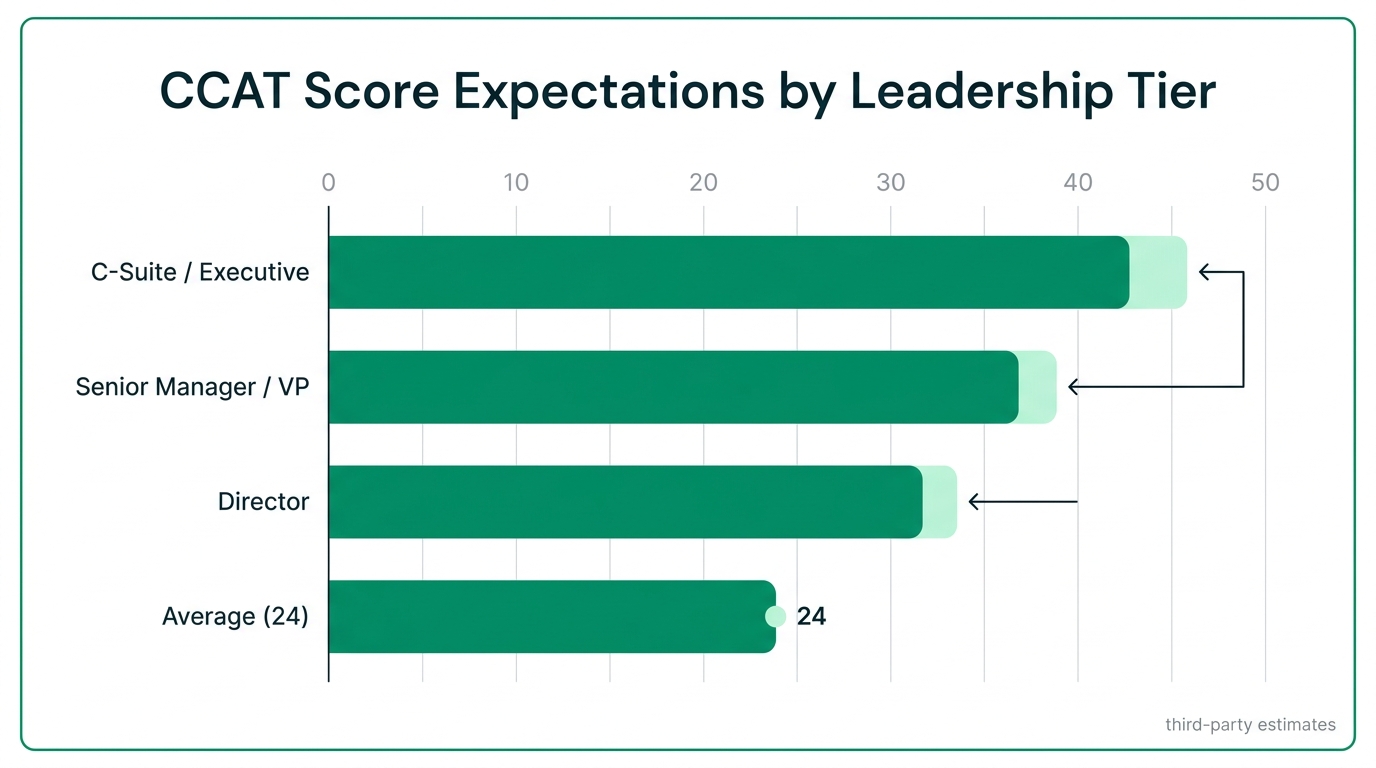
The table pulls commonly-cited suggested ranges for leadership tiers from prep-site tables and candidate forums, with an approximate percentile band and a note on the source.
| Leadership tier | Commonly-cited suggested range | Approx. percentile band | Source-type note |
|---|---|---|---|
| Baseline (average) | 24 | 50th | Criteria Corp standardization sample (official mean/median) |
| Director | roughly 30 to 40 | mid-70s to high-90s | Estimate, extrapolated from prep-site manager/VP tables |
| Senior Manager / VP | 29 to 42 | low-70s to near-top | Prep-site and forum tables (predictiveprep.com, Reddit, Medium) |
| C-Suite / Executive | 32 and up | 64th percentile and up | prepccat.com blog (suggested, not an official cutoff) |
Two honest caveats. No public table lists a row literally labeled “Director,” so that band is an informed estimate placed between the manager and VP figures it sits between. And every one of these ranges is a third-party estimate, not an official Criteria Corp cutoff, with sources disagreeing at the edges as you would expect from crowd-sourced data.
For context on the top of the scale: JobTestPrep suggests a score around 42 puts you at the top for essentially any CCAT job, a ZipRecruiter Q&A on an “Executive CCAT” sets a looser bar of anything above 24, and a Medium write-up by Gregg Fenton lists Senior Manager or VP around 29 to 42. None are cutoffs, but the read across them is consistent: leadership roles cluster above the average, most commonly from the low 30s upward.
So as a working target, treat roughly 32 as the point where you start looking competitive, and mid-to-high 30s as the range that clears most bars with room to spare. A 42 sits near the ceiling, so chasing a perfect 50 wastes prep time you probably do not have.
Why leadership roles weight the CCAT so heavily
Why put a senior candidate through a 15-minute aptitude test at all? Because the CCAT measures the exact things leadership work demands under pressure. According to Criteria Corp, it gauges your ability to solve problems, digest and apply new information, learn new skills, and think critically. Read that as a job description for an executive: you inherit an unfamiliar situation with incomplete information and are expected to reason to a sound decision quickly, then defend it.
Two qualities in particular are why the bar rises with seniority. Speed of learning: leaders move across problems and domains faster than individual contributors, so how quickly you pick up something new predicts how fast you become effective. And decision-making under ambiguity, which the CCAT’s time pressure simulates: the clock forces you to prioritize, cut losses on a hard item, and keep moving, the same triage a leader does with a backlog of decisions. A mis-hire at that level is expensive, so companies set the bar above average on purpose.
How to set and hit your target score
Since leadership bars sit high, untargeted practice will not move you far enough. Start by setting your number: take the band for your tier from the table above, then adjust for the employer. When in doubt for an executive-track seat, anchor on 32 as a floor and mid-to-high 30s as comfortable. Then find where your points are leaking, because the total score hides the real problem.
- Take one full, timed 50-question practice test cold, to fix your true starting percentile and see which question types cost you.
- Read the breakdown, not just the total. Slow on spatial reasoning? Rushing math into careless errors? Leaving verbal items blank at the buzzer? Each has a different fix.
- Drill the single weakest area in short, focused sessions, then re-test under the full 15-minute clock.
- Lock a pacing rule: if a question is not clicking within about 20 seconds, guess and move on. A wrong answer costs nothing, and a blank is a guaranteed zero.
This is where honest analytics matter more than raw hours. A heat-map showing which question types are slowing you down, plus drills aimed at them, turns “I need to get better” into a concrete plan. For an executive-track score, pacing and closing one weak area usually move the number more than getting broadly smarter does.
FAQ
What is a good CCAT test score?
A good score depends on the role. The average is about 24 out of 50, near the 50th percentile, so anything meaningfully above 24 is above average. For leadership-track roles, prep sites commonly suggest aiming for the low 30s and up.
Is 26 out of 50 good for CCAT?
A 26 is slightly above the average of 24 and a little above the 50th percentile. For many general roles that is acceptable, but for a director, VP, or C-suite seat it is below the commonly-cited competitive band, which prep sites usually place from about 30 upward. Treat 26 as a starting point rather than a leadership target.
What is considered a high CCAT score for an executive role?
There is no official figure, because no company publishes an executive cutoff and Criteria Corp does not release per-title scores. Estimates vary: one prep blog cites a typical C-suite requirement of 32 or higher, roughly the 64th percentile and up, while a ZipRecruiter Q&A sets a looser bar of anything above 24. The consistent read is above-average, commonly low-to-mid 30s and up.
What CCAT score do VP and director roles expect?
Prep-site and forum tables commonly suggest a Senior Manager or VP range of about 29 to 42, with a director band alongside it in roughly the low-to-high 30s. These are third-party estimates, not official cutoffs. As a practical target, aim for at least the low 30s to look competitive.
Do most people finish the CCAT?
No. Less than 1 percent of test takers answer all 50 questions in the 15-minute limit, by design. Pacing and prioritization are part of what the test measures, which is why a blank-question habit quietly sinks otherwise strong scores, including at the leadership level.
Why do leadership roles have a higher CCAT bar?
Because the CCAT predicts speed of learning and reasoning under pressure, and both matter more as seniority rises. Leaders move across unfamiliar problems quickly and decide with incomplete information, exactly the profile a timed aptitude test surfaces. A mis-hire at that level is expensive, so companies set the bar above average on purpose.
Related on CCAT Tests
- Guide. What is a good CCAT score. The broader benchmark companion to this page.
- Guide. CCAT percentile chart. Turn any raw score into a percentile so a recruiter’s “top 20 percent” becomes concrete.
- Guide. CCAT scores for tech and analytical roles. Another high-bar role family, useful if your search crosses into technical leadership.
- Guide. How to score 40 or higher on the CCAT. Advanced strategies for candidates chasing the top of the scale.
- Practice. Free CCAT practice tests. Get your true starting percentile before you build a plan.
Try CCAT Tests
Know your number, then close the gap to it.
Executive bars sit high and vary by employer, so find your real starting percentile first, then aim your prep at the exact points a leadership cutoff costs you. Our free tier is a genuinely usable practice experience across all three CCAT domains, including real spatial and abstract reasoning images, so you can measure where you stand before paying for anything. Paid tiers at $9, $29, and $79 one-time add timed full-length simulations and a heat-map that shows which question types are dragging your score down, plus targeted drills to fix them. The $79 Elite tier includes an “until you pass” guarantee, worth considering if you face a hard executive cutoff. The Udemy course behind it is rated 4.5 out of 5 by more than 1,200 students.
If your leadership search puts several assessments in front of you, not just the CCAT, a broader step is the PrepClubs practice platform, which covers more than 21 pre-employment tests for over 1,600 students and carries its own pass guarantee. It is the natural next move when a senior hiring process stacks multiple assessments back to back.