You have a documented disability or a condition like ADHD or dyslexia, a recruiter just sent you a CCAT link, and you want to know if you can get extra time or other support. The short answer is yes, it is often possible, and the request usually goes to the employer that asked you to test, not to Criteria directly. Under the ADA, US employers must provide reasonable accommodations, such as extra time, a screen reader, or extra breaks, for candidates with a documented disability, each decided case by case. One clarification first: this is the Criteria Cognitive Aptitude Test, the workplace hiring test from Criteria Corp, not the Canadian Cognitive Abilities Test or Mercer Publishing’s grade-school CCAT used in schools. Same acronym, different test.
Quick takeaways
- The employer that asked you to take the CCAT usually arranges accommodations, not Criteria Corp directly.
- Extra time is the most common CCAT accommodation because the test is one 15-minute timer for 50 questions.
- Under the ADA, US employers must provide reasonable accommodations for a documented disability, decided case by case.
- Common accommodations: extra time, a screen reader, extra breaks, and an adapted CCAT for vision-impaired candidates (Crossover offers this “on a case-by-case basis”).
- Request early, as soon as you get the invite, and be ready to provide documentation.
- Accommodations are not guaranteed, but a clear, early, documented ask has the best odds.
Who arranges CCAT accommodations, Criteria or the employer?
Criteria Corp builds and hosts the CCAT, but Criteria is the testing vendor, not your prospective employer. Under the ADA in the US, the duty to provide reasonable accommodations sits with the employer running the hiring process, so your request almost always goes to that employer, usually the recruiter or hiring coordinator who sent the test link. Criteria can enable adjustments like an extended-time version, but the employer is the party that requests and approves them. In practice, you ask the recruiter, the recruiter coordinates with Criteria, and the adjusted test gets set up. So do not email Criteria’s support line and wait. Contact the employer’s recruiter first.
Common CCAT accommodation types and what each addresses
The CCAT has constraints that make it hard: a 15-minute limit for 50 questions, about 18 seconds each, three question types (verbal, math and logic, spatial reasoning), and no calculators. Each accommodation softens one.
| Accommodation | The CCAT constraint it addresses |
|---|---|
| Extra time (for example, time-and-a-half or double time) | The 15-minute limit and the ~18-second-per-question pace |
| Screen reader or read-aloud support | Reading load on verbal and math word problems |
| Adapted / vision-impaired version of the CCAT | Spatial reasoning items that rely on seeing shapes and patterns |
| Extra or scheduled breaks | Sustained focus across all 50 questions in one sitting |
| Assistive technology (magnification, high contrast) | Visual access to on-screen questions and options |
| Adjusted or quiet test environment | Distraction and processing conditions during the timed test |
Extra time is by far the most requested, because the 15-minute clock is the hardest part of the CCAT for almost everyone. Fewer than 1% of candidates answer all 50 questions in the standard time, so for someone whose disability affects processing speed, extended time can be the difference between a fair result and one that measures the disability instead of the ability. Screen readers and adapted versions matter for the reading-heavy verbal and math sections and the spatial section, which depends on seeing shapes rotate and fit together. Crossover, one of the largest employers using the CCAT, publicly offers disability support on a case-by-case basis, including an adapted CCAT for vision-impaired candidates: a real-world example of what “case by case” looks like.
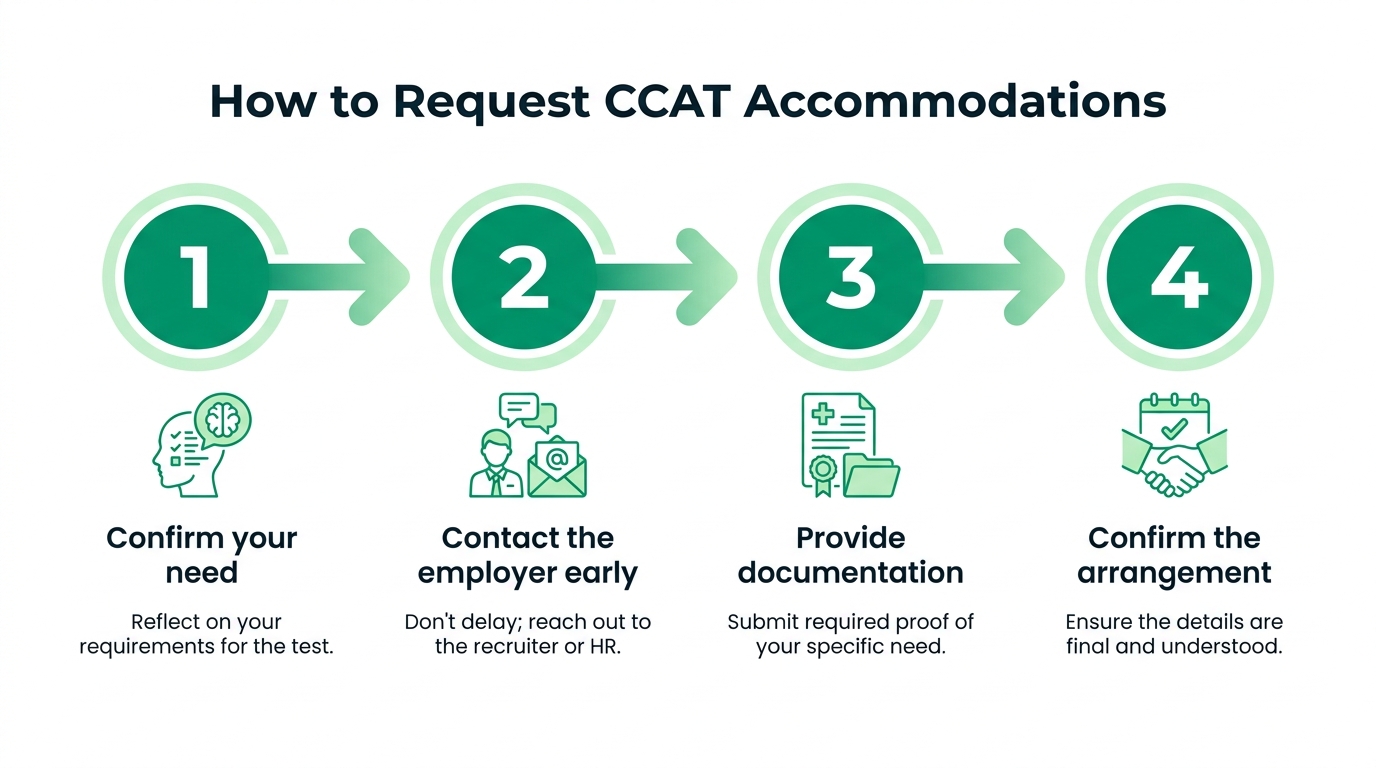
How to request CCAT accommodations, step by step
Follow this process the moment you get a CCAT invitation. Timing matters most of all.
- Confirm your need and decide what to ask for. Match your condition to the constraint it affects: processing speed points to extra time, a vision impairment to a screen reader or the adapted CCAT, and anxiety or focus conditions to extra breaks or a quiet environment. Ask for the specific adjustment.
- Identify the right contact. This is the recruiter or hiring coordinator who sent the CCAT link, not Criteria Corp. If a staffing agency arranged the role, the agency contact is your route.
- Reach out early, before you start the test. Send your request the same day you get the invite. Accommodations take time to set up, and asking after you have opened or taken the test is far harder to honor. Do not click into the test until it is confirmed.
- State your request clearly and in writing. Email creates a record. Say you have a documented disability, name the specific accommodation you want, and ask what documentation they need. Share only enough to support the request.
- Provide documentation when asked. Employers can reasonably ask for proof, such as a doctor’s note or an existing accommodation record. Have it ready.
- Confirm the arrangement before you sit the test. Get written confirmation of exactly what is enabled (for example, “double time on the CCAT”) and how you access it. Only start once that is locked in.
A template you can adapt: “Hi [Name], thank you for the CCAT invitation. I have a documented disability and would like to request [specific accommodation, for example extended time]. Could you let me know the process and what documentation you need? I will hold off on starting until it is arranged.”
What reasonable accommodations actually mean
“Reasonable” is the key word in the ADA. A reasonable testing accommodation gives a candidate with a disability fair access without changing what the test measures or placing an undue burden on the employer, which is why extra time, screen readers, extra breaks, magnification, and a quiet room are all standard examples. It levels the conditions, not the scoring, so it does not guarantee an outcome. Because every request is handled case by case, a well-documented, early ask for something like extra time has strong odds, while a vague or last-minute one is much weaker. The CCAT stays hard for almost everyone even with accommodations, so they help you meet the test on fair footing. They do not remove the need to prepare.
FAQ
Can you get extra time for the CCAT?
Often, yes. Extra time is the most common CCAT accommodation and a standard reasonable accommodation under the ADA for a documented disability. Request it through the employer that sent the test, and Criteria enables an extended-time version once the employer arranges it. Ask before you start, not after.
Who do I ask for CCAT accommodations, Criteria or the employer?
The employer, almost always. Criteria Corp hosts the CCAT, but the employer running the hiring process is responsible for accommodations under the ADA and coordinates the adjusted test with Criteria. Email the recruiter who sent you the link.
How difficult is the CCAT test?
It is genuinely hard for most people. You get 50 questions in 15 minutes, about 18 seconds each, across verbal, math and logic, and spatial reasoning, with no calculator. The average score is roughly 24 out of 50, and fewer than 1% of candidates finish all 50. There is no penalty for wrong answers, so guessing is always worth it.
Is there an adapted CCAT for vision-impaired candidates?
Yes, in at least some cases. Crossover supports applicants on a case-by-case basis, including an adapted version of the CCAT for vision impairment. Availability depends on the employer and Criteria’s setup, so ask your recruiter what accessible versions can be enabled.
When should I request CCAT accommodations?
As early as possible, ideally the same day you get the invite and before you open the test. Accommodations take time to configure, and requesting one after you start is much harder to honor. Wait for written confirmation before starting.
Do I need to disclose my full medical history?
No. You only need enough documentation to support the specific accommodation you request, such as a doctor’s note or an existing accommodation record. You are not obligated to share your whole medical history.
Related on CCAT Tests
- Pillar. The complete CCAT test preparation guide. Format, question types, and prep strategy in one place.
- Checklist. First-time CCAT taker complete checklist. What to do from invite to test day.
- Timing. Is the CCAT timed per question or for the whole test?. Why the 15-minute clock is the part accommodations most often address.
- Reality check. What happens if you fail the CCAT. Honest expectations if a first attempt does not go your way.
If the CCAT is only one of several assessments standing between you and an offer, it helps to prepare for all of them in one place. The broader paid platform where more than 1,600 students prepare across 21 different pre-employment tests, backed by a pass guarantee, is a sensible next step once your accommodations are sorted and you want the same realistic practice for the other tests in your pipeline.
Try CCAT Tests
Get fair conditions, then practice under the real ones. Accommodations give you a fair shot at the CCAT, but they do not replace preparation. Our free tier is genuinely usable, not a three-question teaser: real CCAT-style questions across all three domains, including spatial reasoning images, so the format feels familiar before test day. Paid tiers ($9 Starter, $29 Standard, $79 Elite, one-time) add full-length timed simulations and a heat-map of your weak question types so you know exactly where to drill, and Elite includes the “until you pass” guarantee. Criteria Corp defines the format, and we build practice to match it honestly.