You took the CCAT, you did not get the score you wanted, and now you are staring at one question: can you take it again? The short answer is yes, you can retake the CCAT, but there is no single universal rule. Criteria Corp makes the test, but the employer decides whether, when, and how often you get another attempt. This guide lays out the general wait periods, the specific rules a few well-known employers use (including Crossover’s hard six-month limit), and the one thing that matters more than any of it: what you do to actually score higher the second time.
One quick disambiguation before we start. This is the Criteria Cognitive Aptitude Test from Criteria Corp, the workplace hiring test, not the Canadian Cognitive Abilities Test given to schoolchildren for gifted-program admissions. They share the acronym CCAT and get tangled together in search results, but they are completely different tests. You are prepping for the workplace one.
Quick takeaways
- You can retake the CCAT, but the retake policy is set by the employer, not by Criteria Corp.
- The typical wait between attempts is six to twelve months, though a different role at the same company can sometimes let you retake sooner.
- Crossover has a firm rule: one CCAT attempt per email address per six-month period. Using multiple emails to get around it gets your application rejected.
- A different employer that uses the CCAT usually has no wait period at all, because your prior score is not shared between companies.
- There is no official pass or fail. You only “fail” relative to the score cutoff a specific employer sets for a specific role.
- The retake itself is easy to get. Turning a retake into a higher score is the hard part, and it comes down to fixing your specific weak areas, not just sitting the test again.
Can you retake the CCAT? The honest answer
Yes. Almost every candidate who wants to retake the CCAT eventually can. What varies is the waiting period and how many attempts you get, and that is decided by the company you applied to, not by Criteria Corp.
This trips people up because they assume the test publisher owns the retake rules the way a driving-license authority owns its retest rules. It does not. Criteria Corp provides the assessment platform and the norm data. The hiring company chooses the score cutoff for the role, whether to invite a retake, and how long you must wait. So the real question is never “what is the CCAT’s retake policy,” it is “what is this employer’s retake policy.” When in doubt, ask your recruiter directly. That single email is worth more than any general guide, including this one.
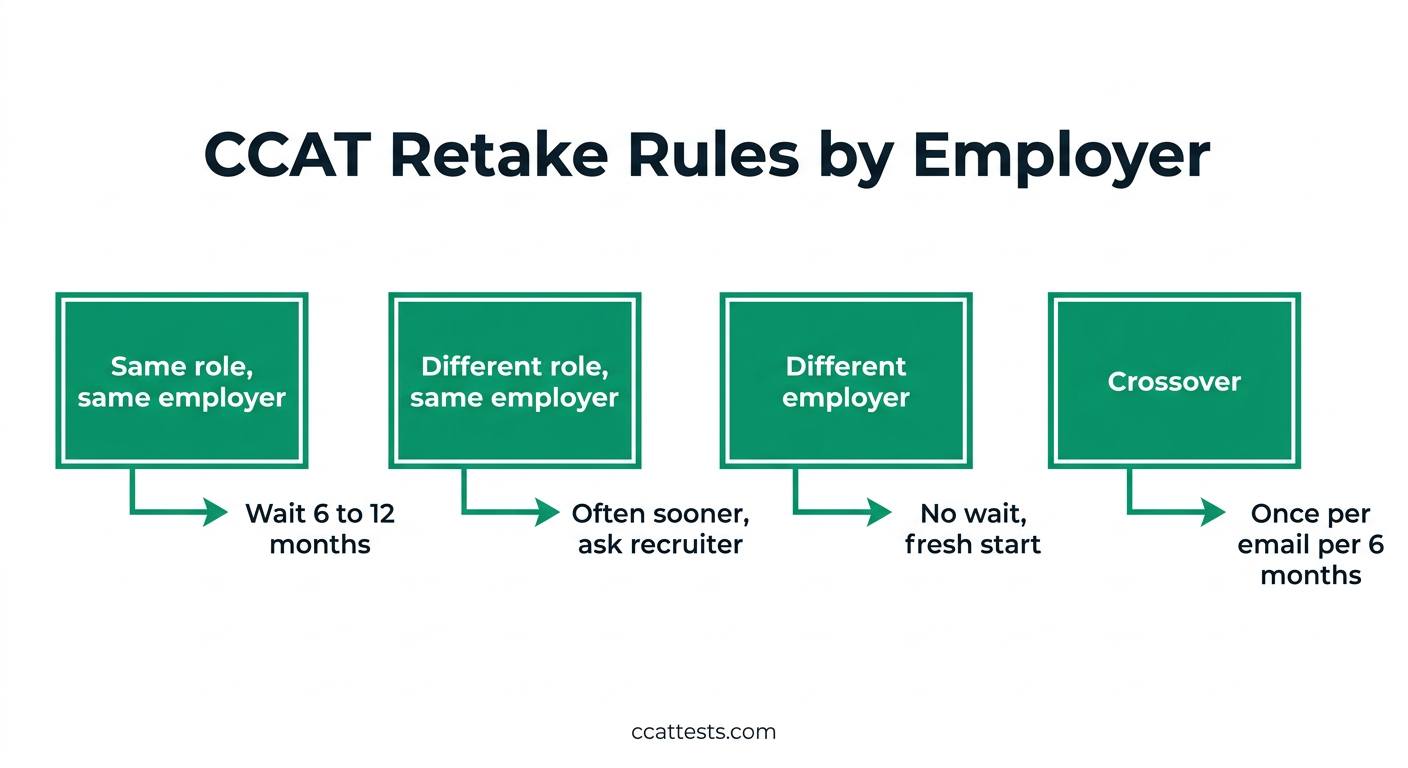
CCAT retake rules by employer
Because the rules are employer-specific, the most useful thing we can do is show you how they actually differ. Here is the picture the scattered forum threads and thin answer pages never put in one place.
| Scenario | Can you retake? | Typical wait | Notes |
|---|---|---|---|
| Same role, same employer, you scored below cutoff | Usually not right away | 6 to 12 months | Most companies want a cooling-off period before a repeat attempt for the same job. |
| Different role, same employer | Often yes, sooner | Varies by company | A new application for a different position can trigger a fresh test invite. Confirm with the recruiter. |
| Different employer that also uses the CCAT | Yes | Usually none | Your score is not shared across companies, so a new employer’s test is effectively a clean start. |
| Crossover (specific policy) | Once per email per 6-month window | 6 months | Hard rule since January 2019. Multiple emails to dodge it means rejection. |
The Crossover example is worth calling out because it is the clearest published rule in the niche. Crossover’s own support documentation states that candidates can attempt the CCAT only once per email address within a six-month period, and that trying to work around this with multiple email addresses will get your application rejected. That policy has been in place since January 21, 2019. Crossover also states that if you apply for another position with them, you will generally need to retake the test.
There is a nuance here that competing articles miss. Some employers may treat a recent, still-valid score as usable for a new application rather than requiring a fresh sit, while others, like Crossover above, tell you to retake. Because employers handle this differently, the safe move is to ask your recruiter whether your existing score can carry over before you assume you need to retake at all.
How many times can you take the CCAT?
There is no lifetime cap set by Criteria Corp. Practically, you are limited by two things: how many times a given employer will invite you back, and any per-window rule like Crossover’s once-per-six-months limit.
For a single application, you effectively get one attempt, and that score locks to that application. To get another shot you generally need either a new application (a different role, or the same role after the wait period) or a different employer. So the honest answer to “how many times” is: as many times as different opportunities and employer windows allow, not an unlimited free-retry button on one job.
Why the wait period exists
The cooling-off period is not employers being difficult. Cognitive aptitude is a fairly stable trait. It does not swing wildly week to week the way your knowledge of a specific topic might after cramming. An employer that let you retake three days later would mostly be measuring test familiarity, not a real change in ability.
That said, six months of deliberate, targeted practice genuinely can move your score, because a large chunk of a first-attempt CCAT result is not raw ability. It is pacing, format familiarity, and avoiding careless errors under a 15-minute clock. Those are all trainable. Plenty of candidates who miss a cutoff on the first try clear it on a later attempt after real preparation. The wait is there so that a retake reflects improvement, not just a second roll of the dice.
What a “good enough” score even is
Before you retake, it helps to know what you are aiming for, because “I failed” usually means “I scored below one employer’s cutoff for one role,” not that there is a universal failing line.
- The average CCAT score is around 24 out of 50. That is the rough 50th percentile.
- A score in the low 30s puts you in the stronger part of the field.
- 36 and above is genuinely excellent, in the top tier of test takers.
- Fewer than 1 percent of candidates answer all 50 questions in the time limit, so not finishing is completely normal and expected.
So a 26 out of 50 is slightly above the average, but it is likely light for competitive technical, finance, or leadership roles that expect the low-to-mid 30s or higher. Knowing the specific cutoff for your target role, or at least a realistic estimate of it, is what turns a vague “retake and hope” into a concrete target. This is also where knowing your own breakdown matters: two people can both score 26 for completely different reasons, and they need completely different retake plans.
How to actually score higher on the retake
Getting the retake is the easy part. Using it well is the whole game. A retake without a plan usually produces a score within a point or two of the first one, which is a wasted attempt and, if the employer has a window, a wasted opportunity you cannot immediately redo.
The candidates who jump five or more points on a second attempt almost always do the same three things:
- They diagnose before they drill. They figure out exactly where the points leaked the first time: verbal, math and logic, or spatial and abstract reasoning, and whether the problem was accuracy or pacing.
- They practice against the clock, not untimed. The CCAT’s difficulty is the speed. Roughly 18 seconds per question is the real test. Untimed practice builds false confidence.
- They fix pacing and skipping. Getting stuck on one hard question can cost you three easy ones later. Learning to recognize and skip a time sink is often worth more points than getting any single question right.
This is exactly why a heat-map of your own performance beats generic practice. When you can see that your accuracy holds up on verbal but collapses on spatial questions in the back half of the test, you know precisely what to drill instead of re-practicing the domain you were already good at.
FAQ
How long do you have to wait to retake the CCAT?
Typically six to twelve months at the same employer for the same role, though a different role at that company can sometimes let you retake sooner. Crossover specifically limits you to one attempt per email address per six-month period. A different employer that uses the CCAT usually has no wait at all.
How many times can you take the CCAT?
There is no lifetime cap from Criteria Corp. You are limited by how many times each employer will invite you back and by any per-window rule (like Crossover’s once-per-six-months limit). Each individual application generally gets one attempt.
Do most people finish the CCAT?
No. Fewer than 1 percent of candidates answer all 50 questions within the 15-minute limit. The test is deliberately designed so almost no one finishes. Not completing it is normal, so accuracy on the questions you do reach matters more than racing to the end.
Can you fail the CCAT test?
There is no official pass or fail. You only “fail” relative to the cutoff a specific employer sets for a specific role. A score that clears the bar for one job might fall short for a more analytical or senior one at the same company.
Is 26 out of 50 good for CCAT?
A 26 is a little above the roughly 24 average, so it beats the median test taker. But it is below the low-30s that competitive technical, finance, and leadership roles often expect, so whether it is “good” depends entirely on the cutoff for the role you want.
Is the CCAT like an IQ test?
It is a cognitive aptitude test, so it is related to and often compared with an IQ test, and it correlates with general mental ability. But it is designed to predict how quickly someone can learn a job and solve problems under pressure, not to produce an IQ number. Treat it as similar to, but not the same as, an IQ test.
Does the employer see how many times I have taken the CCAT?
The employer administering your current test sees your attempt with them. Scores are not shared across different companies, so a new employer that uses the CCAT does not see your history with a previous one. Within a single company, repeated attempts for the same role are usually visible to their hiring team.
Should I retake the CCAT or just accept my score?
If your score is below the role’s likely cutoff and you have a genuine plan to fix your weak areas, a retake after real, timed, targeted practice is worth it. If you scored well above the cutoff, or you would sit the retake without changing anything about how you prepare, a retake is unlikely to help.
Related on CCAT Tests
- Retake strategy. How to improve on your second CCAT attempt. The step-by-step plan for turning a retake into a real score jump.
- Start here. The first-time CCAT taker’s complete checklist. Everything to line up before you sit the test, so a retake is not even needed.
- Pillar. The complete CCAT test preparation guide. The full hub for format, scoring, and prep.
- Practice. Free CCAT practice tests. Time yourself before committing to a retake date.
Try CCAT Tests
A retake is only worth it if you fix the right weak area first.
Sitting the CCAT again without a diagnosis usually lands you within a point or two of your first score. CCAT Tests is built to break that loop: realistic CCAT-style practice across all three domains, including the spatial and abstract-reasoning images generic sites skip, plus a heat-map that shows exactly which question types are costing you points so you drill the domain that will actually move your number. The free tier is a genuinely usable practice experience, not three sample questions and a paywall, so you can find your weak spot before you decide to pay for anything. Paid plans are one-time purchases, see pricing, which suits a candidate who needs a concentrated block of practice before a retake. And if your search has you facing more than one assessment across different applications, our sister platform PrepClubs runs the same free-first, then analytics-driven practice across 21 pre-employment tests with a money-back guarantee, so you stay ready for the whole hiring funnel.