Your manager just told you the next step toward the promotion is a 50-question test with a 15-minute clock, and it lands differently than it would have when you were an outside applicant. Here is the direct answer: employers may use the CCAT for promotion decisions exactly as they use it for hiring, the test itself is identical, and what changes is everything around it. One quick disambiguation before you start: this is the Criteria Cognitive Aptitude Test used in workplace hiring, not the Canadian Cognitive Abilities Test given to schoolchildren that shares the same initials. Below is what the rules actually say, what the published evidence shows about CCAT scores and promotions, and the moves you can make as an internal candidate that an outsider cannot.
Quick takeaways
- Federal guidance treats hiring tests and promotion tests the same way, so being asked to sit a CCAT after years at the company is standard procedure, not a verdict on your standing.
- The CCAT is 50 questions in 15 minutes across verbal, math and logic, and spatial reasoning. Criteria Corp reports that less than 1 percent of candidates answer all 50, and the average test taker gets about 24 right.
- Being internal is an advantage here. You can ask HR questions an outsider cannot, and you usually get weeks of notice instead of days.
- Criteria Corp’s consulting-firm case study found analysts scoring 37 or higher were 7.6 times more likely to be promoted multiple times. That is a correlation at one company, not a promise about you.
- There is no universal pass mark. Your employer sets the bar for the role you are moving into, and it is usually higher than the bar for the job you hold now.
- Get the retake policy in writing before test day. Your HR handbook probably has an answer, and an outside applicant has nobody to ask.
Yes, your employer can test you for a promotion
Your company can legally ask you to take a cognitive test for a promotion, and this is common enough that federal guidance addresses it head on. The EEOC’s guidance on employment tests and selection procedures opens by noting that “employers often use tests and other selection procedures to screen applicants for hire and employees for promotion.” Promotion sits in the same legal category as hiring, so the same protections and obligations apply.
The obligation that matters to you is job-relatedness. A neutral test that disproportionately excludes people by race, color, religion, sex, or national origin must be “job-related and consistent with business necessity.” In plain terms, your employer is supposed to be able to explain why cognitive aptitude predicts success in the role you are being considered for. That is a real constraint on them, and a clue for you: the test is aimed at the future job, not at the job you already do well.
This is the part internal candidates get wrong emotionally. Sitting an aptitude test after four strong years feels like your track record is being ignored. It usually is not. Standardizing the step for every candidate at a given level is precisely the defense against favoritism claims. Your performance history still counts. The CCAT is one input beside it.
What changes when the person taking the CCAT already works there
The test does not change at all. The situation around it changes in five specific ways, and four of them favor you.
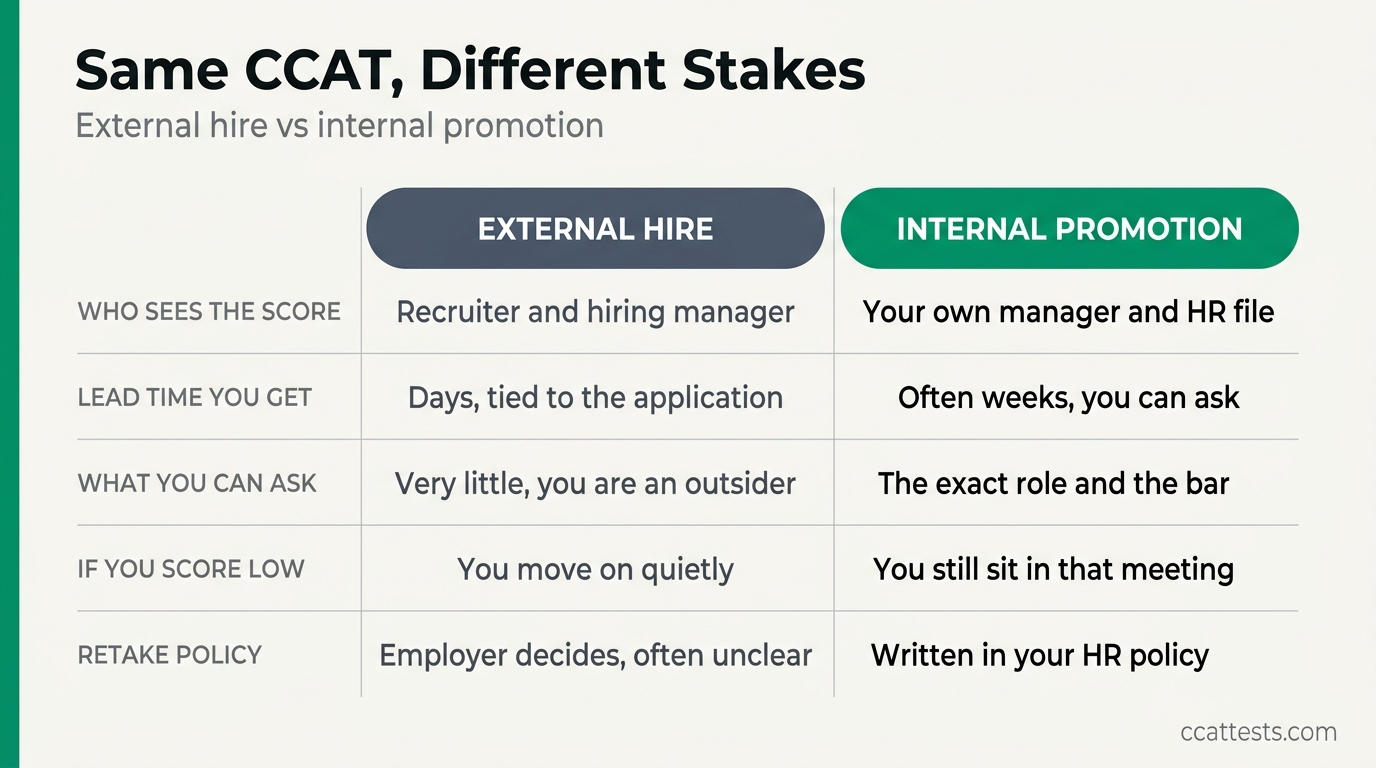
The one genuine downside is social. An external candidate who scores poorly disappears from a pipeline they were never part of. You are still in Tuesday’s standup with the people who saw the number. That discomfort is worth naming, because it is why internal candidates rush to “get it over with” instead of preparing.
Everything else tilts your way. You know the target job from the inside, so you know whether it leans quantitative or verbal. You have a named HR contact obliged to answer process questions. And your company’s testing policy, retakes included, is usually written down somewhere an employee can read it.
In a public r/humanresources thread this year, an HR manager described a final-round candidate landing in the 38th percentile and a CHRO getting cold feet. The sharpest reply was not about the score at all. It asked whether the manager could see the breakdown by section, since verbal mattered more than spatial for that role, and noted that low accuracy and low speed mean very different things.
Your score is one number. Your section breakdown is the actual diagnosis, and it is the only part of the result you can change before test day.
What the evidence says about CCAT scores and promotions
Criteria Corp publishes case studies with real numbers, and two are directly relevant to anyone facing a promotion test.
| Published case study | The setup | What was found | What it means for you |
|---|---|---|---|
| Consulting firm, 200 to 500 employees | Analysts assessed with the CCAT, outcomes tracked over time | Analysts scoring 37 or higher were 7 times more likely to earn a high performance rating, and 7.6 times more likely to be promoted multiple times | Employers who track this have seen CCAT scores correlate with advancement, which is why the step exists |
| Financial services firm | 62 salespeople, cut-off score of 20 applied | Correlation of .30 with performance ratings, significant at p < .02. Of those scoring 0 to 19, 74 percent became low performers. Of those scoring 20 to 50, 28 percent became top producers | Cut-offs are set from data, not folklore, and a real company’s cut-off can be far lower than the internet suggests |
Two honest caveats. A correlation of .30 is meaningful in this kind of research and is nowhere near destiny: a third of the high scorers in the sales study still ended up as low performers. And the 7.6x figure describes one consulting firm’s analysts, not a law of careers. Neither study says a given score buys a given promotion.
What both do establish is why the step is in your process. Cognitive aptitude tends to predict how fast someone becomes effective in an unfamiliar role, and a promotion is by definition an unfamiliar role.
Five questions to ask HR before you sit down
This is the internal candidate’s real edge, and almost nobody uses it. Send one short email and ask these five things.
- Which role is the score evaluated against? The benchmark for the position you are moving into is what matters, and it tells you which question domain carries the most weight.
- Is there a stated minimum, or is it one input among several? Some companies apply a hard cut-off; many treat the score as a discussion point beside your reviews. Knowing which changes how hard you prepare.
- What is the retake policy for internal candidates? Retake windows are usually restricted, but the specific policy is your employer’s choice and is often documented. Ask before you need it.
- Do I get to see my own results? Many employers will share your raw score and percentile on request, and some will share the section breakdown. That breakdown is the most useful thing you can obtain.
- Does the score from when I was hired still count? Companies handle this inconsistently, which is why whether a CCAT score expires is worth checking directly rather than assuming.
An outside applicant asking five process questions looks difficult. An employee asking them looks organized.
A worked example: 12 days, one score, one promotion panel
Say you are a senior support specialist up for a team lead role. HR tells you on the 1st that the CCAT is booked for the 13th and the panel meets on the 20th.
Days 1 and 2. Send the five questions. Take one full 50-question timed run cold, not to score well, but to find out what happens to you at minute 11 when you are still on question 28.
Days 3 to 8. Work your weakest domain, not your favorite one. Most people default to verbal because it feels comfortable, then lose the promotion on spatial questions they never trained.
Days 9 to 11. Two more full timed runs, spaced out, plus drills on whatever the first run exposed. Practice the skip decision deliberately: at roughly 18 seconds per question, abandoning a question you are losing is worth more points than being smarter at it.
Day 12. A short warm-up set, then stop. You already know your pacing.
Expect two things. Your cold score will be lower than your ego wants, because the timer catches people, not the difficulty. And your gains will come almost entirely from pacing and one or two question types, not from a general rise in ability.
Prepping for a CCAT while still doing your current job
Your hardest constraint is not the test. It is finding prep time inside a full week at the company that scheduled it. Three things make that workable.
Keep sessions short and timed. A 15-minute test rewards 15-minute practice, and three focused sessions a week beat one weekend cram, because decision speed under a clock decays without repetition.
Diagnose before you drill. A heat-map breakdown by question type tells you in one session what a week of unfocused practice will not: that you are fine on verbal analogies, slow on number series, and losing four points a run on spatial rotations. That class of per-question-type analytics costs roughly $497 a month from enterprise assessment tools, and it is the difference between six useful days and six wasted ones.
Practice on questions that look like the real thing. Spatial and abstract items are what generic aptitude sites get wrong most often, because they recycle filler across a dozen unrelated test types. With only a few hours to spend, every hour has to measure the right thing.
For a realistic sense of where the bar sits as you move up a level, see our breakdowns of CCAT score expectations for leadership roles and CCAT score requirements across tech jobs.
FAQ
Is 26 out of 50 good for CCAT?
A 26 is slightly above the average of about 24 correct, placing you a little above the 50th percentile. Whether that is good depends entirely on the role. For a promotion into a quantitatively demanding or senior position, employers often look for meaningfully higher, so ask what the benchmark is rather than judging the number in the abstract.
What jobs require the CCAT?
The CCAT appears most in roles where learning speed and problem solving matter: technology, finance, consulting, sales, and management tracks. Companies known to use it include Crossover and portfolio companies of Vista Equity Partners. Internally it tends to show up at the step from individual contributor into a lead or management role.
How difficult is the CCAT test?
Hard, mostly because of the clock. Fifty questions in fifteen minutes is roughly 18 seconds each, and Criteria Corp reports that less than 1 percent of candidates answer all 50. The questions themselves are not exotic; the time pressure is what makes it difficult, which is why practicing under real timing helps more than studying content.
Is the CCAT a good predictor of job performance?
The published evidence says it is real but partial. Criteria Corp’s financial services case study found a statistically significant correlation of .30 between CCAT scores and performance ratings, which leaves plenty unexplained. Research on cognitive tests generally shows the strongest predictive value in complex roles that demand fast learning, and weaker value when a test is used as a standalone filter.
How many people pass the CCAT?
There is no single pass rate because there is no single pass mark. Each employer sets its own benchmark per role, and published case studies show cut-offs as low as 20. What is consistent is the completion rate: less than 1 percent of test takers answer all 50 questions, so leaving items blank is normal, not a failure.
Can I retake the CCAT if I score badly on an internal promotion?
Sometimes, and your employer decides. Retake windows are usually restricted, but as an employee you can request the actual written policy instead of guessing. If anxiety or a misread of the pacing caused the score rather than the questions, that is worth raising with HR. Our guide on retaking the CCAT covers how the rules typically work.
Is this the same CCAT my child took for a gifted program?
No, and the confusion is common because the acronyms are identical. The Canadian Cognitive Abilities Test is a school assessment used for gifted and talented admissions in grades K to 12. The Criteria Cognitive Aptitude Test discussed here is a workplace assessment published by Criteria Corp for hiring and promotion decisions. Nothing about the children’s test applies to yours.
Related on CCAT Tests
- Score validity. Does a CCAT score expire. Directly relevant if you sat the test when you were originally hired.
- Retakes. Can you retake the CCAT. What retake rules usually look like and how to approach a second attempt.
- Leadership benchmarks. CCAT scores for executive and leadership roles. Useful if the promotion moves you into management.
- Role benchmarks. CCAT score requirements for tech jobs. Realistic target bands by role rather than forum guesswork.
- Pillar. The full CCAT preparation guide. Format, question types, and a complete prep path from scratch.
Try CCAT Tests
Find out which section is costing you the promotion, before your employer does
Start with the free tier and take one full timed run. It is a genuinely usable practice experience across all three question domains, not three sample questions and a credit card form, and one honest cold run tells you more than a week of reading. If it exposes a real gap, the paid tiers are one-time, see pricing, and add the heat-map breakdown and weak-area drills that turn “I did badly” into “I lose four points on spatial rotations.” The same approach backs our companion Udemy course, which has 1,200-plus students at 4.5 out of 5.
If your promotion process stacks a personality inventory or a situational judgement assessment on top of the CCAT, prepping the whole set in one place saves a lot of scattered effort. PrepClubs is the broader paid platform built for exactly that, covering 21 pre-employment tests with more than 3,700 students and a money-back guarantee.
CCAT is a registered trademark of Criteria Corp. ccattests.com is an independent study resource and is not affiliated with, endorsed by, or sponsored by Criteria Corp.