An assessment invite lands in your inbox, it is branded Criteria Corp, and nothing in the email tells you which of its two cognitive tests you are about to sit. One quick disambiguation before you start: this is the Criteria Cognitive Aptitude Test used in workplace hiring, not the Canadian Cognitive Abilities Test given to schoolchildren that shares the same initials, and not the medical school admissions exam of the same name used in the UK and Australia. The short answer is that the CCAT gives you 50 questions in 15 minutes and includes a verbal section, while the UCAT gives you 40 questions in 20 minutes and has no verbal section at all. Everything else about them is close enough that most of your prep counts either way.
Quick takeaways
- The CCAT is 50 questions in 15 minutes. The UCAT is 40 questions in 20 minutes. Same publisher, Criteria Corp.
- The biggest difference: the UCAT is language independent and tests no verbal ability, so no analogies, antonyms, or sentence completion.
- The UCAT allows about 30 seconds per question against the CCAT’s 18, roughly 67 percent more time per item.
- More time per question does not mean easier. The UCAT removes the section many native English speakers answer fastest.
- The CCAT comes in English only. The UCAT ships in 20 languages, which is why employers hiring across borders choose it.
- Criteria Corp reports a correlation of r = .80 between the two among 252 people who sat both, so they measure largely the same ability.
- Your math, logic, and spatial practice transfers. Your verbal practice does not, and your 18-second pacing reflex needs recalibrating.
UCAT vs CCAT: the format, side by side
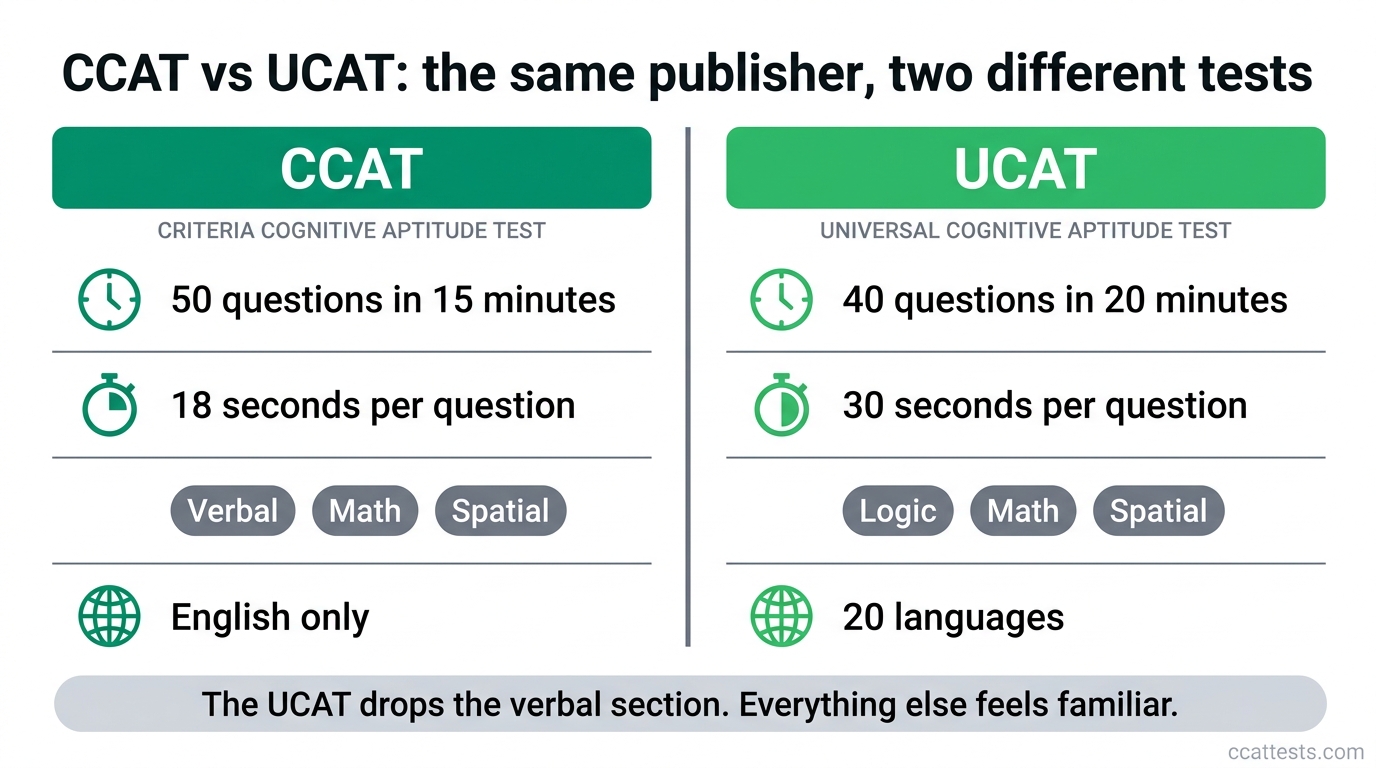
Both tests measure general cognitive aptitude, and the UCAT test format differs from the CCAT’s in exactly four places: length, timing, language availability, and one missing section.
| CCAT | UCAT | |
|---|---|---|
| Full name | Criteria Cognitive Aptitude Test | Universal Cognitive Aptitude Test |
| Publisher | Criteria Corp | Criteria Corp |
| Questions | 50 | 40 |
| Time limit | 15 minutes | 20 minutes |
| Time per question | About 18 seconds | About 30 seconds |
| Verbal ability tested | Yes | No |
| Stated focus | Critical thinking, problem solving, learning ability | Critical thinking, problem solving, attention to detail, logic and analysis |
| Languages | English (US), English (UK) | 20 languages |
| Score report | Raw score out of 50 plus a percentile | Raw score out of 40 plus a percentile |
| Calculator | Not permitted | Not permitted |
Those specifications come from Criteria Corp’s own UCAT product page, which is the only source worth trusting on format, since they wrote both tests.
How to tell which test you have been assigned
You can almost always identify the test before you click start, and it takes about thirty seconds of looking. Work down this list in order.
- Read the assessment name. The invitation and the pre-test screen name it outright: “Criteria Cognitive Aptitude Test” or “Universal Cognitive Aptitude Test.” This settles most cases on its own.
- Check the stated time limit. Fifteen minutes is the CCAT. Twenty minutes is the UCAT. The instructions screen always states it.
- Check the question count. Fifty questions is the CCAT. Forty is the UCAT.
- Look for a language selector. Criteria Corp offers the CCAT in English only and points candidates needing another language to the UCAT. If you can pick Spanish, German, Japanese, or Polish, you are on the UCAT.
- Read the sample questions. Word analogies, antonyms, or sentence completion mean the CCAT. The UCAT contains none of that by design.
- Consider who is hiring. An employer running one process across several countries, or hiring for a role where written English fluency is not part of the job, has a practical reason to standardize on the UCAT. Distributed engineering teams, offshore development, and multilingual support hubs are the obvious candidates for the UCAT. A US-only employer screening for a role built around written English, an analyst, a marketing manager, an operations lead, has the opposite incentive and tends to stay on the CCAT. Treat this as a probability, not a rule, since only the employer knows what they configured.
If the invite is genuinely ambiguous, ask the recruiter. It is a fair question, it takes one line, and the answer changes how you spend your remaining prep time.
The verbal section is the entire difference
Is the UCAT the same as the CCAT? Almost. The Criteria UCAT test is the CCAT with the language-dependent questions taken out. Criteria Corp describes it as a language-independent test that “does not test verbal ability, making it easily translatable and ideal for international use.”
That one decision drives everything else. A word analogy that is medium difficulty in English can become trivially easy or nearly unsolvable once translated, which makes cross-language comparison meaningless. A number series or a rotated shape means the same thing everywhere, so remove verbal and the test travels.
What fills the gap? Criteria Corp lists its UCAT questions as measuring critical thinking, problem solving ability, attention to detail, and logic and analysis. In practice that means more weight on numerical reasoning, spatial and abstract patterns, and careful-reading questions where the trap is a detail you skimmed. If you have worked through CCAT spatial reasoning practice questions, that material carries over directly.
Here is the difference in concrete terms. A CCAT-style verbal item looks like this, and it has no UCAT equivalent:
Doctor is to hospital as teacher is to: (a) student (b) school © lesson (d) principal. The answer is (b), because the pairing is a professional and their workplace, not a professional and the person they serve. That reasoning depends entirely on English word associations, which is exactly why it cannot survive translation.
A shared item, the kind that appears on both tests, looks like this:
What number comes next: 3, 6, 11, 18, 27, ? The answer is 38. The gaps between the terms are 3, 5, 7, 9, so the next gap is 11. Nothing about that depends on the language you read it in, which is why it stays on the UCAT.
So does a spatial item. Picture four squares in a row. In the first, a dot sits in the top-left corner; in the second, the top-right; in the third, the bottom-right. The dot is stepping clockwise one corner per figure, so the fourth square has the dot in the bottom-left. Again, no language involved, and this is the category that quietly carries more of your score once verbal is gone.
One caution worth stating plainly: fewer categories does not mean a narrower test, it means the remaining categories carry more of your score. If abstract patterns are your weak spot, the UCAT exposes that more, not less, because no strong verbal section is left to average it out.
Time per question: 18 seconds versus 30 seconds
The UCAT vs CCAT difficulty question comes down mostly to this one number: the UCAT gives you roughly 67 percent more time per question, and that is the difference candidates most often misread as “the UCAT is easier.”
Do the arithmetic. Fifteen minutes across 50 questions is about 18 seconds each. Twenty minutes across 40 questions is about 30 seconds each. On the CCAT you barely have time to read a long word problem, let alone solve it, and Crossover, one of the larger employers using the test, states that only about 1 percent of candidates answer every question. On the UCAT you can finish a multi-step calculation without panicking.
More time per question is not a gift. It is a different kind of pressure, because the excuse of running out of time gets harder to make.
The trap is that prep habits do not switch over automatically. Drill at CCAT pace and you train yourself to abandon a question after fifteen seconds, so bringing that reflex to the UCAT makes you bail on questions you had another fifteen seconds to solve. Practice at the clock you will actually sit. Our piece on why almost nobody finishes the CCAT lays out the pacing math for the 15-minute version, and the method holds once you recalculate it for 40 questions in 20 minutes.
Scoring: 50 points versus 40, and what the correlation tells you
Both tests report a raw score and a percentile, and the percentile is the number an employer actually reads. Because the raw scales differ, a raw score does not translate between them: 28 out of 50 on the CCAT and 28 out of 40 on the UCAT are very different results. For CCAT context, Criteria Corp’s published standardization sample has a mean of 24.2, a median of 24, and a standard deviation of 8.58, so the average candidate gets about half the questions right. Our CCAT percentile chart maps raw scores onto percentile bands in more detail.
Here is the most useful data point in this comparison, and one none of the prep pages currently ranking for this term mention. In the validity information Criteria Corp publishes on its own UCAT page, the company reports that among a sample of 252 people who took both tests, the correlation between the CCAT and the UCAT was r = .80. That is high. The two are largely measuring the same underlying ability, which is your best evidence that time spent preparing for one is not wasted if you end up sitting the other. It also means the UCAT is not a soft option. Employers using it are not lowering the bar, they are removing a language variable.
Does your CCAT prep transfer to the UCAT?
Most of it transfers, and the parts that do not are easy to spot in advance.
| What you practiced | Transfers to the UCAT? | What to do |
|---|---|---|
| Math word problems | Yes, fully | Keep drilling, and keep it mental, no calculator on either test |
| Number series and sequences | Yes, fully | Keep drilling, core on both |
| Spatial and abstract patterns | Yes, fully | Keep drilling, this carries more of your UCAT score |
| Logic and deduction | Yes, fully | Criteria lists logic and analysis explicitly for the UCAT |
| Attention-to-detail questions | Yes, and they matter more | Slow down deliberately, the trap is a skimmed detail |
| Verbal analogies, antonyms, sentence completion | No | Stop spending time here once you have confirmed it is the UCAT |
| Pacing drills at 18 seconds per question | Partly | Recalibrate to 30 seconds so you do not abandon solvable questions |
A worked example. Say two weeks of CCAT prep has you at 80 percent on verbal, 65 percent on math, and 50 percent on spatial. On the CCAT, strong verbal partly masks the spatial weakness in your total. On the UCAT that cushion is gone and spatial accounts for a bigger share of a 40-question test, so your realistic score drops. Not because the UCAT is harder in the abstract, but because it removed the section you were carrying. The fix is not more hours, it is moving the hours you spent on analogies into abstract-pattern drills.
That is also the argument for practising on realistic material rather than generic aptitude questions recycled across a dozen tests. Spatial and abstract items are the ones most prep sites skip or approximate badly, and they are exactly the items that decide a UCAT score. For the full breakdown of the UCAT itself, our detailed walkthrough of UCAT question types and scoring bands picks up where this comparison stops.
FAQ
What is UCAT and CCAT?
Both are pre-employment cognitive aptitude tests published by Criteria Corp. The CCAT has 50 questions in 15 minutes and covers verbal, math and logic, and spatial reasoning. The UCAT has 40 questions in 20 minutes and drops verbal so the test can be offered in 20 languages. Employers use both to predict how quickly a candidate learns and solves unfamiliar problems.
Is this the same UCAT that medical students take, and how does it compare to the MCAT?
No, and the acronym clash trips up a lot of people. The UCAT here is the Universal Cognitive Aptitude Test from Criteria Corp, used by employers to screen job applicants. The medical school UCAT is a separate university admissions exam used in the UK, Australia, and New Zealand, and any comparison you read between “the UCAT” and the MCAT is about that admissions exam, not this one. A 20-minute hiring assessment and a multi-hour medical admissions test are not comparable in length, content, or purpose. The quickest way to tell which one a search result is discussing: if it talks about scores in the thousands, such as whether 2000 out of 2700 is a good result, it means the medical admissions exam, which scores its cognitive subtests on a scale in that range. The Criteria Corp UCAT is scored out of 40 with a percentile. If your test arrived from a recruiter or a hiring platform, you are taking the Criteria Corp version.
Is the UCAT harder than the CCAT?
Not harder, different. The UCAT gives you about 30 seconds per question against the CCAT’s 18, which eases the time pressure, but it removes verbal, so numerical, logical, spatial, and attention-to-detail performance carries more of your score. Criteria Corp’s own data shows a high correlation (r = .80) between the two, so neither is a soft version of the other.
Is the UCAT just an IQ test?
Not exactly. It measures general cognitive aptitude, which overlaps with what IQ tests measure, but it is validated to predict job performance and trainability rather than to produce a lifetime intelligence figure, and it reports a percentile against a norm group instead of an IQ number. The same applies to the CCAT, which we cover in our comparison of the CCAT against other aptitude tests.
Is 26 out of 50 a good score on the CCAT?
It is slightly above average. Criteria Corp’s standardization sample has a mean of 24.2 and a median of 24, so 26 puts you a little ahead of the typical test taker. Whether it is good enough depends on the employer, since there is no universal pass mark and competitive technical and consulting roles often expect considerably more.
How many people pass the CCAT?
There is no single pass rate, because there is no single passing score. What is documented is how few people finish: Crossover, a large employer that uses the test, states that only about 1 percent of candidates answer all 50 questions in the 15 minutes. Not finishing is normal and is not the same as failing.
What are the typical CCAT scores for gifted students?
That question belongs to a different test. Gifted-program score bands come from the Canadian Cognitive Abilities Test, a school assessment for children that shares the acronym. The Criteria Cognitive Aptitude Test discussed here is a workplace hiring assessment scored out of 50 with a percentile, and it has no gifted-student bands.
Can I use a calculator on the UCAT?
No. Like the CCAT, the UCAT is designed to be taken without one, so its numerical questions reward mental arithmetic, estimation, and knowing when an approximate answer is enough to eliminate three of the four options.
Related on CCAT Tests
- Deep dive. The complete Universal Cognitive Aptitude Test guide. Question types, scoring, and a full UCAT prep plan.
- The full family. The Criteria Corp test suite explained. Every assessment the publisher offers and where the UCAT fits.
- Comparison. CCAT vs other aptitude tests. How the CCAT stacks up against Wonderlic, SHL, and more.
- Weak spot. CCAT spatial reasoning practice questions. The category that carries more weight on the UCAT.
- Pillar. The CCAT test preparation guide. The hub for preparing for the test.
- Practice. Free CCAT practice tests. See where you stand before you pay for anything.
Try CCAT Tests
Practice the questions both tests actually share
Whichever one you were sent, the math, logic, and spatial-abstract questions are the overlap, and those are the ones worth drilling. Our question bank mirrors the real thing, including the spatial and abstract-reasoning imagery most prep sites skip or approximate with generic filler, which is the material that decides a UCAT score once verbal is off the table. The free tier is a genuinely usable practice run across all three domains rather than three sample questions and a paywall, so you can find your weakest category before deciding whether to pay for anything. Paid plans are one-time purchases, see pricing, and add heat-map analytics showing exactly which question types cost you points, the class of insight that normally sits behind a subscription costing hundreds a month. And if this employer has more assessments queued behind the cognitive test, the wider platform we run for that is PrepClubs, covering 21 pre-employment tests with more than 3,700 students and a money-back guarantee.
CCAT is a registered trademark of Criteria Corp. ccattests.com is an independent study resource and is not affiliated with, endorsed by, or sponsored by Criteria Corp.