You finished the CCAT, the screen thanked you, and then nothing happened. No number, no report, no email, just a hiring process that went quiet. Here is the direct answer to the question you are almost certainly typing right now: you are not sent your own CCAT score, because Criteria Corp sends the result to the company that asked you to take the test. One quick disambiguation before you read on: this is the Criteria Cognitive Aptitude Test used in workplace hiring, not the Canadian Cognitive Abilities Test given to schoolchildren that shares the same initials. This page covers who does see your number, what is on the report you never receive, how to ask for it properly, and what to do when the answer is no.
Quick takeaways
- Criteria Corp states plainly that your results are emailed directly to the company you applied to, and that its own support team does not have access to them.
- Because the result never routes to you, getting no score back tells you nothing about how you actually performed.
- The employer decides whether to share your number. Some recruiters pass on a general range, others decline as a matter of policy, and neither response is a verdict on your performance.
- The report the employer receives is more than one number: Criteria confirms a raw score out of 50 and a percentile ranking, plus custom score ranges for the position.
- You can ask. Keep the request short, ask after the employer has communicated a decision, and give the recruiter an easy way to say no.
- Results belong to that one application. Criteria’s candidate guidance says assessments have to be retaken for each new employer, and retake rules are set by the company, not by Criteria.
- The only CCAT-style score you will always be able to see is the one from your own practice testing, which is also the only one you can act on.
Who actually receives your CCAT score
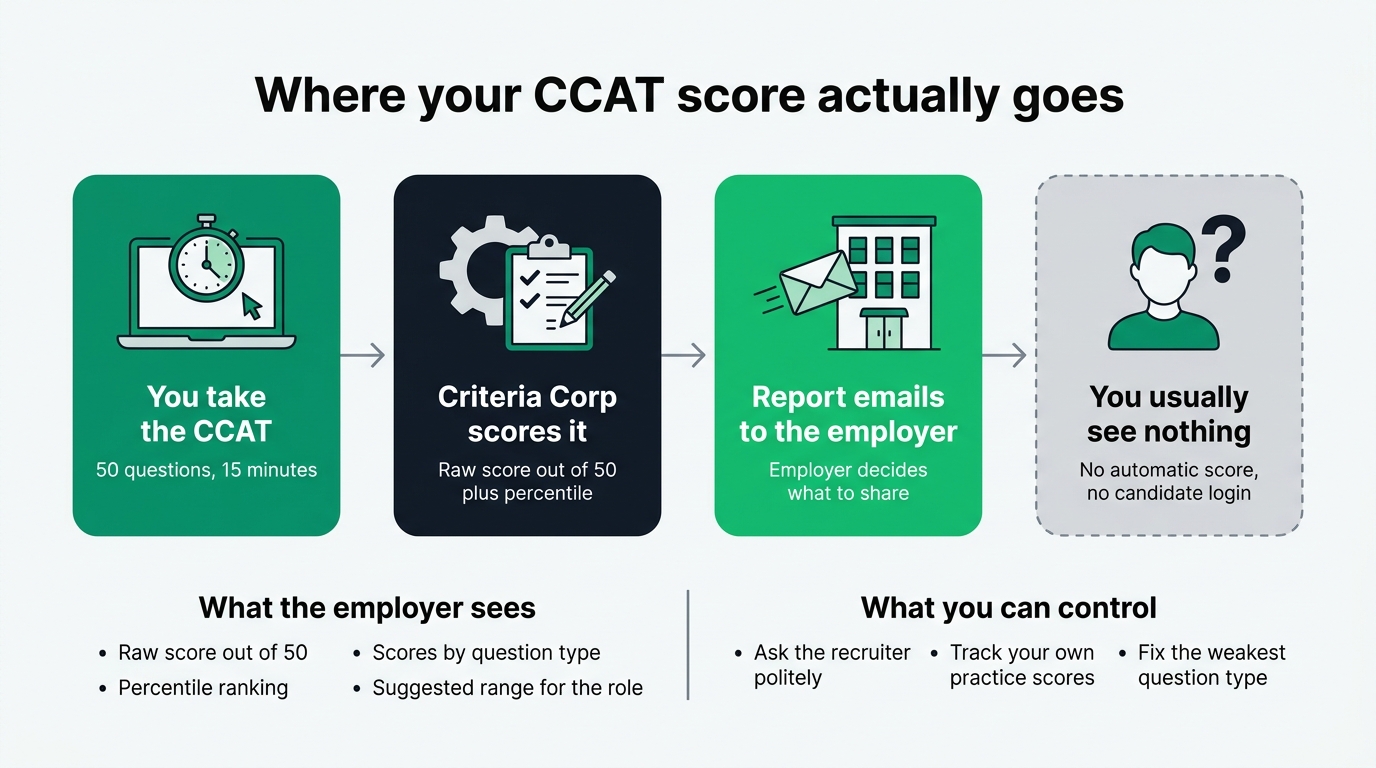
The company that administered the assessment receives the result, and candidates are not automatically sent a copy. Criteria Corp’s candidate FAQs state that “your results are emailed directly to the company for which you applied” and that “the Criteria Support Team does not have access to your results.” The same guidance describes assessment results as part of a confidential candidate record that is only available to the company that administered the test.
That design is deliberate, and once you understand it the silence stops feeling personal. Criteria is the assessment vendor, not your employer. The company buys the test, sets the role it is used for, and owns the output.
Three practical consequences follow. You cannot create an account to look your score up later. You cannot email Criteria’s support team and be sent a copy. And if a recruiter goes quiet after your test, you genuinely cannot tell from that silence whether you scored a 19 or a 39.
What is on the report you never see
Criteria publicly confirms that employers receive a raw score and a percentile ranking, not a pass or fail. Its CCAT product page explains that “each individual is given a raw score and a percentile ranking,” where the raw score is how many of the 50 questions you answered correctly and the percentile shows how you did relative to others in Criteria’s norm group. Criteria publishes the norms behind that percentile too: a mean of 24.2, a median of 24, and a standard deviation of 8.58. The test also includes custom score ranges for a wide variety of positions, so the recruiter can read your number next to a benchmark for the job you applied for.
Here is the gap between what lands in their inbox and what lands in yours.
| Line on the employer’s report | Do you see it? | How close can you get on your own? |
|---|---|---|
| Raw score out of 50 | No | Very close. Take full-length timed practice tests and count correct answers |
| Percentile ranking | No | An estimate only. A published percentile table approximates it, it is not the official norm |
| Custom score range for the position | No | Rough. You can research typical target ranges for your job family |
| How that number is read next to the rest of your application | No | Not reproducible. That judgment belongs to the employer |
Timed practice can estimate your raw score and expose which question types are hurting you, but it cannot reproduce the official percentile, the role range, or the hiring judgment layered on top. That is fine, because the first two are the parts you can still change. For the mechanics, our breakdown of how the CCAT is scored walks through raw scores and percentiles line by line.
How to ask your employer for your CCAT score
Ask the recruiter, not Criteria, and ask once. The recruiter is the only person in the chain who can legitimately share the number, and most hiring teams have a settled policy on it: some share a general band, some share nothing, a few will forward the report.
If you decide to ask, keep the request brief and give the recruiter an easy way to decline. Asking after the employer has communicated a decision is less intrusive than asking while it is still pending. That is practical etiquette rather than a Criteria policy, and something short works best:
Thanks for letting me know. If it is something you are able to share, I would find it useful to know roughly how I did on the cognitive assessment, even just the general range. I am working on that skill set and any signal helps. Completely understand if it is not something you can pass on.
Three things make that version work. It gives the recruiter an easy exit, so a no costs nobody anything. It asks for a range rather than the exact number, which many companies can share when a full report is off limits. And it frames the request around your own improvement rather than around challenging the decision.
If you applied in the UK or the EU, you may have a right to request the personal data an employer holds about you, and an assessment result can fall inside that. The usual route is a subject access request to the company, not to Criteria. Exemptions and local rules affect whether a score or a full report has to be handed over, and in the United States access rights vary by state and situation. Treat all of that as general information rather than legal advice, and check the official guidance that applies where you applied.
What to do instead: build the score report you can actually see
You cannot get the official number, so build a better one before you sit the test. That is not a consolation prize. The official report tells you what happened after the decision was made, while a practice report tells you what to fix while it still changes the outcome.
A practice score report worth trusting needs four things. Full-length timed conditions, because very few people finish all 50 items in 15 minutes and a 20-question sample never exposes the pacing collapse at question 35. A raw score you actually write down, so you see a trend rather than a feeling. Accuracy split by question type, since a 26 built on strong verbal and weak spatial is a different problem from a 26 built on careless math. And repetition, because one test measures a Tuesday and three tests measure you.
That per-question-type split is the piece almost nobody does by hand, and it is the piece that decides what you study tomorrow morning. Guessing at your weak area is how people spend three weeks polishing verbal analogies while spatial reasoning quietly costs them six points.
A worked example: two candidates, the same invisible 29
Picture two candidates who both score 29 on the real CCAT for the same operations role, and neither of them ever finds out.
The first hears nothing, assumes the test went badly, and treats it as a wall. When the next CCAT invitation arrives four months later, nothing about his preparation has changed, so the score does not move either.
The second had already run three full timed practice tests before test day. Her own reports showed 74 percent accuracy on verbal, 68 percent on math and logic, and 41 percent on spatial and abstract questions, plus a habit of running out of time around question 36. She did not need the official report to know what to fix, because she already had a sharper one, and her next round of prep targets spatial pattern recognition and pacing instead of starting over.
Same hidden number, completely different position. To check where a practice raw score actually sits, our CCAT percentile chart maps raw scores to percentiles, and what counts as a good CCAT score covers how those targets shift by role.
FAQ
How do I find out my CCAT score?
Ask the employer who invited you to take it, because they are the party who receives the report. Criteria Corp states that results are emailed directly to the company you applied to and that its support team does not have access to them, so contacting Criteria will not produce your number. Whether you learn it comes down to the employer’s own policy on sharing.
Can I see my Criteria assessment results?
Usually not. Criteria treats assessment results as part of a confidential candidate record available only to the company that administered the test, so the decision to share sits entirely with that employer. Some recruiters will tell you a general range if you ask after a hiring decision, and some will decline as a matter of policy.
Is 26 out of 50 good for CCAT?
A 26 is two points above Criteria’s published median of 24 and just under two points above its published mean of 24.2, so it is above average in that standardization sample. It is not an automatic pass, because employers read the number against role guidance and the rest of your application. Roles that lean heavily on analytical work usually set a higher bar than that.
What is a good CCAT test score?
Criteria does not publish one universal passing score. It supplies custom score ranges for different positions, so a good result depends on the role and the employer rather than on a single benchmark. Prep providers commonly treat the top 20 percent of test takers as a strong result, but treat that as general guidance, not as any company’s internal cutoff.
What are the typical CCAT scores for gifted students?
That question refers to a different test. Gifted-program scoring belongs to the Canadian Cognitive Abilities Test, a separate school assessment that shares the CCAT initials, and its interpretation depends on that test’s age-based norms and the school board’s criteria. The Criteria Cognitive Aptitude Test covered here is a workplace hiring assessment scored out of 50 with a percentile ranking, and it has no gifted classification.
Does my employer have to tell me my CCAT score?
It depends on where you applied. In the UK and the EU you may have a right to request the personal data an employer holds about you, though exemptions and local rules affect whether a score or a full report has to be disclosed, and a subject access request goes to the employer rather than to Criteria. In the United States, access rights vary by state and situation. This is general information rather than legal advice.
What other Criteria candidate rules should I check before test day?
Criteria’s candidate FAQ also covers technical requirements, the resume file formats it accepts, and extension requests, and it states that its support team cannot grant extensions on an employer’s behalf. Read the current instructions in your invitation before you start, since a browser or connection problem is a much more common reason for a bad experience than the questions are. None of those administrative rules change who receives your result.
How long does it take to get CCAT results?
Criteria says the result is emailed to the company, and its candidate FAQ does not promise candidates any delivery time, so there is no results date for you to wait on. What you are waiting on is the hiring process, not the scoring. Once the employer’s stated timeline has passed, following up on the application makes more sense than asking Criteria Support for a score they say they cannot access.
Related on CCAT Tests
- Scoring mechanics. How the CCAT is scored. Raw scores, percentiles, and what the two numbers actually mean.
- Benchmarks. What is a good CCAT score. The realistic target ranges by role, without invented cutoffs.
- Percentiles. CCAT percentile chart. Convert a practice raw score into a percentile in one look.
- Pillar. CCAT scores and results guide. Everything about reading, comparing, and improving CCAT results.
- Practice. Free CCAT practice tests. Generate the score report the employer will never send you.
Try CCAT Tests
The score you cannot see, replaced by one you can.
You will probably never receive the official CCAT report, so the practical move is to build a sharper one first. CCAT Tests gives you a heat-map of exactly which question types are costing you points and drills aimed at those weak spots, the class of analytics that normally runs into hundreds of dollars a month, in a one-time purchase. The free tier is a real practice experience across all three domains, including the spatial and abstract images most generic aptitude sites skip, so you can see your first diagnostic before deciding whether to pay for anything. If the CCAT is one hurdle in a hiring process that also throws personality, situational, or other cognitive assessments at you, our sister platform PrepClubs covers that whole gauntlet with 21 pre-employment tests, more than 3,700 students, and a money-back guarantee.