You are 12 minutes into the CCAT, you have 20 questions left, and the clock is winning. This is the exact moment the test is designed to create, and how you handle these last three minutes can be worth five or more points. The honest truth is that almost nobody finishes the CCAT cleanly, so guessing is not a fallback you resort to in failure. It is a planned part of the test that good candidates use on purpose. This guide gives you a real system for it: when to answer, when to make an educated guess, when to blind-guess and move on, and the exact move to make in the final 30 seconds.
One quick disambiguation first. This is the Criteria Cognitive Aptitude Test from Criteria Corp, the workplace hiring test, not the Canadian Cognitive Abilities Test given to schoolchildren for gifted-program admissions. Same acronym, different test. You are prepping for the workplace one.
Quick takeaways
- The CCAT has no penalty for wrong answers, so a guessed question can only help you, never hurt you.
- Never leave a blank. Every unanswered question is a guaranteed zero you chose on purpose.
- Getting stuck on one hard question can cost you three easy ones. Skipping is a scoring decision, not a defeat.
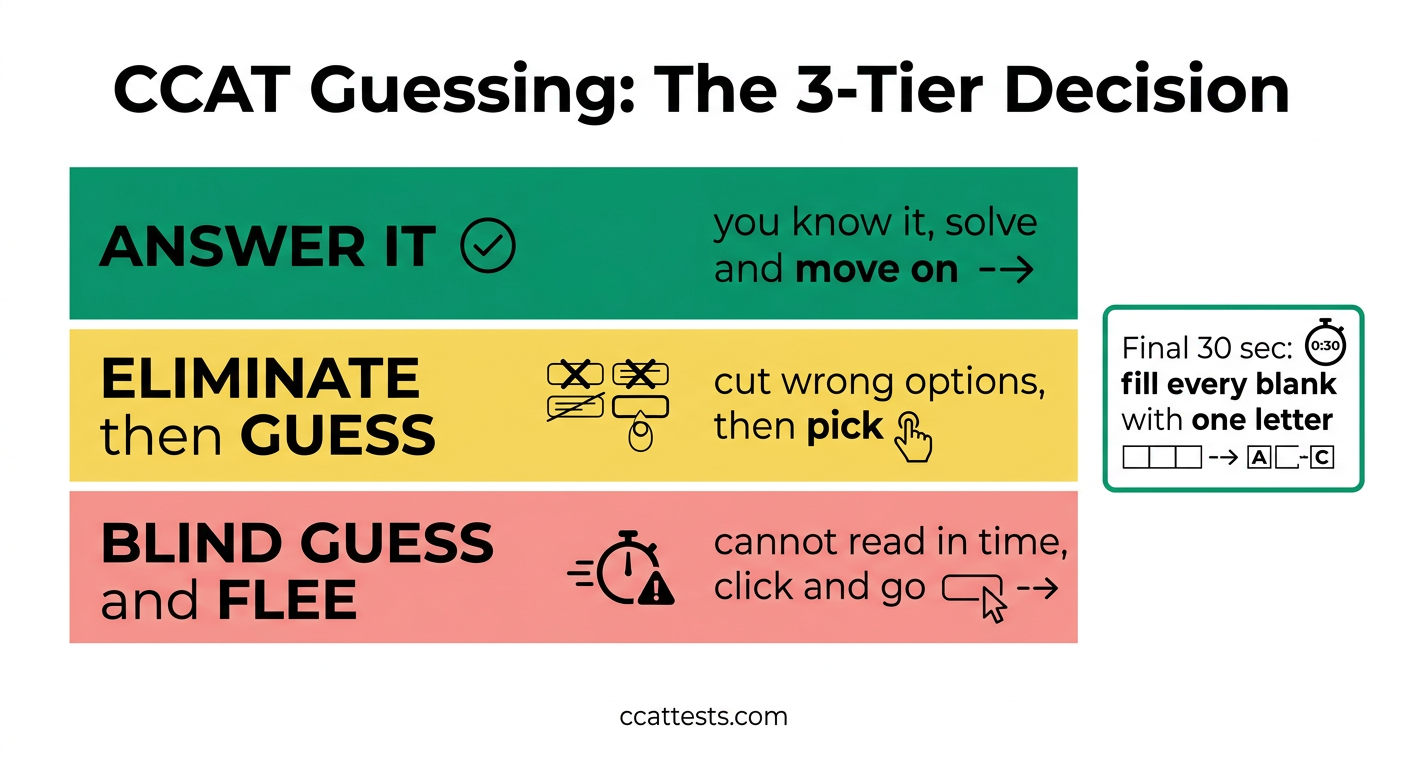
- Guess in tiers: answer what you know, eliminate-and-guess what you half-know, blind-guess what you cannot read in time.
- In the final 30 seconds, fill every remaining blank with a single letter. At roughly 20 to 25 percent per question, that reliably nets you points.
- Elimination is where guessing earns its keep: cutting even one wrong option lifts a blind 20 percent guess to a 25 to 33 percent shot.
Why guessing is a scoring strategy, not a mistake
Start with the single fact that changes how you should play the entire test: the CCAT does not penalize wrong answers. Criteria Corp, the test’s publisher, is explicit that your score is the number of questions you answer correctly, with nothing subtracted for wrong ones. That means a blank and a wrong answer cost you exactly the same, but a guess gives you a real chance at a point the blank never had.
Now layer on the format. The CCAT is 50 questions in 15 minutes, about 18 seconds each. Less than 1 percent of candidates answer all 50, and the average person answers around 24. You are not expected to finish, which means running out of time is the normal case, not the emergency. The candidates who score well are not the ones who never guess. They are the ones who guess deliberately and keep moving.
So the mindset shift is this: guessing is not what happens when your prep fails. It is a tool you deploy on schedule, on every hard or slow question, from the very first minute.
The cost-of-a-hard-question math
Here is the trap the CCAT sets. You hit a genuinely hard question at, say, question 18. You feel like you almost have it. You spend 60 seconds grinding on it.
That 60 seconds was not one question’s worth of time. At 18 seconds per question, 60 seconds is more than three questions. So the real price of that one stubborn question is not “I might get this one.” It is “I gave up my shot at three easier questions later in the test to chase one hard one.” On a test where easy and hard questions are worth the same single point, that trade is almost always a loss.
The rule that falls out of this math is simple:
If a question is not yielding within about 20 seconds, it is costing you more than it can pay. Guess it and go.
This is why pacing and guessing are the same skill. You do not need a separate “guessing plan” and “timing plan.” You need one habit: recognize a slow question fast, take your best guess, and protect the easy points still ahead of you. For the full pacing side of this, our 15-minute CCAT time management strategy breaks down how to budget the clock across the whole test.
The three-tier guessing framework
Not all guesses are equal. The mistake most people make is treating every uncertain question the same way, either freezing on all of them or panic-clicking through all of them. Sort them into three tiers instead, and decide in the first few seconds which tier you are in.
Tier 1: Answer it (you know it)
You read the question, you see the path, you can solve it inside your time budget. Answer it and move on. Do not double-check three times. The CCAT does not reward certainty, it rewards correct answers submitted before the clock runs out. Trust your first solid read.
Tier 2: Eliminate, then guess (you half-know it)
You cannot solve it cleanly, but you can rule things out. This is the highest-value guessing tier, because every option you eliminate raises your odds. Blind-guessing one of five options is a 20 percent shot. Kill two options and your guess is a 33 percent shot. Over a dozen questions, that difference is real points. Spend your elimination effort here, not on Tier 3.
Tier 3: Blind-guess and flee (you cannot read it in time)
The question is dense, the clock is short, or the topic is your weakest area. Do not read it three times hoping it clicks. Pick your pre-chosen guess letter, click, and move to the next question. A Tier 3 question you spend 40 seconds on is a Tier 3 question that also stole a Tier 1 question from you. Flee fast.
The discipline is in the sorting, not the solving. Deciding “this is a Tier 3, I am guessing and leaving” in five seconds is the single most valuable time-management move on the test.
Elimination tactics by question type
Tier 2 is where you make your money, and elimination looks different in each of the CCAT’s three question domains. Here is how to cut options fast in each.
| Question type | Fast elimination move | Why it works |
|---|---|---|
| Verbal (analogies, antonyms, sentence completion) | Kill the obvious opposite and the obviously unrelated word first | Test writers include one “trap” near-synonym and one clear distractor; removing the clear distractor is instant |
| Math and logic (word problems, number series) | Ballpark the answer, then delete options that are the wrong order of magnitude | You rarely need the exact number to see that two of five options are far too big or too small |
| Spatial and abstract reasoning | Rule out by a single feature: count sides, check rotation direction, or spot the odd shape | You do not need to fully “solve” the pattern to eliminate a figure that breaks one obvious rule |
None of these require you to finish the problem. They just shrink the field so your guess is a 33 percent or 50 percent shot instead of a 20 percent one. That is exactly what realistic practice trains, because the only way to get fast at “which option is clearly wrong” is to have seen enough real CCAT-style questions that the traps become familiar.
A worked example: guessing a number series under pressure
Say you hit this with 25 seconds left and four questions to go:
What number comes next? 3, 6, 11, 18, 27, ?
The clean solve: the gaps are 3, 5, 7, 9, so the next gap is 11, giving 38. If you see that in your budget, answer 38 and move on. Tier 1.
But suppose you froze and the pattern is not clicking. Do not walk away with a blank. Eliminate instead. The numbers are climbing by a growing amount, so the answer has to be meaningfully bigger than 27, and the gaps have been in the high single digits. An option like 30 is too small, an option like 54 is too big. That likely leaves you two plausible options in the high 30s. Now your guess is a coin flip, not a 20 percent shot, and it took five seconds. That is a Tier 2 save, and across a test it is the difference between an average and an above-average score.
The last-30-seconds move that nobody tells you
Here is the tactic that separates people who understand the CCAT from people who just take it. When you see the timer drop under about 30 seconds and you still have blanks, stop trying to solve anything. Fill in every remaining blank with a single, pre-chosen letter.
The math is straightforward. Each CCAT question has four or five answer choices, so a blind guess is worth roughly 20 to 25 percent. If you have eight blanks left and 20 seconds, you cannot solve eight questions, but you can click eight times. On average, mass-guessing those eight nets you about two extra correct answers you would otherwise have scored zero on. Two points on the CCAT can move you a full percentile band or more.
Pick your guess letter before the test starts (any consistent choice is fine, since the correct answers are distributed across positions) so that in the final rush you are not also deciding which letter to click. One letter, every blank, no thinking. It is the cheapest points on the entire test.
Common guessing mistakes that quietly cost points
- Leaving blanks “to be safe.” There is no safe blank. A blank is a guaranteed zero. With no wrong-answer penalty, not guessing is the only guessing mistake you can make.
- Re-reading a hard question three times. If it did not click on read one or two, read three will not save it. It will just burn a Tier 1 question you had not reached yet.
- Guessing without eliminating when you had time to eliminate. A five-second elimination pass often turns a 20 percent guess into a 33 percent one. Skipping it on Tier 2 questions leaves points on the table.
- Deciding your guess letter mid-panic. Choose it before the test. Decision fatigue in the last 30 seconds is real, and it slows your clicks.
- Treating the whole test as one long grind. The test rewards triage. Sort every question into a tier fast, and spend your effort where it pays.
Why practicing your guessing matters as much as practicing the questions
Most CCAT prep teaches you to solve questions. Almost none teaches you to guess them well, which is strange, because guessing is guaranteed to happen. The skills in this guide, five-second triage, fast elimination, and the clean last-30-seconds sweep, only become automatic if you have rehearsed them under a real clock on real CCAT-style questions.
That is exactly what we built the practice bank at CCAT Tests for. You can run genuinely CCAT-style questions across all three domains, including the spatial and abstract-reasoning items that are hardest to guess blind, and the free tier is a real practice experience, not three sample questions and a paywall. Practice with the timer on, and pay attention not just to how many you got right, but to how fast you decided to guess the ones you could not solve. When you want to see exactly where your guessing habits are leaking points, whether you freeze on spatial, over-check math, or leave blanks under pressure, the heat-map analytics show you the specific question types where your accuracy drops, so you drill the right weak area instead of practicing what you are already good at. If you are prepping across several tests and want that same weak-area breakdown with a money-back guarantee behind it, the broader PrepClubs practice platform is where that all lives.
FAQ
Does guessing hurt your CCAT score?
No. The CCAT has no penalty for wrong answers, so guessing can only help your score. A wrong guess costs you exactly what a blank costs you, which is nothing, but a guess gives you a real chance at the point. Always guess rather than leave a blank.
Should you guess or skip on the CCAT?
You should do both, in that order. Skip a question you cannot solve quickly so you can reach easier questions, but before your time runs out, go back and guess every skipped question. A skipped question left blank at the end is a wasted point. Skipping buys you time; guessing at the end banks the points.
What happens if you run out of time on the CCAT?
The test simply ends and scores the questions you answered. Any blank counts as incorrect. This is why the last-30-seconds sweep matters: filling every remaining blank with a single letter before time expires converts guaranteed zeros into a real shot at points.
What letter should you guess on the CCAT?
It does not matter which letter you pick, only that you pick one consistently so you are not wasting time deciding. Correct answers are spread across all answer positions, so no single letter is “smarter.” Choose your guess letter before the test starts and use it for every blind guess.
How many questions are you expected to leave blank on the CCAT?
Effectively none, if you use the end-game sweep. You will likely run out of time before answering all 50, and that is normal, since the average candidate answers about 24. But “did not solve” and “left blank” are different. Solve what you can, guess the rest, and submit zero true blanks.
Is it better to answer fewer questions carefully or more questions with guessing?
More questions, with guessing on the hard ones. Because every question is worth the same single point and there is no wrong-answer penalty, a fast pace with strategic guesses reaches more scorable questions than a slow, careful pace that runs out of time at question 30. Accuracy matters, but coverage plus smart guessing beats perfectionism on this test.
Is 26 out of 50 a good CCAT score?
It is right around and slightly above the average raw score of about 24, so 26 is a solid middle-of-the-pack result, though strong technical roles often look for higher. Because scores are reported as percentiles against other candidates, the same raw number can land differently depending on the role. Good guessing is one of the most reliable ways to push a raw score of 24 up to 28 or 30 without solving a single extra question the hard way.
Related on CCAT Tests
- Pacing. The 15-minute CCAT time management strategy. The clock side of guessing, with a full pacing plan for all 50 questions.
- Full plan. How to pass the CCAT: a 7-step success plan. Where guessing fits into a complete prep approach.
- Pillar. The CCAT test preparation guide. Everything from format to strategy in one hub.
- Practice. Free CCAT practice tests. Rehearse your triage and guessing under a real timer.
Try CCAT Tests
Turn “I ran out of time” into “I guessed my way to more points.”
Guessing well is a skill, and it only sticks if you rehearse it under a real clock. CCAT Tests gives you a genuinely usable free practice tier across all three question domains, so you can practice fast triage and clean end-game guessing before it counts. When you want to know exactly which question types you keep freezing on, the heat-map analytics point you straight at your weak spot so you drill the right thing.