You have a CCAT coming up and the logic and reasoning items are the part making you nervous. Here is the direct answer: CCAT logic questions ask you to find the rule behind a sequence, an “if-then” chain, or a set of options, and the one skill that decides your score is fast pattern recognition, not deep calculation. To be clear about which test this is, the CCAT here is the Criteria Cognitive Aptitude Test from Criteria Corp, the workplace hiring test, not the Canadian Cognitive Abilities Test for schoolchildren that shares the acronym. With 50 questions in 15 minutes, you get roughly 18 seconds per question, so the goal is to name the pattern in a few seconds and spend the rest applying it.
Quick takeaways
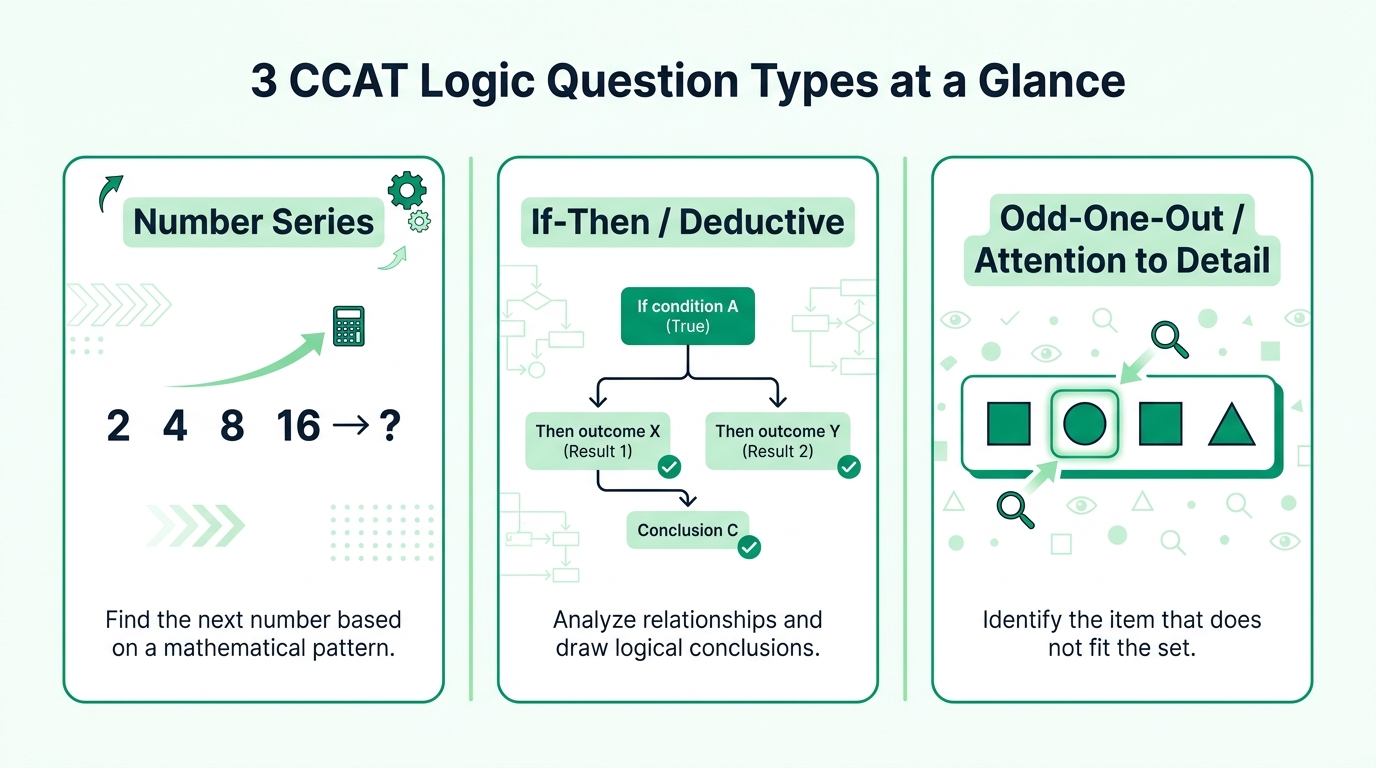
- CCAT logic questions are the reasoning items inside the test’s “math and logic” group: number series, if-then and deductive chains, syllogisms, and attention-to-detail or odd-one-out items.
- Criteria groups math and logic together and does not publish an exact split, so any “there are exactly X logic questions” claim is a third-party estimate, not a Criteria fact.
- The whole game is recognizing the type in about 3 seconds, then running a fixed method for that type.
- No calculator is allowed and there is no penalty for wrong answers, so never leave a logic question blank.
- Average performance is about 24 of 50 correct and fewer than 1 percent finish all 50, so a few clean logic points move you up the percentile.
- If the rule does not resolve in a few seconds, mark a best guess and move on. A stuck question costs more than a wrong one.
What are logic questions on the CCAT?
Logic questions test whether you can spot a rule and apply it under time pressure. Criteria Corp describes the test as having three kinds of questions: verbal, math and logic, and spatial reasoning. Logic lives inside that middle group, which is why there is no standalone “logic” count on the official page. In practice, these reasoning items fall into a few recognizable shapes.
- Number and letter series: a sequence with a missing term, where you find the rule and fill the gap.
- If-then and deductive items: short conditional statements where you follow the chain to a valid conclusion.
- Syllogisms: statements about groups (“all A are B”) where you decide what must be true.
- Attention to detail and odd-one-out: sets where you compare items and find the match, the mismatch, or the one that breaks the pattern.
None of these need advanced math. The gap most prep skips is that knowing the definition is easy, but solving the actual item at 18-second pace is the real test.
How many logic questions are on the CCAT?
Nobody outside Criteria knows the exact number, because Criteria groups math and logic together and does not publish a per-type breakdown. The whole test is 50 questions in 15 minutes. Some prep sites estimate pure “logic” items are a small slice, roughly a handful, while others fold number series and deductive items into a wider bucket. Both are estimates, so treat any precise count as a guess. Logic-style reasoning shows up often enough that a reliable method pays off, but balance your practice across verbal, math, spatial, and logic rather than over-drilling one type.
The main CCAT logic sub-types and how to attack each
Fast candidates recognize the shape first, then run the matching method. Use this table to build that reflex.
| Logic sub-type | What it looks like | Fast attack method |
|---|---|---|
| Number or letter series | A sequence with a blank: 3, 6, 12, 24, ? | Check the gap between neighbors first, then the ratio, then look at the gaps for a pattern, then check for two interleaved series. |
| If-then / conditional | “If sales rise, the bonus pays. Sales rose.” | Follow the arrow forward only. A true “if” plus a true condition gives a true result. Do not reverse it. |
| Deductive chain | Several linked statements leading to a conclusion | Line up the facts, chain them (A leads to B, B leads to C), and read off the end. |
| Syllogism | “All managers are staff. All staff are paid.” | Picture the groups as nested circles. Only conclusions that must always be true count. |
| Attention to detail | Two strings or rows to compare for a match | Scan left to right in fixed chunks. The first difference decides it. |
| Odd-one-out | A set where one item breaks the pattern | Find the rule that fits most items, then flag the one that violates it, not the one that merely looks different. |
3 worked CCAT logic examples, solved step by step
Reading definitions will not build the reflex. Watching the reasoning happen will. Here are three items, one per major shape, worked the way you should work them on the clock.
Example 1: Number series (find the pattern)
Question: 2, 6, 18, 54, ? What comes next?
- Check the difference: 6 minus 2 is 4, 18 minus 6 is 12. Not constant, so it is not a simple add.
- Check the ratio: 6 over 2 is 3, 18 over 6 is 3, 54 over 18 is 3. Each term is the previous times 3.
- Apply the rule once: 54 times 3 is 162.
- Answer: 162.
The lesson is the order: test difference first, rule it out in a second, then test ratio and lock the rule. That fixed sequence keeps you off the “try random operations” trap.
Example 2: If-then / deductive item
Question: If a project is over budget, it needs sign-off. The Rivera project is over budget. What must be true?
- Identify the rule: over budget leads to needs sign-off. The arrow points one way.
- Apply the given fact: the Rivera project is over budget, which triggers the “if” side.
- Follow the arrow forward: the condition is met, so the result follows.
- Answer: The Rivera project needs sign-off.
The trap is reversing the arrow. “Needs sign-off” does not prove “over budget,” because a project could need sign-off for other reasons. On the CCAT, only move in the direction the statement gives you.
Example 3: Syllogism (what must be true)
Question: All auditors are analysts. No analysts are interns. Which conclusion follows?
- Picture the groups: auditors sit fully inside the analysts group.
- Add the second fact: the analysts group and the interns group do not overlap at all.
- Combine: every auditor is inside analysts, and analysts never overlap interns, so no auditor can be an intern.
- Answer: No auditors are interns.
Watch for tempting but wrong options like “some interns are auditors” or “all analysts are auditors.” On syllogisms, a conclusion counts only if it holds in every case. For the arithmetic that number-based logic leans on, our complete CCAT math guide goes deeper.
Time strategy for CCAT logic items
Logic questions live and die on pacing. Your budget is about 18 seconds a question, and logic items vary: a constant-difference series can be under 10 seconds, while a three-statement syllogism might take 30. That average only holds if you refuse to let any single item run away.
- Name the type in about 3 seconds. Before solving anything, decide the shape: number series, if-then, syllogism, or detail check. That tells you which method to run and stops the panic freeze.
- Skip and return. If the rule does not resolve in a few seconds, mark your best guess, flag it mentally, and move on. A stuck question eats time you needed for three easy points elsewhere.
- Never leave a logic question blank. There is no penalty for wrong answers, so a guess can only help. Before time runs out, make sure every item has an answer filled in.
- No calculator, so keep the math light. Logic items are built for mental estimation. If an item seems to demand heavy calculation, you have probably misread it.
For a full pacing plan across the 15 minutes, see our CCAT time management strategy.
Are CCAT logic questions hard?
They are hard in a specific way: the reasoning is not advanced, but the clock is unforgiving. Most CCAT logic items would be easy with unlimited time. The difficulty is doing them in seconds, back to back, while the timer ticks. That is good news, because practice moves the needle fast: once the common shapes feel familiar, recognition speed climbs and the same items stop feeling hard. A heat-map of your weak types helps here, because if logic is where you lose points, you will see it and can drill it before it costs you the job.
FAQ
What are logic questions on the CCAT?
They are the reasoning items inside the CCAT’s “math and logic” group, including number and letter series, if-then and deductive chains, syllogisms, and attention-to-detail or odd-one-out items. Each asks you to find a rule and apply it, not to do heavy math.
How many logic questions are on the CCAT?
Criteria does not publish an exact number, because it groups math and logic together rather than listing a per-type count. The full test is 50 questions in 15 minutes. Any specific “there are X logic questions” figure online is a third-party estimate, so treat it as a rough guide.
How do I solve CCAT logic questions fast?
Recognize the type first, in about three seconds, then run the method for that type. For series, test difference then ratio. For if-then, follow the arrow one way. For syllogisms, picture the groups and accept only what must always be true. Speed comes from having a method ready, not from thinking harder.
Are CCAT logic questions hard?
The reasoning is usually simple, but the time limit makes them feel hard. With about 18 seconds per question, the challenge is doing them quickly and in a row. Practice with realistic items lowers that difficulty fast because recognition speed improves.
What is a CCAT if-then question?
It is a conditional item that gives you a rule (“if A, then B”) plus a fact, and asks what follows. You apply the rule in the direction it points. The common mistake is reversing it, so “B” does not let you conclude “A” unless the statement says so.
Can I use a calculator on CCAT logic questions?
No. The CCAT does not allow calculators, so logic and math items are built for mental estimation. If an item seems to need long calculation, re-read it, because you have likely missed a shortcut.
Is there a penalty for guessing on CCAT logic questions?
No. There is no penalty for wrong answers, so never leave a logic question blank. If you are running out of time, fill in an answer for every remaining item, since a guess can only add points.
How can I practice CCAT logic questions realistically?
Use a question bank that mirrors the real item shapes and the 18-second pace, not just definitions. Timed practice tests with weak-area analytics show whether logic is your slow type so you can drill it before test day.
Related on CCAT Tests
- Master the CCAT math section
- CCAT number sequences and pattern mastery
- CCAT spatial patterns and visual problem solving
- The CCAT 15-minute time management strategy
- Free CCAT practice tests
Try CCAT Tests
Practice on real CCAT-style logic items, not definitions
The honest pitch: our free tier is genuinely usable for CCAT logic practice, with a realistic CCAT-style question bank that includes worked examples and spatial images, so you drill the actual shapes you will face. Paid plans are one-time, not a subscription, see pricing, and they add fully timed simulations plus a heat-map of your weak question types, so you can see whether logic is dragging your score.
If the CCAT is only one of several assessments between you and an offer, the broader paid platform at PrepClubs is the sensible next step: it covers 21 pre-employment tests, has helped more than 3,700 students prepare, and backs its prep with a money-back guarantee. For a single test, start free here and level up only if you need the timed sims and analytics.