A recruiter sends you a CCAT link, you start searching, and within about four minutes you hit the question everyone hits: what score do I need to pass? Here is the direct answer. There is no official CCAT passing score. Criteria Corp, the company that publishes the test, never sets one, because the bar is chosen by the employer running the hiring process, not by the test itself. One quick disambiguation before you go further: this is the Criteria Cognitive Aptitude Test used in workplace hiring, not the Canadian Cognitive Abilities Test given to schoolchildren that shares the same initials, so ignore anything you find about stanines or “Very Superior” bands.
Quick takeaways
- The CCAT has no universal pass mark. Employers configure their own acceptable score range for each position.
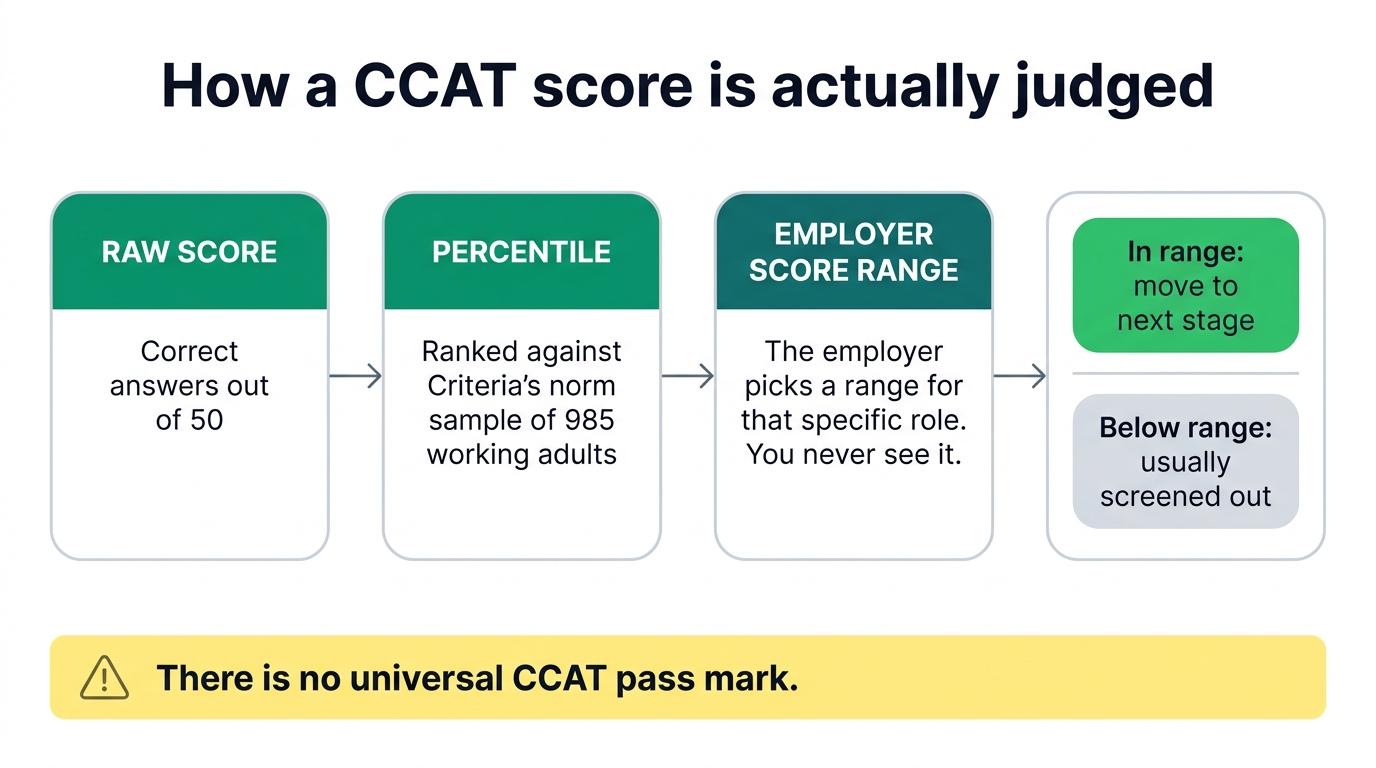
- Criteria sends the employer two numbers after you finish: your raw score out of 50 and your percentile.
- The standardization sample mean is 24.2, the median is 24, and the standard deviation is 8.58, drawn from 985 working adults.
- The number 31 gets quoted as “the passing score” because it sits roughly four fifths of a standard deviation above that mean, not because anyone official declared it.
- Fewer than 1% of candidates answer all 50 questions in the 15 minutes, so an unfinished test is normal, not a failure.
- Because you cannot see the employer’s range, the only sane strategy is to build a margin above the average rather than aim at a rumored number.
There is no official CCAT passing score, and that is deliberate
The CCAT is a ranking instrument, not a certification exam. Criteria Corp’s own candidate page describes what happens at the end: “After the test is completed, employers are sent your raw score (the number of questions you get right) and your percentile (how you did compared to everyone else who’s taken the test).” Notice what is absent from that sentence. There is no pass, no fail, no threshold, and no verdict. The test hands over two numbers and stops.
What fills that gap is the employer. Criteria’s product documentation notes that the assessment “includes custom score ranges for a wide variety of positions,” which means the hiring company picks the band it considers acceptable for the specific role you applied to and compares you against it. A support role and a senior engineering role at the same company can sit on completely different bands. That is why two people can post the identical raw score on Reddit and one says they passed while the other says they were rejected. Both are telling the truth.
What the employer sees, and what you do not
The employer receives a report; you usually receive nothing. The hiring team gets your raw score, your percentile, and a view of how you performed against the range they set for the role. Unless they choose to share it, you see none of it. You finish, the screen closes, and you wait.
That matters for how you prepare. You are aiming at a target you cannot measure, set by someone you have not met, for a role whose internal benchmark is published nowhere. Anyone quoting a specific company’s exact cutoff is repeating a forum post, not a fact, including the ones who sound confident.
Where the number 31 comes from
Almost every prep site quotes something near 31 out of 50 as the informal passing score. That number is not arbitrary, but it is also not official, and the reasoning behind it is rarely explained. Here is the arithmetic.
Criteria publishes the standardization statistics for the CCAT: a mean of 24.2, a median of 24, and a standard deviation of 8.58, based on a norm sample of 985 working adults aged 18 and older. A raw score of 31 sits 6.8 points above the mean, which is about 0.79 standard deviations up. If the distribution were perfectly normal, that lands near the 79th percentile. So 31 is shorthand for “roughly the top fifth of test takers,” which is a defensible target for a lot of professional roles and completely irrelevant for others.
The table below applies that same normal approximation to a range of raw scores. Treat it as an estimate for planning, not as Criteria’s official percentile table, which is not published publicly.
| Raw score (of 50) | Standard deviations from mean | Approximate percentile | What it usually signals |
|---|---|---|---|
| 20 | -0.49 | ~31st | Below the typical working-adult average |
| 24 | -0.02 | ~49th | Almost exactly average |
| 26 | +0.21 | ~58th | Slightly above average |
| 28 | +0.44 | ~67th | Comfortable for many general roles |
| 31 | +0.79 | ~79th | The commonly quoted informal bar |
| 35 | +1.26 | ~90th | Strong for most technical and analytical roles |
| 40 | +1.84 | ~97th | Top-tier, rarely required |
If you want the fuller picture of how raw scores translate upward, the CCAT percentile chart walks through the conversion in more detail.
Not finishing is not failing
A lot of people assume they failed because the timer ran out with fifteen questions untouched. Criteria states directly that less than 1% of candidates answer all 50 questions in the 15-minute window, and adds that “you don’t need to get all the questions right to shine in front of employers.” The test is built so that almost nobody finishes. Running out of time is the expected experience, not a sign that something went wrong.
The three question types, verbal, math and logic, and spatial reasoning, are mixed together rather than grouped, so the final stretch is not concentrated in one skill. A strong finish is less about sprinting at the end and more about not losing thirty seconds to one stubborn question early.
A worked example: same score, two different outcomes
Consider two candidates who both score 28 out of 50, roughly the 67th percentile on the estimate above.
Candidate A applied to an operations coordinator role at a mid-size logistics company. The hiring team set their acceptable band near the middle of the distribution, because the job is judgment-heavy rather than analysis-heavy. A 28 clears their floor. She moves to interview, and nobody mentions the test again.
Candidate B applied to a backend engineering role at a private-equity-backed software company using the assessment to compress a very large applicant pool. Their configured range for that role sits higher. The same 28 lands below the floor, and a rejection arrives two days later with no explanation.
Neither result was better or worse on the test itself. They hit different bands. That is the practical meaning of “no passing score,” and it is why chasing a rumored number is weaker than building a margin.
What to aim for when you cannot see the bar
Target a cushion rather than a threshold. Aim to land clearly above the mid-20s average, and if the role is analytical, technical, or at a company known to screen hard, aim higher still. The good CCAT score breakdown by job level gets specific about where different roles tend to sit.
The more useful question is not “what score do I need” but “where am I losing points right now.” A candidate stuck at 24 because number series are slow needs a different fix from one stuck at 24 because verbal analogies get misread under pressure. Both would gain points, but not from the same practice.
That is where a practice test which only hands back a number stops helping. A score tells you the outcome; a breakdown by question type tells you the cause. Enterprise assessment-analytics tools that produce that kind of diagnostic typically run around $497 a month, which is not a realistic purchase for one person preparing for one hiring process. Getting that class of insight without the subscription is the practical reason to use a tool that reports section-level performance instead of a single total.
FAQ
What is a passing score on the CCAT?
There is no official passing score. Criteria Corp does not define one, and the employer sets an acceptable score range for the specific role you applied to. A raw score near 31 out of 50 is the number most often quoted informally, because it sits roughly 0.79 standard deviations above the published mean of 24.2.
What is a good score on the CCAT?
A good score is one that clears the band your target employer set, which usually means comfortably above the working-adult average of about 24. For most professional roles, the high 20s to low 30s is a reasonable aim, and analytical or technical roles often sit higher. There is no single number that is good everywhere.
Is 26 out of 50 good for the CCAT?
A 26 is slightly above the standardization sample mean of 24.2, landing near the 58th percentile on a normal approximation. It is a respectable result for a general role and a thin margin for a competitive technical one. If the job you want is in the second category, 26 is a starting point rather than a finishing point.
Is the CCAT test hard?
It is genuinely hard, and mostly because of the clock. Fifty questions in fifteen minutes leaves about eighteen seconds each, and fewer than 1% of candidates finish. The individual questions are not advanced mathematics or obscure vocabulary; the difficulty comes from sustaining accuracy at that pace across three different question types.
Is there a CCAT passing score calculator?
No official one exists, because there is nothing official to calculate against. Any calculator you find converts a raw score to an estimated percentile using published averages, which is useful context but not a pass or fail verdict. The employer’s range decides the outcome, and it is not public.
Do employers see my exact score or just a band?
Criteria sends the employer your raw score and your percentile, so they see exact figures, not a vague category. What they do with those numbers depends on the range they configured for the role. You will not normally see either number yourself.
What is the minimum CCAT score to move forward?
There is no published minimum. Scores below the mid-20s put you under the norm sample average, which narrows your options at employers using the test to filter a large applicant pool. Treat the average as your floor rather than hunting for an official minimum.
Can I improve my CCAT score before test day?
Yes, though gains come from mechanics rather than raw intelligence: recognizing recurring question patterns faster, deciding sooner when to skip, and cutting the careless errors that pace pressure produces. That takes timed practice and knowing which of the three question types is actually costing you points.
Related on CCAT Tests
- Benchmark. What counts as a good CCAT score by job level. The role-by-role view of where the bar tends to sit.
- Scoring mechanics. How the CCAT is scored: raw scores vs percentiles. What the two numbers on the report mean and how they relate.
- If it goes badly. What happens if you fail the CCAT. Retake rules, rejections, and realistic next steps.
- Pillar. CCAT score interpretation hub. The full scoring and percentile reference.
- Practice. Free CCAT practice test. Fifty questions, fifteen minutes, the real format.
Try CCAT Tests
Stop guessing at the number. Find out where your points are actually going.
Since nobody will tell you the employer’s cutoff, the useful move is knowing your own numbers precisely. Our free tier is a genuinely usable practice experience, not a seven-day trial: real CCAT-style questions across verbal, math and logic, and spatial reasoning, including the abstract imagery most generic aptitude sites skip. Paid plans are one-time, see pricing, and add the heat-map breakdown showing which question types drain your clock, plus drills aimed at those specific weaknesses. A companion Udemy course with 1,200+ students rated 4.5/5 covers the same material. A comparable CCAT pack from JobTestPrep runs roughly three times the price, with no free tier worth using first.
If the CCAT turns out to be one hurdle in a hiring process that also throws personality questionnaires, situational judgement, or another cognitive test at you, it makes more sense to prepare for the whole sequence in one place. PrepClubs covers that wider set of assessments, with 21 pre-employment tests, more than 3,700 students, and a money-back guarantee.
CCAT is a registered trademark of Criteria Corp. ccattests.com is an independent study resource and is not affiliated with, endorsed by, or sponsored by Criteria Corp. Format and scoring facts in this article come from Criteria Corp’s candidate guidance and its CCAT assessment page.