A recruiter just told you the next step is a CCAT, you have a few days at most, and you want to sit a real practice run before the one that counts. That is the right instinct, and this guide gives you a genuinely free way to do it: a full 50-question, 15-minute practice test across all three CCAT sections, with answers, plus an honest map of which other “free” tests online are actually full-length and which are three-question teasers. First, the disambiguation that trips up half of searchers: the CCAT here is the Criteria Cognitive Aptitude Test, the workplace hiring test from Criteria Corp, not the Canadian Cognitive Abilities Test, the school gifted-and-talented test for children that unfortunately shares the same acronym. If a “CCAT” page is talking about grades 7 and 8, you are on the wrong test.
The short answer: yes, you can take a real, free CCAT practice test that mirrors the actual format. The real CCAT is 50 questions in 15 minutes, covering verbal, math and logic, and spatial reasoning, with no calculator allowed. A practice test worth your time matches those exact constraints, because the format, especially the clock, is most of what makes the CCAT hard.
Quick takeaways
- The real CCAT is 50 questions in 15 minutes, three sections (verbal, math and logic, spatial/abstract), no calculator. Source: Criteria Corp.
- A useful free practice test matches that format: 50 questions, a 15-minute timer, and all three question types, not a shortened sampler.
- Many “free CCAT tests” online are actually 16 to 30 questions or a different time limit, which under-prepares you for the real pace of about 18 seconds per question.
- Take the timed test once cold to find your weakest section, then drill that section specifically. Do not just retake full tests over and over.
- Finishing all 50 is rare; Criteria Corp notes the average score is around 24 of 50, and completing every question is uncommon. Accuracy under time pressure matters more than reaching question 50.
- Practice with answers and explanations, not just a score. The explanation is where the learning happens.
What a real CCAT practice test has to include
A CCAT practice test is only useful if it recreates the conditions you will actually face. Criteria Corp, the test’s publisher, describes the CCAT as 50 questions in 15 minutes, with three kinds of questions: verbal, math and logic, and spatial reasoning. No calculator is permitted. That is the whole test, and a practice version that changes any of those variables changes what it is training you for.
Three things a free practice test must get right:
- The count and the clock together. Fifty questions in fifteen minutes is roughly 18 seconds per question. That pace is the single biggest reason people underperform, and a 30-question or 10-minute practice test quietly hides it from you.
- All three sections mixed. The real CCAT interleaves verbal, numerical, and spatial questions rather than grouping them. Practicing one type at a time is fine for drilling, but your first full run should mix them so you feel the mental gear-changing.
- Answers with explanations. A raw score tells you where you are. An explanation tells you why you missed a question, which is the only thing that moves your score. Prefer any practice test that shows worked solutions.
Our own free CCAT sample questions walk through examples in each section with full explanations, which is a good warm-up before you sit a timed full-length run.
Take the free practice test the right way
Here is the sequence that gets the most value out of a single free practice test, whether you use ours or another site’s.
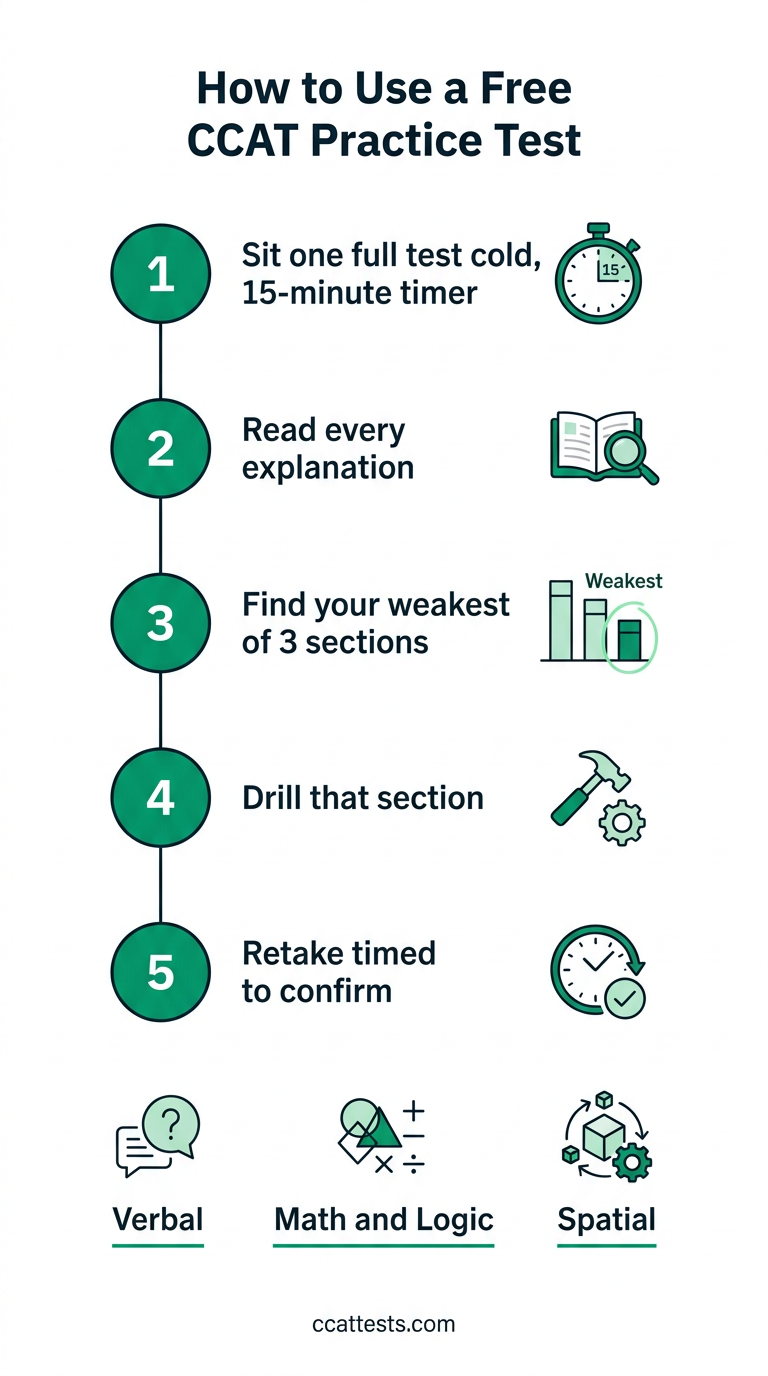
- Sit one full test cold, timed, no interruptions. Set a real 15-minute timer, close other tabs, and do not look up answers mid-test. The point of the first run is diagnosis, not a good score. Treat it like the real thing.
- Score it, then read every explanation, including the ones you got right. You want to know both which questions you missed and which ones you got right slowly. A question you answered correctly in 45 seconds is still a problem at CCAT pace.
- Find your weakest section. Nearly everyone has one section that drags: for many people it is the spatial/abstract questions, for others it is the word problems. Your weak section is where the fastest points are hiding.
- Drill that one section. Spend the bulk of your remaining prep time on your weak area, not on retaking full tests. If spatial is your gap, do spatial sets until the pattern types feel familiar.
- Take a second full timed test near the end to confirm the drilling worked and to re-acclimate to the mixed-section pace.
The most common mistake is step 4 in reverse: people take full practice test after full practice test, which mostly measures the same weakness again without fixing it. If you want a fuller answer on the right number, we wrote a whole piece on how many CCAT practice tests you should actually take.
Which “free” CCAT tests online are actually full-length
Search “free CCAT practice test” and you get a mix of genuinely useful full-length tests and shortened samplers dressed up as complete practice. Neither is dishonest, exactly, but you should know what you are getting before you rely on it. Here is the honest landscape based on what the top free options publicly offer.
| What you often find | Typical format | Good for |
|---|---|---|
| Full-length simulated exam | 50 questions, 15-minute timer, all sections | Your realistic diagnostic run |
| Shortened sampler | 16 to 30 questions, shorter or different timer | A quick taste of question types, not real-pace practice |
| Single-section drill | One section only (e.g. math or spatial) | Targeted practice after you know your weak area |
| Video walkthrough | A few worked questions on screen | Understanding a method, not timed practice |
| Free preview of a paid course | A handful of questions, then a paywall | Deciding whether to buy that course |
The takeaway is not that shorter tests are useless. A single-section drill is exactly what you want in step 4 above. The trap is treating a 16-question, 8-minute sampler as if it prepared you for 50 questions in 15 minutes. It did not simulate the pace, and pace is the hard part.
This is also where a lot of frustration comes from with the bigger prep brands. A well-known option like JobTestPrep offers some free preview questions but gates the full course behind a paywall that can run several times the price of a one-time practice product, and some readers have flagged answer-accuracy issues in third-party question banks. Free previews are fine for window-shopping. Just do not mistake them for a full-length diagnostic.
What your practice score actually means
A number out of 50 only helps if you know how to read it. The average CCAT score is around 24 out of 50, according to Criteria Corp, and there is no single universal pass mark: each employer sets its own threshold for each role. Technical and highly competitive positions tend to expect scores in the mid-30s or higher, while many roles are competitive around or a bit above average.
Two honest points that calm a lot of nerves:
- Not finishing is normal. Very few candidates answer all 50 questions in the 15 minutes. If you reached question 38, that is not a failure, and we explain why in is it normal to not finish the CCAT. Your score is based on correct answers, so accuracy and smart question-picking beat racing to the end and guessing.
- A practice score is a starting line, not a verdict. People routinely gain several points between a cold first practice test and test day, purely from getting used to the format and fixing one weak section. That gain is the entire reason to practice.
Where the real gains come from: analytics, not more tests
Once you have your first free practice score, the fastest way to raise it is to stop guessing about your weak spot and start measuring it. A raw score says “you got 26.” What actually changes your outcome is knowing that, say, you lost six of those points on spatial-reasoning questions and three more on word problems where you were correct but slow.
That is the idea behind the heat-map analytics built into our paid tiers: instead of one number, you see exactly which question types are costing you points and where your pace breaks down under the clock. It is the kind of per-question-type breakdown that dedicated analytics tools charge hundreds of dollars a month for, packaged into a one-time purchase built for a single test-taker. You do not need it to start, though. Start with a free timed run and honest self-review, and add the analytics only if you want the shortcut to your weak areas.
FAQ
Is there a genuinely free CCAT practice test?
Yes. A genuinely free CCAT practice test matches the real format: 50 questions, a 15-minute timer, and all three sections (verbal, math and logic, spatial reasoning). Our free tier is a real, usable practice experience rather than a three-question teaser, and several other sites offer full-length or single-section free tests too. The key is checking that the format matches the real CCAT before you rely on the result.
How many questions is the real CCAT?
The CCAT has 50 questions and a 15-minute time limit, per Criteria Corp. There are three question types: verbal, math and logic, and spatial reasoning. No calculator is allowed. Any practice test claiming a different count or time limit is either a shortened sampler or, occasionally, a different test entirely (the children’s Canadian Cognitive Abilities Test shares the acronym).
What is a good score on a CCAT practice test?
The average CCAT score is around 24 out of 50. There is no universal pass mark because each employer sets its own cutoff per role. As a rough guide, mid-30s and above is strong, and many technical or competitive roles expect scores in that range. Treat your first practice score as a diagnostic starting point, not a final verdict.
Should I take the practice test timed?
Yes, especially the first full run. The 15-minute clock for 50 questions is the hardest part of the CCAT, so an untimed practice test hides your biggest challenge. Sit at least your first and your final practice tests under a real timer, and use untimed mode only for slow, careful review of explanations in between.
Is it bad if I do not finish the practice test?
No. Very few people finish all 50 questions of the real CCAT in 15 minutes, so not finishing a timed practice test is normal and expected. Your score depends on correct answers, so it is usually better to answer carefully and skip the questions that would eat too much time than to rush and guess on everything.
How many free practice tests should I take?
Fewer full tests than most people think. A good pattern is one full timed test to diagnose your weak section, focused drilling on that section, and one more full test near the end to confirm the gain. Retaking full tests repeatedly mostly re-measures the same weakness. See our full breakdown on how many CCAT practice tests to take.
Is the CCAT like an IQ test?
Not exactly. The CCAT (the Criteria Cognitive Aptitude Test) measures general cognitive ability, so it overlaps with what IQ tests assess, but it is a pre-employment aptitude test built to predict job performance, not a clinical IQ measure. It is scored out of 50 with a percentile, and each employer decides what score they want, rather than producing a standardized IQ number. It is also not the children’s Canadian Cognitive Abilities Test, which is a different test that shares the acronym.
Can you fail the CCAT?
There is no built-in pass or fail on the CCAT itself; it returns a raw score and a percentile, and the employer decides whether your number clears their bar for the role. So you can score below what a specific company wants, which functions like failing for that application, even though there is no universal cutoff. Because the average is around 24 out of 50 and finishing all 50 is rare, a below-target score is common and usually just means practicing your weak section and, where the employer allows it, retaking.
Are free CCAT PDFs with answers reliable?
They can be a useful supplement, but check the source and the format. A downloadable PDF cannot enforce the 15-minute timer, so it is better for untimed review than for real-pace practice. Also watch for accuracy: some third-party question sets contain errors in their answer keys, so prefer sources that explain each answer rather than just listing a letter.
Related on CCAT Tests
- Samples. CCAT sample questions with explanations. Worked examples in each section before you sit a full test.
- Strategy. How many CCAT practice tests should you take. The right amount, and why more is not better.
- Reassurance. Is it normal to not finish the CCAT. What recruiters actually expect from your completion rate.
- Pillar. The CCAT test preparation guide. The full hub for preparing.
- Practice. Free CCAT practice tests. Start a real timed run now.
Try CCAT Tests
Find your weak spot free, then fix it if it is worth it to you
The best first move costs nothing: take a genuinely usable free practice test, timed, across all three sections, and see where you actually stand. Our free tier is built for exactly that, a real diagnostic rather than a teaser behind a paywall, so you can decide with real information whether structured prep is worth paying for. If it is, paid plans start at $9 one-time and add heat-map analytics that pinpoint the exact question types costing you points, with an “until you pass” guarantee on the Elite tier. And if this CCAT is one of several assessments a company has lined up for you, our sister platform PrepClubs runs realistic practice across 21 pre-employment tests with a pass guarantee, so you can build reps for whatever else stands between you and the offer.