Most people who “fail” the CCAT did not lack the ability to pass. They lost points to a handful of avoidable mistakes about how you practice and how you spend 15 minutes, not how smart you are. This article names the 7 CCAT prep mistakes that cost the most and gives you the fix for each. The short version: stop trying to finish, always guess when time runs out, and practice under the clock against your weakest question type. One naming note: this is the Criteria Cognitive Aptitude Test used in workplace hiring, not the Canadian Cognitive Abilities Test given in schools.
Quick takeaways
- The CCAT is 50 questions in 15 minutes, roughly 18 seconds each. Fewer than 1% finish all 50 and the average is about 24 correct, so trying to answer everything is a trap, not a target.
- Criteria Corp says the single most common mistake is rushing through the instructions, which costs points before question one.
- There is no penalty for wrong answers, so a blank throws away free expected points. Guess on anything you cannot solve in time.
- Untimed practice teaches the wrong skill. The CCAT is a speed test, so every rep should run against a clock.
- The biggest cluster of these mistakes comes from studying blind. You cannot fix a weak question type you have never measured, which is where weak-area analytics turn “study more” into a targeted plan.
Mistake 1: Trying to answer all 50 questions
Most candidates walk in believing the goal is to finish. It is not. Fewer than 1% of test-takers answer all 50 questions, and the average score is around 24 correct. When you chase all 50, you speed up on every question, make careless errors on ones you could have gotten right, and end up with fewer correct answers than someone who worked calmly through 35.
Why it happens: every other timed test you have taken rewarded completion, so “finish the paper” feels like the safe instinct.
The fix: aim for accuracy on a realistic number, not coverage of all 50. Pick a pace that lets you actually read and solve, and treat the last few questions as bonus territory rather than a requirement.
Mistake 2: Rushing through the instructions
Criteria Corp names this as the most common CCAT mistake outright. Under a 15-minute clock, skimming the setup feels efficient, so people blow past the instructions and the format of each section, then misread what a question is asking and burn seconds recovering.
Why it happens: the timer creates panic before the test even starts, and reading instructions feels like wasted time when the clock is the enemy.
The fix: read the instructions once, deliberately, before the clock matters. Know the three question types going in so nothing is a surprise: verbal, math and logic, and spatial reasoning. Familiarity bought during prep is time you do not spend decoding the format live.
Mistake 3: Leaving questions blank
The CCAT has no penalty for wrong answers. That one rule changes the entire strategy, and most people never adjust for it. A blank is worth exactly zero. A guess is worth zero if wrong and a full point if right, so a blank is strictly worse than a guess, every time.
Why it happens: honest test-takers feel that guessing is somehow cheating, or they run out of time and simply stop.
The fix: never leave anything blank. In the final seconds, fill every remaining answer, even with the same letter. On any single question you cannot crack, eliminate one or two options and guess.
Mistake 4: Practicing untimed
The CCAT is a speed test wearing an aptitude test’s clothes. Roughly 18 seconds per question is the whole difficulty. If you practice untimed, you get good at solving CCAT questions with unlimited time, a skill the real test never lets you use. You feel ready and then get crushed by the pace.
Why it happens: untimed practice feels more productive because your accuracy looks higher and studying is less stressful.
The fix: put a clock on every session from day one. Practice full 15-minute sets so your brain learns the “solve or move on” reflex, which builds the instinct for which questions to skip fast. Our CCAT time management guide covers how to pace the 15 minutes.
Mistake 5: Studying what you are already good at
This is the quietest score-killer of them all. Practicing your strong areas feels great because you get answers right and your confidence climbs. But your score is dragged down by the type you are worst at, and every minute spent polishing a strength is a minute not spent fixing the weakness that is actually costing you.
Why it happens: it is human to repeat what feels rewarding and avoid what feels hard, and without data you honestly cannot tell which type is your weak one.
The fix: measure first, then aim your practice at the bottom of the list. This is the analytics point, and it deserves its own section below.
Find your weak type before you study anything else
You cannot fix what you cannot see. When your only feedback is a single overall score, “study more” is the best plan you can make, and it is a bad one. It sends you back to the same mixed practice with no idea where your points are actually leaking.
A weak-area heat map changes that. When your results are broken down by question type, verbal versus math and logic versus spatial reasoning, the pattern is obvious at a glance. Maybe your verbal is fine and spatial reasoning is quietly eating a third of your misses. That single insight converts a vague plan into a targeted one: drill spatial reasoning, retest, watch the weak column shrink.
On CCAT Tests, the free tier is genuinely usable for finding that weak spot, and the paid tiers add a heat map showing precisely which types cost you points. Instead of guessing what to fix, you get told, which is why the analytics angle matters more than raw hours studied.
Mistake 6: Drilling one question type in isolation
The real CCAT jumps between verbal, math and logic, and spatial reasoning from one question to the next. If you only ever practice math in a solid block, you never train the mental gear-shift the live test demands, and the switching itself costs you time and accuracy on test day.
Why it happens: blocked practice feels smoother and shows faster in-session gains, so it is tempting to keep going.
The fix: use your heat map to decide how much to weight each type, then practice in mixed sets that mirror the real format. Do targeted drills to shore up a weak type, but always return to realistic interleaved sets before test day.
Mistake 7: Cramming the night before
Sleep loss slows your processing speed, which is the exact thing a 15-minute test measures. Cram the night before and you show up tired, slower, and more error-prone, and no amount of last-minute review offsets a foggy brain on a speed test.
Why it happens: life gets busy, prep gets deferred, and panic makes a big final session feel responsible.
The fix: space your practice across days or weeks instead of one heroic night. Short, timed, mixed sessions spread out beat one long cram, both for retention and for showing up rested. A two-week runway with a few sessions a week is plenty. See our 2-week CCAT study plan for a schedule that spaces the work.
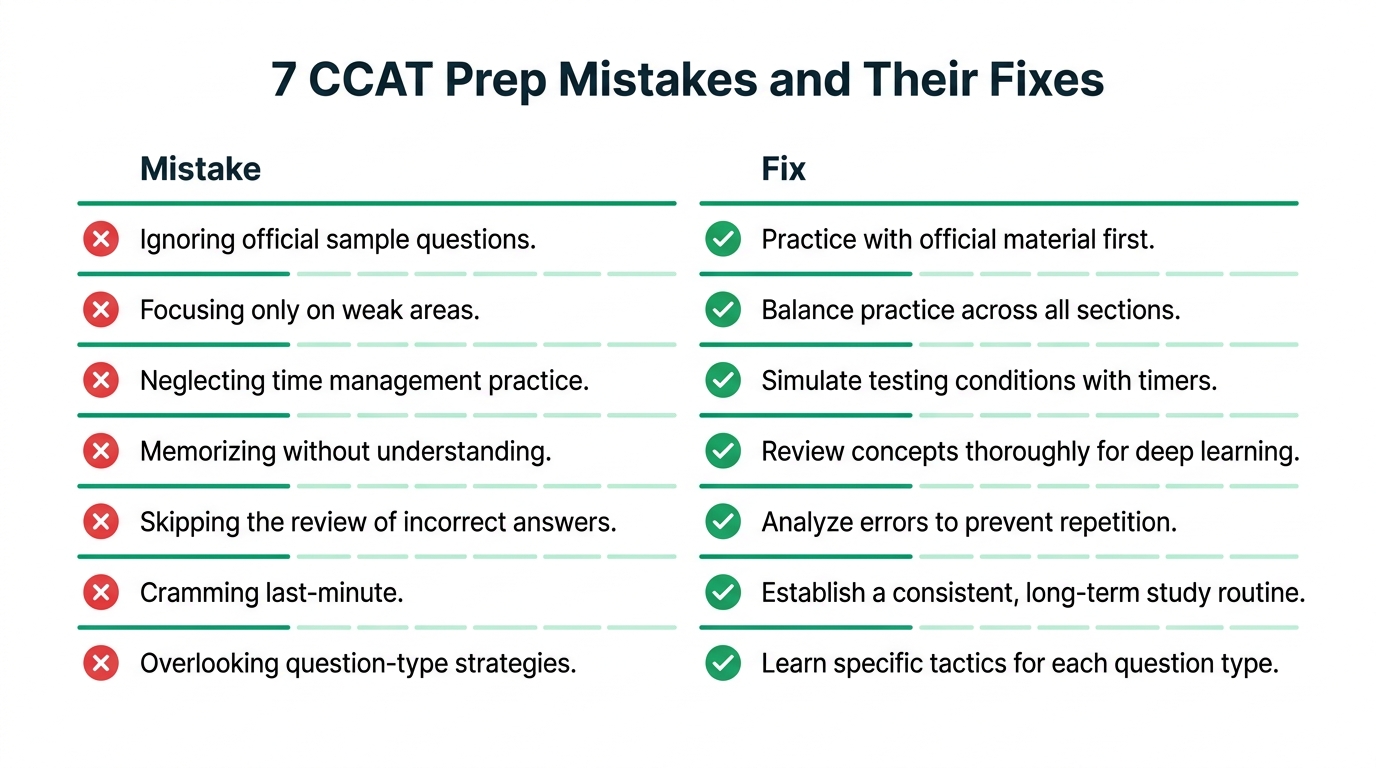
The 7 mistakes at a glance
| Mistake | Why it costs points | The fix |
|---|---|---|
| Trying to answer all 50 | Speeding up causes careless errors; under 1% finish anyway | Aim for accuracy on a realistic count, not coverage |
| Rushing the instructions | Misreads and format confusion (Criteria’s top mistake) | Read once, deliberately; know the three types going in |
| Leaving questions blank | A blank scores zero; there is no wrong-answer penalty | Always guess; fill every answer before time ends |
| Practicing untimed | Trains a skill the real speed test never allows | Put a clock on every session, run full 15-minute sets |
| Studying your strong areas | Your weakest type drags the score; strengths are maxed | Measure with a heat map, then drill the weakest type |
| Drilling one type in blocks | Never trains the live gear-shift between types | Practice mixed, interleaved sets that mirror the format |
| Cramming the night before | Sleep loss slows processing speed, the exact metric tested | Space practice across days; show up rested |
FAQ
What is the most common CCAT mistake?
Rushing through the instructions. Criteria Corp, the company behind the test, names it as the single most common mistake. Under the 15-minute clock, people skim the setup, misread questions, and lose points and time recovering. Reading the instructions carefully before the timer pressure builds is the cheapest fix on this list.
Should you answer all 50 CCAT questions?
No, and you almost certainly will not. Fewer than 1% of test-takers finish all 50, and the average is about 24 correct. Chasing all 50 forces you to rush, which lowers accuracy. Aim for a realistic number of correct answers instead of trying to reach the end.
Should you guess on the CCAT?
Yes, always. There is no penalty for a wrong answer, so a guess can only help you. A blank is worth zero points; a guess is worth zero if wrong and a full point if right. Fill in every remaining answer before the clock runs out, even if you have to pick a letter blindly.
How do I stop running out of time on the CCAT?
Practice under a clock and learn to skip fast. The pace is about 18 seconds per question, so the skill is deciding quickly which questions to solve and which to abandon. Timed, full-length practice builds that instinct. If a question is not clicking in the first few seconds, guess and move on rather than sinking a minute into it.
How many questions do you need to get right to pass the CCAT?
There is no universal passing score. Employers set their own cutoff, often benchmarked to the role, so the “pass” mark for a software engineering role differs from a sales one. What you can control is maximizing correct answers, which is why accuracy under time beats trying to finish.
Can I use a calculator on the CCAT?
No. Calculators are not allowed, so the math and logic questions are built to be done by hand under time pressure. Practicing your mental math, especially quick estimation and percentages, is part of prep, not an optional extra.
Related on CCAT Tests
- How to pass the CCAT: a 7-step success plan
- CCAT time management: your 15-minute strategy
- How to stop overthinking CCAT questions
- The complete CCAT test preparation guide
Try CCAT Tests
Stop guessing what to fix and start seeing it.
Every mistake on this list points back to the same root cause: studying blind. CCAT Tests removes the guesswork. The free tier is genuinely usable to find your weak spot, no card required, so you can start diagnosing today. The paid tiers (all one-time, see pricing) add timed, realistic simulations that include spatial reasoning, plus a heat map showing exactly which question types are costing you points, so your practice goes straight at the weakness instead of your comfort zone.
If the CCAT is one of several assessments in your hiring pipeline, PrepClubs is the broader paid platform worth a look next: it covers 21 pre-employment tests, has helped over 3,700 students, and backs the work with a money-back guarantee.
Worth naming honestly: some prep sites, like JobTestPrep, charge roughly three times what CCAT Tests does for the same category of practice. Find your weak type for free here first, then decide if a paid tier is worth it.