You applied for an engineering role, cleared a screen or two, and the next step is a 15-minute cognitive test with almost no coding in sight. If you are a software engineer facing the CCAT, the frustrating part is that most prep advice treats you like a generic candidate, telling you to “study all three question types equally.” That is not how the test predicts engineering performance, and it is not the smartest way to spend limited prep time. This guide breaks the CCAT down the way an engineer should think about it: which question types map most directly to the way you already reason about code, why employers weight them, and exactly how to drill each one.
One disambiguation first. This is the Criteria Cognitive Aptitude Test from Criteria Corp, the workplace hiring test, not the Canadian Cognitive Abilities Test for schoolchildren that shares the acronym. You are taking the workplace one, and it is a common screen for engineering roles precisely because it predicts problem-solving speed.
Quick takeaways
- The CCAT is 50 questions in 15 minutes across three domains: math and logic, verbal, and spatial and abstract reasoning.
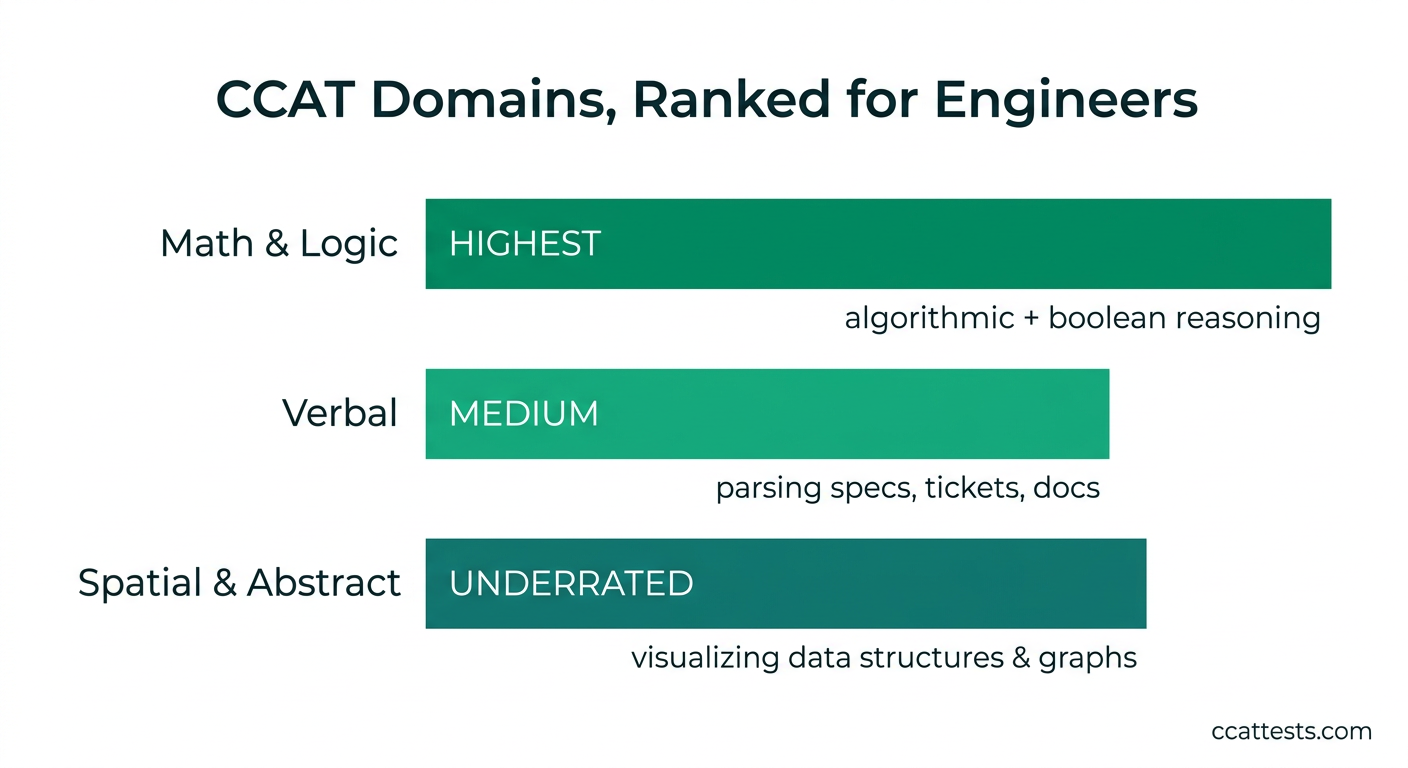
- For engineers, math and logic is the highest-signal domain: number series and logic mirror algorithmic and boolean reasoning.
- Verbal is medium-signal: reading comprehension maps to parsing specs, tickets, and docs.
- Spatial and abstract is underrated: it maps to visualizing data structures, graphs, and system models.
- Employers use the CCAT on engineers because it predicts learning speed and problem-solving under constraint, which is most of the job.
- No calculators, no wrong-answer penalty, and technical roles typically expect above-average scores.
Why engineers get the CCAT in the first place
Employers do not give software engineers a cognitive test because they think you cannot code. They give it because coding ability alone does not tell them how fast you learn an unfamiliar codebase, reason through an ambiguous problem, or hold several constraints in your head at once. The CCAT is a general problem-solving test, and Criteria Corp positions it as a predictor of on-the-job learning and performance across roles.
For engineering specifically, that predictive angle is why companies known for CCAT-heavy hiring, Crossover among the most visible, lean on it hard for developer roles. The reasoning is that a 15-minute test of fluid problem-solving correlates with how quickly a new engineer ramps and how well they handle novel problems, which is a large fraction of the actual job. Two mechanics matter here and both favor a fast, decisive test-taker: no calculators are allowed, so all arithmetic is mental, and there is no penalty for wrong answers, so you should never leave a blank. Understanding that framing changes how you prep: you are not proving you know trivia, you are demonstrating the same reasoning you already use every day, just under a tight clock.
The three CCAT domains, ranked for engineers
Here is the breakdown the generic guides skip: which of the three CCAT question types carries the most signal for an engineering role, and why each one connects to real development work.
| CCAT domain | Signal for engineers | Engineering skill it predicts | How to drill it |
|---|---|---|---|
| Math and logic | Highest | Algorithmic thinking, boolean and conditional reasoning, translating requirements into logic | Number series, logic puzzles, word problems to equations, mental estimation |
| Verbal | Medium | Parsing specs, tickets, and documentation; abstraction via analogies | Analogies, antonyms, sentence completion, fast relationship-spotting |
| Spatial and abstract | Underrated | Visualizing data structures, graphs, and system models; rotating abstract representations | Matrices, rotations, odd-one-out, pattern completion |
The takeaway is not that any domain is optional, since every question is worth the same single point. It is that if you have limited time, math and logic gives you the most transferable practice, verbal is where strong engineers lose easy points by rushing, and spatial is the one people neglect precisely because it feels least like coding, even though it maps cleanly to how you visualize systems.
Math and logic: your home turf, played fast
For most engineers, this is the highest-comfort domain, and it is also the highest-signal one. The connection to your day job is direct.
- Number series are pattern recognition under constraint. Spotting that 3, 6, 12, 24 doubles, or that 2, 3, 5, 8, 12 grows by an increasing gap, is the same mental move as recognizing a recurrence relation or the shape of an algorithm’s growth. This is arguably the single most engineer-relevant question type on the test.
- Logic and conditional questions are boolean reasoning. “If all A are B, and some B are C” is the same structure as reasoning about nested conditionals and truth tables. You already do this in code review without naming it.
- Word problems are requirements translation. Turning a paragraph into “so the equation is X” is exactly what you do when a product spec becomes a function signature.
The catch is speed. You know how to solve these, but at 18 seconds per question and no calculator, the bottleneck is mental arithmetic and setup, not concept. Drill the shortcuts: percentage-to-fraction conversions, ballpark estimation to eliminate wrong options, and translating a word problem into one clean equation on the first read. Your reasoning is fine. Your job here is to make it fast enough to survive the clock.
Verbal: where engineers quietly lose points
Verbal reasoning feels the least like engineering, which is exactly why capable developers leave points on the table here. But the mapping is real. Reading comprehension is parsing a dense spec or a poorly written ticket and extracting the actual requirement. Analogies are abstraction: seeing that “cache is to memory as index is to database” is the same relational thinking that lets you recognize a familiar pattern in an unfamiliar system.
The mistake engineers make is speed-reading verbal questions the way they skim code they wrote. CCAT verbal questions are built with a trap near-synonym and an obvious distractor, and rushing past the exact wording is how you fall for the trap. The fix is counterintuitive for a fast reader: slow down just enough to identify the relationship type (opposite, category, degree, function) before you look at the options, then eliminate the clear distractor first. A few extra seconds of reading here buys more points than the same seconds spent grinding a hard math question.
Spatial and abstract: the underrated engineering domain
Spatial reasoning looks like the odd one out on a test for coders, and that reputation is why it is undertrained and where a smart candidate can gain an edge. The truth is that abstract-visual reasoning maps directly to a lot of engineering cognition.
Think about what you actually do: you visualize a graph or tree, you rotate a mental model of how services connect, you hold the shape of a data structure in your head and mentally transform it. CCAT spatial questions, rotations, matrices, odd-one-out, and pattern completion, exercise the same mental machinery. An engineer who can mentally trace a linked list or picture a state machine already has the underlying skill. What they lack is exposure to the specific figure styles the CCAT uses, which is a familiarity problem, not an ability one.
Because this domain benefits most from raw exposure to real CCAT-style figures, it is where realistic practice pays off most. Our deep dive on CCAT spatial patterns and visual problem-solving walks through the specific figure types and the fastest way to read them, which is the most efficient way to close the gap here.
A worked example, engineer-style
Take a logic item you might see:
All deployments that fail the smoke test are rolled back. Some rolled-back deployments are hotfixes. Which must be true?
An engineer already has the tool for this: treat it as set membership. Failed-smoke-test deployments are a subset of rolled-back ones. Some rolled-back ones are hotfixes, but that “some” does not flow backward to the failed-smoke-test subset. So “some hotfixes failed the smoke test” is not guaranteed, and any option asserting it can be eliminated immediately. You did not need the CCAT’s phrasing, you needed the same boolean discipline you use to reason about guard clauses. That is the whole point: the test is measuring reasoning you already own, and prepping is mostly about recognizing it fast under a clock you are not used to.
How to prep as an engineer, efficiently
Spend your time in proportion to your gaps, not evenly across domains. A practical order for most engineers:
- Start with a timed diagnostic to see where you actually leak points. Many engineers are surprised to find verbal or spatial, not math, is their weak spot.
- Fix pacing on math and logic first, since it is your strongest domain and pure speed gains are easiest there.
- Drill spatial exposure, because unfamiliarity, not inability, is usually what hurts here.
- Slow your verbal reading down deliberately, to stop losing easy points to traps.
- Practice under the real clock, since the CCAT’s difficulty is as much about 18-second pacing as about the questions themselves.
For the score side of this, how high engineering roles actually aim and what a competitive number looks like, see our guide on CCAT scores for software engineers.
Why realistic, engineer-relevant practice matters
The failure mode for engineers prepping for the CCAT is practicing on generic aptitude questions that do not match the real test’s style, then getting blindsided by the specific spatial figures or the exact number-series patterns the CCAT favors. Recognition is most of the game at this speed, and you only build recognition on material that mirrors the real thing.
That is what we built the CCAT Tests practice bank to do: genuinely CCAT-style questions across all three domains, including the spatial and abstract items engineers neglect, with a free tier that is a real practice experience rather than a three-question teaser. The analytics are what make it efficient for a time-poor engineer, the heat-map shows you whether your points are actually leaking on verbal traps, spatial unfamiliarity, or math pacing, so you drill the domain that will move your score instead of re-practicing your strongest one. If you are interviewing across multiple companies and facing more than one kind of pre-employment test, the broader PrepClubs platform runs the same free-first, then analytics-driven model across a range of tests, with a money-back guarantee. Find your weak spot for free, then decide what is worth paying to improve.
FAQ
Do you need to be good at math to pass the CCAT as a software engineer?
You need to be fast at basic math, not advanced at it. The CCAT’s math is percentages, ratios, averages, and word problems, no calculus, done without a calculator in about 18 seconds each. For most engineers the concepts are easy and the challenge is speed and mental arithmetic, so drilling estimation and quick setup matters more than deep math knowledge.
Which CCAT question type is most important for engineers?
Math and logic carries the most signal, because number series map to algorithmic pattern-spotting and logic questions map to the boolean reasoning you already use in code. That said, every question is worth the same point, so the “most important” domain in practice is whichever one your diagnostic shows is your weakest, since closing that gap moves your score the most.
Does spatial reasoning matter for coding jobs?
More than most people expect. Spatial and abstract questions exercise the same mental machinery you use to visualize data structures, graphs, and system models. Engineers often underperform here not because they lack the ability but because they have not seen the CCAT’s specific figure styles, so exposure to realistic spatial practice usually closes the gap quickly.
What CCAT score do software engineering roles want?
Technical roles typically look for above-average scores, and the exact target varies by company and seniority since scores are reported as percentiles. Rather than chase a single magic number, aim to answer as many questions accurately as you can under time. Our dedicated guide on CCAT scores for software engineers covers the realistic target ranges in detail.
Why do tech companies use a cognitive test instead of just a coding challenge?
Because a coding challenge shows what you can already do, while the CCAT predicts how fast you learn and reason through unfamiliar problems, which is a large part of real engineering work. Companies pair the two: the coding assessment checks current skill, and the CCAT estimates ramp speed and general problem-solving under constraint.
Is the CCAT harder for engineers than for other candidates?
Not harder, but different from what engineers expect. Strong developers often assume the math will be the challenge and get tripped up by verbal traps or unfamiliar spatial figures instead. The test also punishes the habit of over-checking, since 18 seconds per question rewards fast, confident reasoning over perfectionism. Knowing this in advance is half the battle.
How long should an engineer study for the CCAT?
For most engineers, a focused week is enough, because you are training recognition and pacing, not learning new concepts. A timed diagnostic plus targeted drills on your weakest domain and consistent timed practice will get a capable engineer comfortable with the format. Beyond a couple of weeks, returns drop off fast.
Related on CCAT Tests
- Scores. CCAT scores for software engineers. The target ranges and what a competitive number looks like for dev roles.
- Spatial. CCAT spatial patterns and visual problem-solving. The figure types engineers neglect, and how to read them fast.
- Pillar. CCAT practice questions. Question types across all three domains in depth.
- Practice. Free CCAT practice tests. Rehearse under the real clock across every domain.
Try CCAT Tests
Prep the way you already think, on questions that match the real test.
The CCAT measures reasoning you already use as an engineer, but only realistic practice builds the recognition speed the clock demands. CCAT Tests gives you a genuinely usable free tier across all three domains, and the heat-map analytics tell you whether your points are leaking on verbal traps, spatial unfamiliarity, or math pacing, so you drill the right thing. Start free, find your gap, and improve where it counts.