You just found out the CCAT includes spatial reasoning questions, and now you are staring at a folder of practice sets that show you a few sample shapes with no explanation of how to actually solve them. That is the frustrating part. Spatial questions are the ones most people have never trained for, and on a test that gives you roughly 18 seconds per question, guessing is not a strategy. This page walks you through 10 CCAT spatial reasoning practice questions across every type you will see, with the full logic for each one, so you learn the method instead of just checking an answer key.
Quick note before we start: this is about the Criteria Cognitive Aptitude Test, the workplace hiring test built by Criteria Corp. It is not the Canadian Cognitive Abilities Test, the school gifted-and-talented exam for children that shares the same acronym. Different test, different questions. You want this one.
Quick takeaways
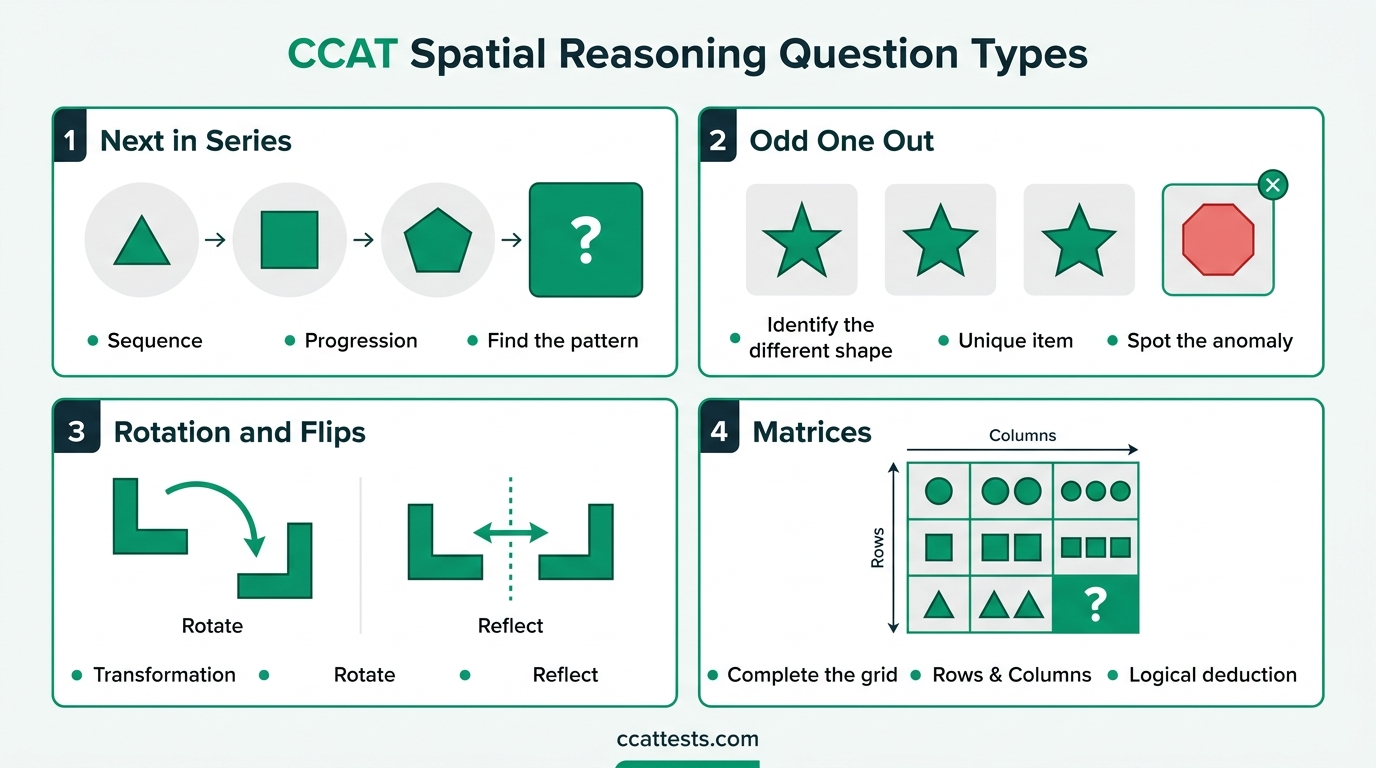
- Spatial reasoning on the CCAT covers four recurring patterns: next in series, odd one out, rotation and flips, and matrices.
- Criteria Corp describes these questions as asking you to “rotate or flip images in your head, recognize patterns, and identify outliers.”
- There is no penalty for a wrong answer, so never leave a spatial question blank if you are running out of time. Guess and move on.
- The fastest solvers find the single changing feature (rotation, count, shading, position) and ignore everything that stays the same.
- These questions reward pattern practice more than raw talent, which is exactly why they are trainable in a week or two.
- Work at the real 15-minute pace from day one, or your practice score will not predict your test score.
What CCAT spatial reasoning actually tests
Spatial reasoning measures how well you manipulate shapes and patterns in your head, quickly, without writing anything down. Criteria Corp, the test’s publisher, describes it as your ability to rotate or flip images mentally, recognize patterns, and identify outliers. In practice, that shows up as abstract shapes: arrows, grids, dots, and geometric figures that change according to a hidden rule you have to spot.
The reason this section trips people up is not difficulty, it is unfamiliarity. Most adults have not solved a shape-pattern puzzle since childhood, so the format feels alien under time pressure. The good news is that spatial questions follow a small number of repeating patterns. Once you know the four main types and the one habit that solves all of them, the section becomes the most trainable part of the whole test.
You will sometimes read that the CCAT has a fixed number of spatial questions, often quoted as around 11 out of 50. Treat that as a widely-cited estimate, not an official figure. Criteria Corp does not publish a guaranteed per-type breakdown, and the exact mix varies. What matters is that spatial reasoning is a meaningful chunk of the test, enough that being unprepared for it can cost you a passing score on its own.
The one habit that solves every spatial question
Before the questions, learn the single move that separates fast solvers from slow ones: find what changes and ignore what stays the same.
Every spatial puzzle has elements that are constant (a shape that never moves, a count that never changes) and one or two elements that shift according to a rule. Slow solvers try to process the whole figure at once and get overwhelmed. Fast solvers scan for the one moving part first: is a shape rotating? is a dot moving around the edge? is the number of sides increasing? is the shading flipping? Lock onto that single variable, and the answer usually reveals itself in a few seconds.
Keep that in mind as you work the examples below. For each one, ask “what is the one thing that changes here?” before you look at the options.
5 practice questions: patterns and series
Question 1: Next in series (rotation)
You see a single arrow that points up, then right, then down, then left, across four boxes. What comes next in the fifth box?
Answer: Up. The arrow rotates 90 degrees clockwise each step. Up, right, down, left, and then back to up. The one changing feature is direction, rotating a quarter turn clockwise. Nothing else about the arrow changes, so you ignore its size and color entirely.
Question 2: Next in series (growing count)
A sequence shows one dot, then two dots, then three dots inside identical squares. The fourth square is blank. What belongs in it?
Answer: Four dots. The rule is a simple increasing count: plus one dot each step. The square is constant, the dot count is the variable. This is the easiest spatial pattern and the one to bank quickly so you save time for harder items.
Question 3: Next in series (two variables)
A shape sequence shows a circle that alternates black, white, black, white, while also gaining one small tick mark on its edge each step: black circle with one tick, white circle with two ticks, black circle with three ticks. What is next?
Answer: A white circle with four ticks. Here two things change at once: the shading alternates (black, white, black, white, so next is white) and the tick count climbs by one (one, two, three, so next is four). When two variables move, solve each independently, then combine. This is where slow solvers lose time by trying to track both at once.
Question 4: Odd one out
You see five figures. Four of them are squares divided into four equal quadrants. One is a square divided into three sections. Which one does not belong?
Answer: The three-section square. The shared rule across the group is “four equal parts.” The outlier breaks that single rule. For odd-one-out questions, identify the property that four of the five share, then find the one that violates it. Do not get distracted by size or orientation differences that are just noise.
Question 5: Odd one out (harder)
Five arrows all point in different directions. Four of them are solid black. One is outlined but not filled. Which does not belong?
Answer: The outlined arrow. The direction each arrow points is deliberate noise designed to make you overthink it. The actual shared property is “solid fill,” and only one arrow breaks it. The lesson: when a question feels like it has too many differences, the real rule is usually the simplest shared feature, and everything else is a distraction.
5 practice questions: rotation, flips, and matrices
Question 6: Mental rotation
An L-shaped figure is shown, then the same figure appears rotated. Which of the answer options shows that L rotated 90 degrees clockwise?
Answer: The option where the L’s corner has moved a quarter turn to the right, so the foot of the L that pointed right now points down. The trick is to pick one identifiable point on the shape (the corner, the longest arm) and track only that point through the rotation. Rotating the whole shape in your head is slow and error-prone; tracking one anchor point is fast.
Question 7: Mirror flip
A shape shows the letter-like figure “b.” Which option shows it flipped horizontally (mirrored left to right)?
Answer: The figure that looks like “d.” A horizontal flip swaps left and right, so a rightward-facing bump becomes leftward-facing. Watch the difference between a flip and a rotation: a flip produces a mirror image, a rotation turns the same image without mirroring it. The CCAT uses both, and the wrong-answer options usually include the rotation when a flip is asked, and vice versa.
Question 8: Rotation plus flip
A triangle with a dot in its top corner is rotated 180 degrees. Where is the dot now?
Answer: In the bottom corner. A 180-degree rotation sends every point to the exact opposite side. Top becomes bottom, left becomes right. For 180-degree turns, you do not even need to rotate mentally: just move each feature to its opposite position. That shortcut saves several seconds per question.
Question 9: Matrix (single rule)
A 3x3 grid is filled with shapes, but the bottom-right cell is blank. Reading across each row, the shapes gain one side each: triangle, square, pentagon. What fills the blank cell?
Answer: A hexagon. The rule runs along the rows (plus one side per step), and the bottom row has been triangle, square, and then the blank. Following the same plus-one-side rule, the missing shape has six sides: a hexagon. For matrices, always test the rows first, then the columns, then diagonals if neither works.
Question 10: Matrix (two rules)
A 3x3 grid changes two ways at once: across each row the shape gets larger, and down each column the shading darkens from white to gray to black. The bottom-right cell is missing. What goes there?
Answer: The largest shape, in black. The row rule (increasing size) puts the biggest shape in the rightmost column; the column rule (darkening) puts black in the bottom row. Combine the two rules at the intersection and you get “largest and black.” Matrices with two rules are the hardest spatial items on the CCAT, and the method is always the same: solve the row rule and the column rule separately, then combine them at the target cell.
On the CCAT, spatial reasoning is not about talent. It is about spotting the one variable that changes and ignoring everything that does not.
How to pace spatial questions on test day
Here is the honest constraint: the CCAT gives you 15 minutes for 50 questions, which is about 18 seconds each. Spatial questions can eat far more than that if you let them, especially the two-variable series and the double-rule matrices.
Use a hard rule for yourself. Give any spatial question a first pass of about 15 seconds. If the pattern has not clicked, make your best guess (there is no penalty for a wrong answer, so a blank is strictly worse than a guess) and move on. Very few people finish all 50 questions, so leaving a hard spatial item after one honest attempt is not failing, it is smart triage. The points you protect by not sinking two minutes into one rotation puzzle are worth more than the single point you might eventually earn on it.
The only way to make 18 seconds feel like enough is to practice at that speed. Solving spatial questions slowly, with unlimited time, teaches you the patterns but not the pace, and pace is half the battle on this test.
FAQ
How many spatial reasoning questions are on the CCAT?
There is no officially published fixed number. A figure of around 11 out of 50 is commonly cited, but Criteria Corp does not guarantee a per-type breakdown and the exact mix varies between test versions. Plan for spatial reasoning to be a meaningful portion of the test, enough that skipping preparation for it can cost you.
Are CCAT spatial reasoning questions the same as abstract reasoning?
They overlap heavily. On the CCAT, spatial and abstract reasoning both use non-verbal shape patterns: series, odd-one-out, rotations, and matrices. Some sources use the terms interchangeably. Whatever the label, the solving method is the same: find the one changing feature and follow its rule.
How do I get faster at mental rotation?
Track a single anchor point instead of rotating the whole shape. Pick one identifiable feature (a corner, the longest side, a marked dot) and follow only that point through the turn. For 180-degree rotations, skip the mental turn entirely and just move each feature to its opposite position.
Is there a penalty for guessing on spatial questions?
No. The CCAT does not deduct points for wrong answers, so a guess is always better than a blank. If a spatial question has not clicked after about 15 seconds, pick your best option and move on. The clock is the real enemy, not the wrong-answer count.
Can you get better at spatial reasoning, or is it fixed?
You can absolutely get better. Spatial questions follow a small set of repeating patterns, so a week or two of focused practice noticeably improves both accuracy and speed. This is one of the most trainable sections on the CCAT precisely because so few people arrive already practiced at shape puzzles.
Why do the spatial questions feel harder than the sample ones online?
Real test items often stack two variables (a shape that rotates while also changing shade, or a matrix with a row rule and a column rule) where free samples usually show only one. Practicing with realistic two-variable questions, at the real time limit, closes the gap between how prepared you feel and how prepared you actually are.
Related on CCAT Tests
- Guide. CCAT spatial patterns and visual problem solving. A deeper walkthrough of the three core spatial pattern types and how to read them fast.
- Companion. CCAT abstract reasoning. How to solve the non-verbal pattern questions that overlap with spatial items.
- Pillar. CCAT question types mastery. Every question type on the CCAT, broken down by section.
- Practice. Free CCAT practice tests. See rendered spatial questions at the real 15-minute pace.
Try CCAT Tests
Practice spatial questions that actually look like the real ones.
The reason most spatial practice fails is that free sample sets show flat, single-variable puzzles that do not match the two-variable rotations and matrices you meet on test day. Our practice bank is built to mirror the real CCAT, including the spatial and abstract-reasoning images that generic aptitude sites skip, so the score you see in practice tracks the score you will see for real. The free tier is a genuinely usable practice experience across all three domains, not a three-question teaser, so you can find your weakest question type before deciding whether to pay for anything. Paid plans are one-time, see pricing, and add a heat-map that shows exactly how many points you are losing to spatial questions specifically. And if the same hiring process lines up other assessments alongside the CCAT, our sister platform PrepClubs runs realistic practice for 21 pre-employment tests with a money-back guarantee, so you are ready for whatever else the funnel throws at you.