You applied for a job, and now a Criteria Cognitive Aptitude Test link is sitting in your inbox with a window that closes in a week or two. You also have a full-time job, so the honest question is not “how do I clear my calendar for months,” it is “how do I fit real prep around a 9-to-5.” The direct answer: you need a handful of focused hours spread over one or two weeks, not a months-long study grind. The CCAT is a 15-minute test, and employers usually send it on short notice, so it rewards a tight, targeted plan far more than a marathon. One quick disambiguation before you start: this is the Criteria Cognitive Aptitude Test used in workplace hiring, not the Canadian Cognitive Abilities Test given to schoolchildren that shares the same initials.
Quick takeaways
- The CCAT is 50 questions in 15 minutes, about 18 seconds each, so it does not need months of study the way the MCAT or GRE does.
- A working professional can prep well in a few hours total: short weeknight blocks plus one longer weekend timed test.
- Day one is a diagnostic. It tells you which of the three question types is your weak spot so you stop wasting evenings.
- The 1-week version is enough if your test is soon; the 2-week version adds a second timed simulation and more targeted drilling.
- Spend your limited hours on your weakest type, not an even split across all three.
- There is no penalty for wrong answers and no calculators, so pacing and guessing matter as much as knowledge.
Why the CCAT does not need a months-long plan
If you searched for a study schedule and landed on advice about 12-week or 6-month timelines, that advice is for a different kind of test. The MCAT, GRE, and LSAT are multi-hour exams that cover deep, teachable content, so they genuinely reward months of study. The CCAT is the opposite: it is a 15-minute aptitude test of 50 questions across verbal, math and logic, and spatial reasoning. It measures how quickly you reason with material you mostly already know, not how much new material you have memorized.
That changes everything about your schedule. According to Criteria Corp, the company that makes the test, less than 1 percent of candidates finish all 50 questions and the average score is about 24. You are not studying to master new subjects. You are training two things: familiarity with the question formats so nothing surprises you, and pacing so the clock does not eat your score. Both are built in hours, not months.
There is also a practical reason months are off the table. Employers usually schedule the CCAT on short notice, often a few days to two weeks after an application stage, so you rarely get a long runway even if you wanted one. The realistic plan is not “study more,” it is “study the right things in the time you have.”
How to fit CCAT prep around a full-time job
The trick is to stop thinking about big study sessions and start thinking about small, repeatable blocks. Twenty to thirty minutes on a weeknight is enough to drill one question type or run one short pacing set. You do not need a free evening; you need a consistent one.
A few ground rules that make limited time count:
- Keep weeknight blocks short and single-focus. One type per session beats a scattered hour.
- Do the one thing that needs a real block, a full 15-minute timed simulation, on a weekend when you are fresh.
- Add a timer before test day. The CCAT is a pacing test, so untimed practice alone will mislead you.
- Protect your sleep the night before. A tired brain loses more points on a speeded test than a slightly under-prepped one.
The schedule below turns those rules into specific evenings.
A CCAT study schedule around a full-time job
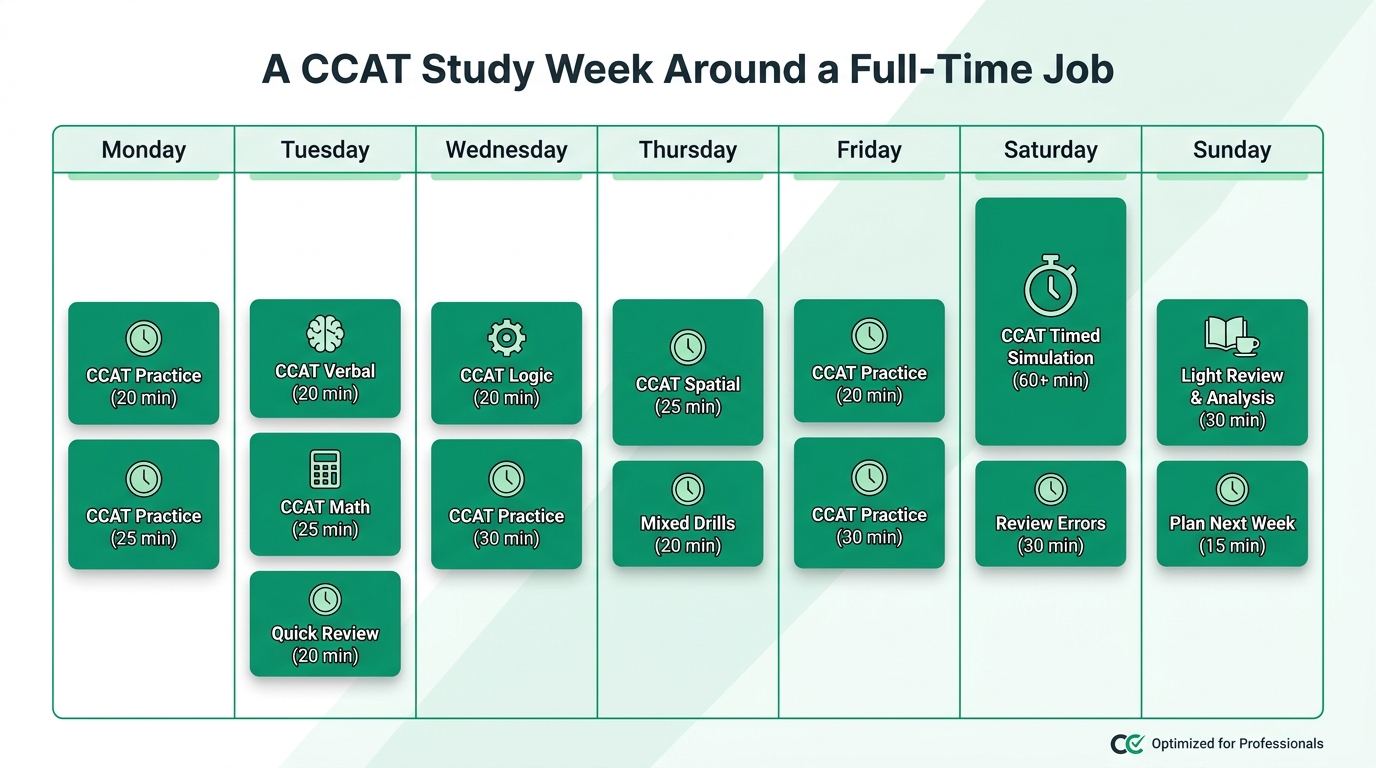
Here is a concrete micro-schedule you can drop onto a normal work week. Each weeknight block is short enough to do after dinner; the weekend holds your one longer timed session.
| Day | Time block | Focus |
|---|---|---|
| Monday | 20-30 min, evening | Timed diagnostic: one short set to find your weak type |
| Tuesday | 20-30 min, evening | Drill your weakest type (verbal, math and logic, or spatial) |
| Wednesday | 20-30 min, evening | Second-weakest type, plus a quick 5-minute pacing set |
| Thursday | 20-30 min, evening | Back to your weakest type, now lightly timed |
| Friday | Rest | No study; protect your energy |
| Saturday | 45-60 min, morning | Full 15-minute timed simulation, then review every miss |
| Sunday | 20-30 min | Redo only the question types you missed most on Saturday |
Notice the shape: five short weeknight touches, one longer weekend simulation, and a light review. Total time is roughly three to four hours across the week, realistic to carve out even in a busy stretch.
The 1-week plan and the 2-week plan
Pick the version that matches how much notice you got.
The 1-week plan is the table above, run once. It is enough when your test window is close. The non-negotiables inside it are the Monday diagnostic and the Saturday timed simulation. The diagnostic points your limited evenings at the right target, and the simulation is the single most useful thing you can do, because it rehearses the exact pressure of 50 questions in 15 minutes. If you only had time for two sessions all week, make them those two.
The 2-week plan stretches the same idea and adds depth. Use week one to diagnose and drill your weakest type heavily, then run a first timed simulation that weekend. Use week two to attack your second weakest type, tighten pacing, and run a second full simulation the weekend before test day. The gap between the two simulations is where most of the improvement shows up, because you can see whether your weak-type drilling actually moved the number. For the full day-by-day version, the ultimate CCAT study plan and 2-week strategy walks through it, and if your window is even shorter than a week, the last-minute CCAT preparation guide covers what to prioritize in a day or two.
Spend your limited hours on your weak type, not the whole test
This is the single principle that separates efficient CCAT prep from wasted evenings. With only a few hours available, an even split across all three question types is the wrong move. If your spatial reasoning is already solid but word problems slow you down, another spatial drill buys you almost nothing while your real weakness sits untouched.
So the first job of your Monday diagnostic is to answer one question: which type is dragging you down. Then every weeknight block after that is aimed there. This is where analytics earns its keep. When your practice tool shows a heat-map or a per-type breakdown instead of just a final score, you can see at a glance that, say, math and logic is your weakest area and put your Tuesday and Thursday blocks entirely into it. That targeting is what makes three hours behave like ten.
It also tells you when to stop. Once your weak type climbs to roughly match your others, you have gotten most of the available gain, and more study returns very little. For how many timed runs are actually useful before that point, see how many CCAT practice tests you should take. And because pacing is its own skill, the 15-minute CCAT time management strategy is worth one of your evenings on its own.
FAQ
How do I study for the CCAT while working a full-time job?
Use short, single-focus blocks on weeknights, 20 to 30 minutes each, plus one longer timed simulation on a weekend. Start with a diagnostic to find your weakest question type, then aim your evenings there. Total prep of three to four hours across a week is realistic and enough.
How long do I need to study for the CCAT?
Not long. Because the CCAT is a 15-minute test that measures reasoning speed rather than memorized content, a few focused hours over one to two weeks is plenty for most people. It is not the MCAT or GRE, so months of study are unnecessary and, given how quickly employers schedule it, usually impossible anyway.
Can I prepare for the CCAT in a week?
Yes. A one-week plan of short weeknight drills plus one full timed simulation on the weekend is enough to get comfortable with the format and the clock. The two things that must happen are an early diagnostic and at least one 50-question timed run before test day.
What is the best way to prepare for the CCAT while working?
Diagnose first, drill your weakest type second, and always finish with timed practice. The best return on limited time comes from a per-type breakdown that shows where you are losing points, so you spend your hours on the one area that moves your score.
Should I study every night before the CCAT?
No. Build in at least one rest evening, and keep the night before test day light. This is a speeded test, so a rested brain outperforms an over-drilled tired one. Consistency across short blocks beats cramming a few long nights.
Do I need to buy prep to study for the CCAT?
Not to start. A free practice test is enough to find your weak question type and get familiar with the format. Paid prep helps when you want repeated timed simulations under real conditions and analytics that pinpoint where your limited study time should go.
How many practice tests should I take before the CCAT?
For a working professional, one to three full timed simulations is usually the sweet spot: the first as a diagnostic, and one or two more to confirm your weak type has improved. Beyond that, added tests give diminishing returns. Quality of review matters more than volume.
Related on CCAT Tests
- The ultimate CCAT study plan: a 2-week strategy
- Last-minute CCAT preparation
- How many CCAT practice tests should I take?
- CCAT time management: the 15-minute strategy
Try CCAT Tests
Make your limited hours count
When you only have a few evenings, the whole game is spending them on the right thing. The free tier at CCAT Tests is genuinely usable on its own: take a practice test, see which of the three question types is dragging you down, and start drilling it tonight, no payment needed. When you want more, the paid tiers, all one-time, see pricing, add full timed simulations that rehearse the real 15-minute clock plus a heat-map that shows exactly where your points are leaking, so a busy professional can aim every session at the type that matters instead of guessing.
If the CCAT is just one hurdle in a hiring pipeline that also throws personality, situational, or other cognitive assessments at you, it is worth prepping the whole gauntlet in one place. PrepClubs is the broader paid platform for exactly that, with 21 pre-employment tests, more than 3,700 students, and a money-back guarantee, so a working candidate facing several rounds does not have to piece prep together test by test.