If a recruiter sent you a cognitive test link and you are not sure whether it is the CCAT or the Predictive Index, you are asking exactly the right question, because they are two different tests with different timers, different scoring, and different owners. The CCAT here is the Criteria Cognitive Aptitude Test, the workplace hiring test from Criteria Corp, not the Canadian Cognitive Abilities Test for schoolchildren that shares the acronym. The Predictive Index Cognitive Assessment, often just called the PI test or PICA, is a separate test from a company called The Predictive Index. This comparison breaks down what each one measures, how they differ, which is harder, and how to tell which one you are actually facing.
Quick takeaways
- The CCAT gives you 50 questions in 15 minutes. The PI Cognitive Assessment gives you 50 questions in 12 minutes.
- Both are timed cognitive aptitude tests, but the PI is even faster: about 14.4 seconds per question versus roughly 18 for the CCAT.
- The CCAT covers verbal, math and logic, and spatial reasoning. The PI covers verbal, numerical, and abstract reasoning.
- The CCAT reports a raw score plus a percentile. The PI converts your raw score to a scaled score from 100 to 450.
- The PI is often paired with a separate, untimed Behavioral Assessment. The CCAT is a standalone cognitive test.
- Neither is designed to be finished. Getting through every question is rare on both.
CCAT vs Predictive Index at a glance
Here is the fast version before we get into the details. Both tests are trying to measure the same underlying thing, your general problem-solving and learning ability, but they package it differently.
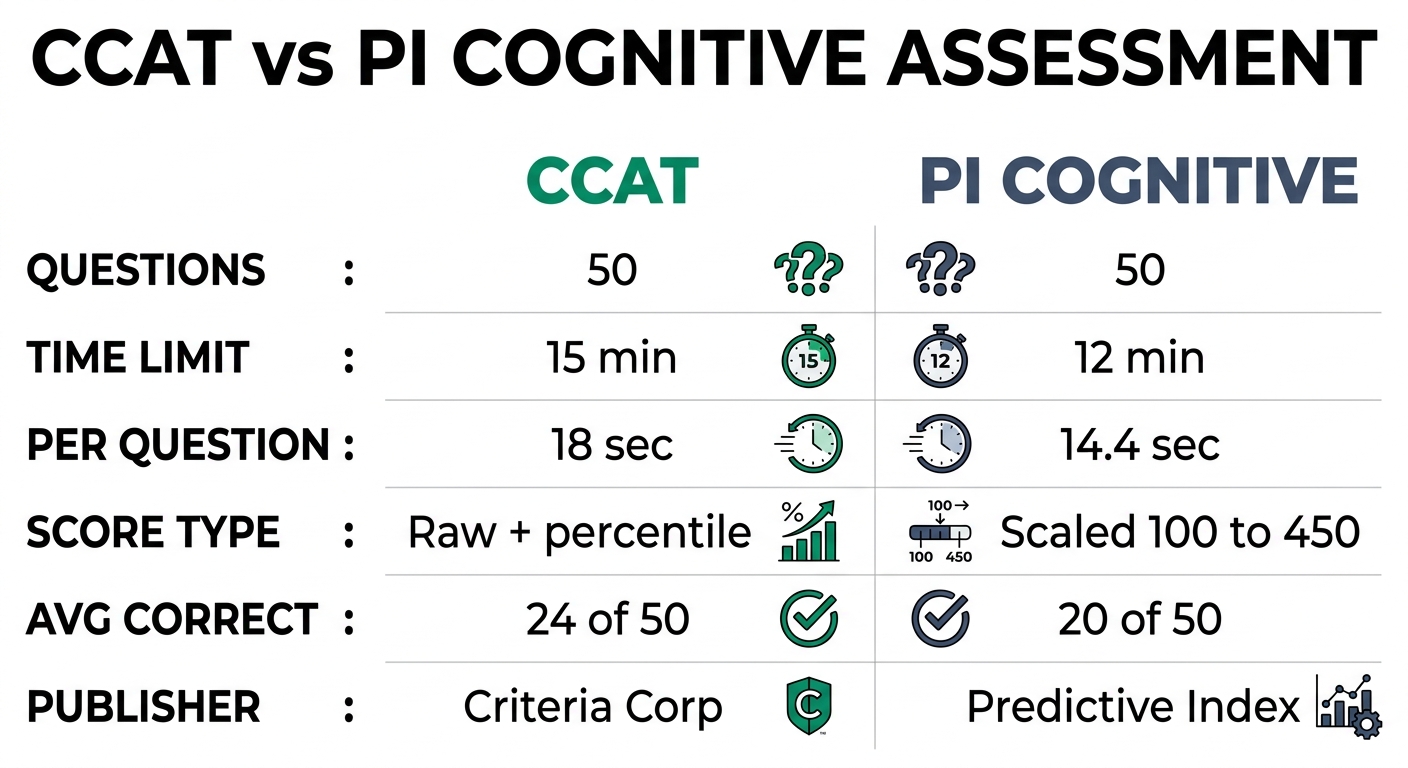
| CCAT (Criteria Corp) | PI Cognitive Assessment | |
|---|---|---|
| Questions | 50 | 50 |
| Time limit | 15 minutes | 12 minutes |
| Time per question | About 18 seconds | About 14.4 seconds |
| Question areas | Verbal, math and logic, spatial reasoning | Verbal, numerical, abstract reasoning |
| Answer options | Usually 4, five on many spatial questions | Usually 4 |
| Calculator | Not allowed | Not allowed |
| Scoring sent to employer | Raw score and percentile | Scaled score (100 to 450) |
| Average result | About 24 of 50 correct | Around 20 of 50 correct |
| Publisher | Criteria Corp | The Predictive Index |
| Common pairing | Standalone | Often paired with an untimed Behavioral Assessment |
What each test measures
Both tests are cognitive aptitude tests, which means they measure how quickly you can reason through unfamiliar problems rather than what you already know. Criteria Corp says the CCAT “measures your ability to problem solve, use new information, and think critically.” The Predictive Index describes its Cognitive Assessment as a measure of general cognitive ability, sometimes called “g,” and stresses that it does not measure IQ or acquired job knowledge but rather how fast you can learn.
The practical difference is in the question categories. The CCAT splits into verbal, math and logic, and spatial reasoning, and that spatial component (rotating shapes, “which figure comes next” pattern grids) is a signature part of the test. The PI Cognitive Assessment splits into verbal, numerical, and abstract reasoning. Abstract reasoning on the PI plays a similar role to spatial reasoning on the CCAT: it is the shape-and-pattern category that trips up people who only practiced word problems and arithmetic.
Timing: the PI is faster, the CCAT is broader
This is where the two tests genuinely diverge. The CCAT gives you 15 minutes for 50 questions, which is roughly 18 seconds each. The PI gives you 12 minutes for the same 50 questions, which is about 14.4 seconds each. That three-minute gap sounds small, but it changes the feel of the test. On the PI, you have even less room to sit and think, so quick recognition and fast decisions matter more.
On both tests, the timer runs for the whole thing, not per question, so you control your own pacing. And on both, almost nobody finishes. That is by design. If you have practiced pacing for the CCAT’s 18-second rhythm, the PI’s 14.4-second rhythm will feel noticeably tighter, so do not assume prep for one transfers perfectly to the other. Our CCAT time-management strategy covers the pacing math in depth, and most of that thinking carries over to the PI with a tighter clock.
Scoring: percentile versus scaled score
The two tests report results in different formats, which matters when you are trying to interpret whether you did well.
The CCAT sends the employer two numbers: your raw score (how many of the 50 you got right) and your percentile (how you rank against other test-takers). Criteria Corp reports that the average test-taker gets 24 questions right and that less than 1% of candidates finish all 50.
The PI Cognitive Assessment converts your raw score into a scaled score ranging from 100 to 450, benchmarked against a norm group. Prep providers commonly cite a raw score around 20 correct as roughly average on the PI, with higher scaled scores expected for demanding roles. There is no universal pass mark on either test. Employers set their own thresholds, and those thresholds vary by role and seniority. So a “good” score is really “good enough for this specific job,” on both tests.
The tests report scores differently, but the honest takeaway is the same: you are not expected to finish, and there is no single number that means you passed. What counts is doing well relative to the bar the employer set.
Which is harder, the CCAT or the PI?
Neither test is objectively “harder” in a way that holds for everyone, but here is the fair breakdown. The PI has a tighter clock (14.4 seconds per question versus 18), so if raw speed is your weakness, the PI will feel harder. The CCAT includes a spatial-reasoning category and a slightly wider spread of math-and-logic question styles, so if visual pattern questions are your weakness, the CCAT may feel harder.
There is one mechanical difference worth knowing for your guessing strategy. Neither test penalizes wrong answers, so guessing on anything you cannot reach is always better than leaving it blank. The odds of a blind guess landing depend on how many answer options a question has. On the PI, questions typically have four options, so a blind guess has about a one-in-four chance. On the CCAT, verbal and math questions usually have four options too, but many spatial questions have five, which nudges the blind-guess odds slightly lower on those. In practice, this means eliminating even one obviously wrong option matters a little more on the CCAT’s spatial questions than elsewhere, because it moves your odds more.
The difficulty you actually experience depends far more on your own weak category than on which test it is. Someone strong at verbal and shaky at pattern questions will find both tests hard in the same place. That is why the smartest prep move is not memorizing which test is “harder” but finding your own weak category and drilling it. For a broader look at how the CCAT stacks up against several other assessments, see our CCAT vs other aptitude tests comparison.
How to tell which test you are taking
Recruiters do not always name the test clearly, so use these tells:
- Check the sender and the login screen. A CCAT is administered through Criteria Corp’s platform; the PI runs on The Predictive Index’s platform. The branding on the assessment link or login page is the clearest signal.
- Count the clock. If you are told you have 12 minutes, it is almost certainly the PI. Fifteen minutes points to the CCAT.
- Look for a second, untimed questionnaire. The PI Cognitive Assessment is frequently paired with the PI Behavioral Assessment, a short, untimed personality-style questionnaire. If you were also asked to complete an untimed “which words describe you” survey, you are likely in a PI process.
- Watch the question types. Spatial shape-rotation questions lean CCAT; the overall structure is similar, so this is a softer signal than the timer and the branding.
When in doubt, prepare for the format you were told and practice on realistic questions for that specific test, because generic aptitude drills recycled across a dozen test types will not match either one closely.
FAQ
Is the CCAT the same as the Predictive Index test?
No. They are two separate tests from two different companies. The CCAT is the Criteria Cognitive Aptitude Test from Criteria Corp (50 questions, 15 minutes). The Predictive Index Cognitive Assessment is from The Predictive Index (50 questions, 12 minutes). They measure similar abilities but differ in timing, question categories, and scoring.
Which is harder, the CCAT or the PI Cognitive Assessment?
It depends on your strengths. The PI has a tighter time limit (about 14.4 seconds per question versus 18 on the CCAT), so it feels harder if speed is your weakness. The CCAT includes spatial-reasoning questions, so it feels harder if visual pattern questions are your weakness. Your own weak category matters more than the test itself.
How many questions are on each test?
Both the CCAT and the PI Cognitive Assessment have 50 questions. The difference is the clock: 15 minutes for the CCAT and 12 minutes for the PI.
Do people finish the CCAT or the PI?
Rarely, on either. The CCAT is built so that less than 1% of candidates answer all 50 in 15 minutes, and the PI’s tighter clock makes finishing at least as unlikely. Not finishing is normal on both. We cover why in is it normal to not finish the CCAT.
What is a good score on each test?
There is no fixed pass mark on either. The CCAT reports a raw score and a percentile; the PI reports a scaled score from 100 to 450. Employers set their own cutoffs that vary by role, so a good score is one that clears the bar for the specific job you are applying to.
Can I use a calculator on the CCAT or the PI?
No. Neither test allows a calculator. Both are designed to be solved with mental math and estimation, so practicing without one is important for the numerical questions.
Is the PI test the same as PICA, and how does the CCAT fit in?
The names cause a lot of confusion. “PI test,” “PI Cognitive Assessment,” and “PICA” all refer to the same cognitive test from The Predictive Index; PICA is just its acronym. The CCAT is a completely separate test from Criteria Corp. So the real three-way distinction is: the CCAT (Criteria Corp), the PI Cognitive Assessment or PICA (The Predictive Index), and the PI Behavioral Assessment, which is the untimed personality-style questionnaire that PI often pairs with its cognitive test. If you were asked to do a timed reasoning test plus a separate untimed “describe yourself” survey, you are in a PI process, not a CCAT one.
If I prepared for the CCAT, am I ready for the PI?
Mostly, but not entirely. The reasoning skills transfer, but the PI’s clock is tighter and its abstract-reasoning category is styled a little differently from the CCAT’s spatial section. If you know you are taking the PI, practice at its 12-minute pace specifically rather than assuming CCAT prep is enough.
Related on CCAT Tests
- Comparison. CCAT vs other aptitude tests. How the CCAT compares against Wonderlic, SHL, and more.
- Guide. The complete CCAT test guide. What the CCAT is and how to approach it.
- Timing. CCAT time-management strategy. Pacing tactics that carry over to the PI’s tighter clock.
- Pillar. The CCAT test preparation guide. The hub for preparing for the test.
- Practice. Free CCAT practice tests. See where you stand before you pay for anything.
Try CCAT Tests
Practice the real format for the test you are actually taking
If you have confirmed it is the CCAT, the fastest way to calm the nerves is to take one that mirrors the real thing, spatial-reasoning questions included. Our free tier is a genuinely usable practice experience, not a three-question teaser behind a paywall, so you can find your weak category before deciding whether to pay for anything. Paid plans are one-time, see pricing, and add heat-map analytics that pinpoint exactly which question type is costing you points. If it turns out you are facing the Predictive Index instead, or both, our sister platform PrepClubs runs realistic practice for the PI Cognitive Assessment and 20 other pre-employment tests with a money-back guarantee.