You got an assessment invite, and it either says CCAT or SHL somewhere in the fine print, or it says nothing useful at all and you are left guessing. These are two different cognitive tests, and knowing which one you face changes how you should prepare, because they run on different clocks, different question types, and different rules on things as basic as whether you can use a calculator. The CCAT here is the Criteria Cognitive Aptitude Test from Criteria Corp, the workplace hiring test, not the Canadian Cognitive Abilities Test for schoolchildren that shares the acronym. SHL is a different test publisher, and its flagship cognitive test is called Verify G+. This guide shows you how to tell them apart and how to prep for whichever one you are taking.
The short answer: the CCAT and SHL are not the same test. The CCAT is a fast 50-question, 15-minute test from Criteria Corp with no calculator, covering verbal, math and logic, and spatial reasoning. SHL’s Verify G+ is a longer 36-minute test (30 questions, or 24 in its interactive version) from SHL, with a calculator allowed, covering numerical, inductive, and deductive reasoning.
Quick takeaways
- The CCAT is 50 questions in 15 minutes. The SHL Verify G+ is 30 questions (or 24 in the interactive version) in 36 minutes.
- The CCAT covers verbal, math and logic, and spatial reasoning. SHL Verify G+ covers numerical, inductive, and deductive reasoning.
- No calculator on the CCAT. SHL permits a calculator.
- The CCAT reports a raw score and a percentile. SHL is typically scored against a norm group, and many employers set a percentile bar (often around the 80th) to pass.
- SHL has an “interactive” version with drag-and-drop, graph-building tasks. The CCAT is standard multiple choice.
- If your test is 15 minutes and no calculator, it is almost certainly the CCAT.
CCAT vs SHL at a glance
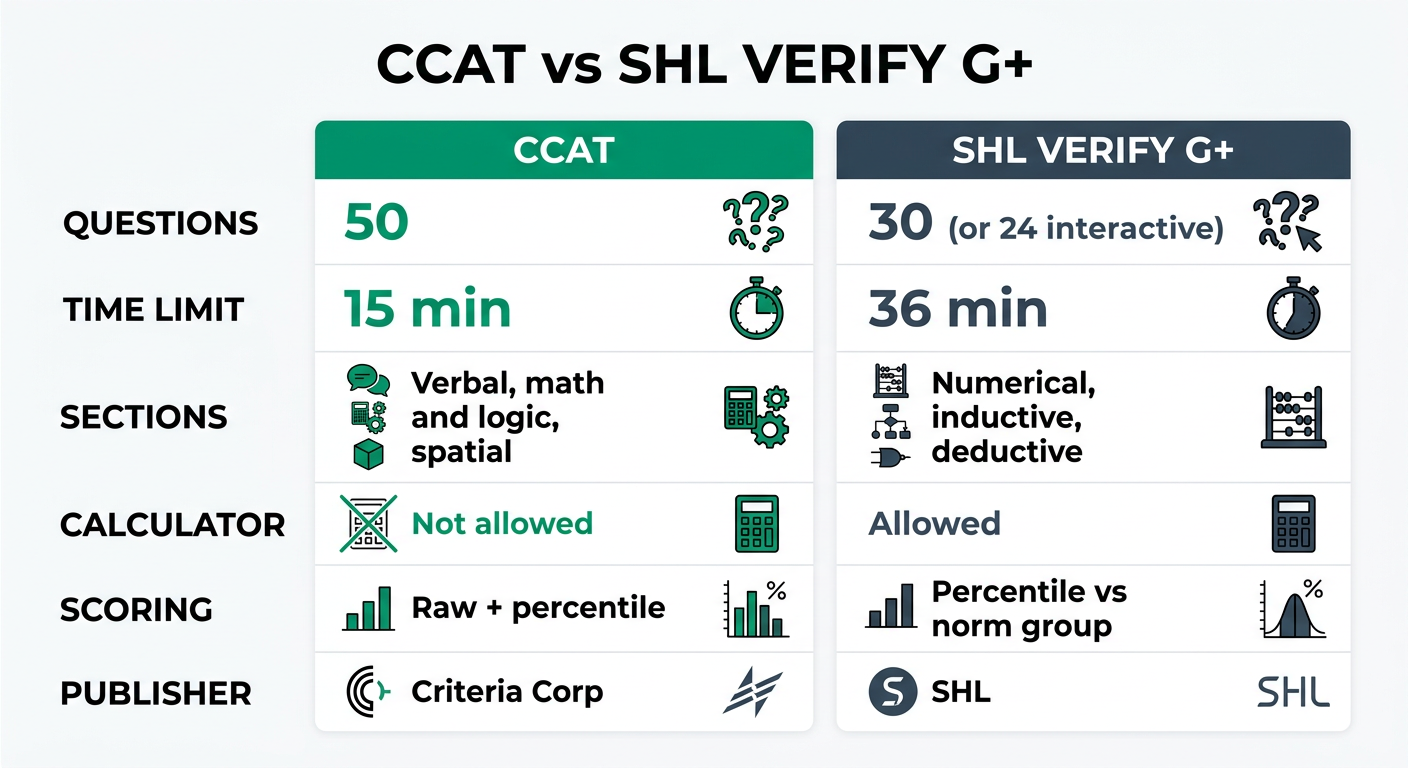
Both are cognitive ability tests employers use to screen candidates, but they are built differently. Here is the side-by-side before we dig in.
| CCAT (Criteria Corp) | SHL Verify G+ | |
|---|---|---|
| Questions | 50 | 30 (or 24 interactive) |
| Time limit | 15 minutes | 36 minutes |
| Question areas | Verbal, math and logic, spatial reasoning | Numerical, inductive, deductive reasoning |
| Calculator | Not allowed | Allowed |
| Format | Standard multiple choice | Multiple choice, plus an interactive drag-and-drop version |
| Scoring | Raw score and percentile | Percentile against a norm group |
| Typical pass bar | Set by employer, varies by role | Often around the 80th percentile, higher for competitive roles |
| Publisher | Criteria Corp | SHL |
What each test measures
Both tests aim at general cognitive ability, the capacity to reason through new problems quickly, but they slice it into different sections.
The CCAT has three areas: verbal, math and logic, and spatial reasoning. Criteria Corp says the test “measures your ability to problem solve, use new information, and think critically.” Its spatial section (rotating shapes, “which figure comes next” patterns) is a signature feature that catches people off guard.
The SHL Verify G+ also has three areas, but different ones: numerical reasoning, inductive reasoning, and deductive reasoning. Numerical reasoning is data-and-calculation questions, often reading a table or chart. Inductive reasoning is the shape-and-pattern category, similar in spirit to the CCAT’s spatial section. Deductive reasoning is verbal logic: you read short premises and pick which conclusion must follow. On the standard Verify G+, the three types are mixed together, so a numerical question can be followed immediately by a deductive one.
Timing: short and frantic versus longer but denser
This is the difference you will feel most. The CCAT gives you 15 minutes for 50 questions, which is roughly 18 seconds per question. It is short and frantic. The SHL Verify G+ gives you 36 minutes for 30 questions (about 72 seconds each), which sounds far more relaxed, but SHL questions are individually denser and often involve reading a chart or working through a multi-step logic chain.
So “more time per question” does not mean “easier.” The CCAT punishes you with speed. The SHL punishes you with question complexity. On the CCAT, your enemy is the clock. On the SHL, your enemy is a single question that eats several minutes if you let it. Both reward the same discipline: know when to cut your losses on a hard question and move on. If it turns out you have to sit both tests in the same hiring process, we wrote a dedicated game plan for that in taking both the CCAT and SHL.
Calculator, format, and the “interactive” curveball
Two practical differences can catch you out on test day.
First, the calculator. On the CCAT, calculators are not allowed, so its math questions are designed for mental arithmetic and estimation. On the SHL Verify G+, you may use a calculator, which is why SHL numerical questions can lean on heavier data and multi-step calculations. If you practiced mental math for the CCAT and then sit an SHL test, do not forget you are allowed the tool. Our note on whether you can use a calculator on the CCAT covers the CCAT side in more detail.
The single fastest way to tell the two apart on the day: a 15-minute test with no calculator is the CCAT. A longer test where a calculator is allowed is the SHL.
Second, SHL has an “interactive” version of Verify G+. Instead of picking from multiple-choice options, you might drag to build a graph, adjust a chart, or manipulate shapes directly, and this version is adaptive, meaning the difficulty shifts based on your previous answers. The CCAT has no equivalent; it is straightforward multiple choice throughout. If your SHL invite mentions an interactive or activity-based assessment, expect that hands-on format.
Scoring: percentile bars you can actually miss
The CCAT sends the employer a raw score (out of 50) and a percentile. There is no universal pass mark; each employer sets its own threshold.
SHL is also norm-referenced, but the bar is often stated more explicitly. As a general rule, many employers expect at least the 80th percentile on an SHL test, and competitive fields like top-tier consulting and law can expect the 85th or higher. That is a meaningfully high bar, and it is one reason SHL tests have a reputation for being tough to pass. On both tests, though, the number that matters is the one the specific employer set, so treat any “typical” figure as a rough guide, not a guarantee. If you want the fuller scoring breakdown alongside other tests, our CCAT vs other aptitude tests comparison puts the CCAT, SHL, and Wonderlic scoring side by side.
How to tell which test you are taking
If the invite does not say clearly, use these tells:
- Time and calculator. Fifteen minutes and no calculator is the CCAT. Around 36 minutes with a calculator allowed is the SHL Verify G+.
- Question count. Fifty questions points to the CCAT. Thirty (or 24 interactive) points to SHL.
- The platform branding. A CCAT runs on Criteria Corp’s platform; the SHL runs on SHL’s. The login or invite branding is usually the clearest signal.
- Interactive tasks. If you are asked to drag, build a graph, or manipulate a chart rather than pick A, B, C, or D, you are almost certainly in SHL’s interactive Verify G+, not the CCAT.
- The wording. SHL uses the terms “inductive” and “deductive” reasoning; the CCAT talks about “spatial reasoning.” The category names in your prep materials or invite can give it away.
When you know which one it is, practice on realistic questions for that specific test. Generic aptitude drills recycled across a dozen test types will not match either format closely, and the section names alone (spatial versus inductive/deductive) tell you the practice needs to be test-specific.
FAQ
Is the CCAT the same as the SHL test?
No. They are two different tests from two different publishers. The CCAT is the Criteria Cognitive Aptitude Test from Criteria Corp (50 questions, 15 minutes, no calculator). SHL’s Verify G+ is a separate cognitive test (30 questions or 24 interactive, 36 minutes, calculator allowed). They measure overlapping abilities but differ in timing, sections, and rules.
Which is harder, the CCAT or SHL?
Different kinds of hard. The CCAT is harder on speed, with only 15 minutes for 50 questions. SHL Verify G+ gives more time per question but the questions are denser and the pass bar is often high (frequently around the 80th percentile). Your weakest area matters more than the test name.
How many questions are on each test?
The CCAT has 50 questions. The SHL Verify G+ has 30 questions in the standard multiple-choice version, or 24 in the interactive version. The time limits are 15 minutes for the CCAT and 36 minutes for SHL.
Can I use a calculator on the CCAT or SHL?
Not on the CCAT; it is designed for mental math. Yes on the SHL Verify G+, where a calculator is permitted. This is one of the quickest ways to tell which test you are taking.
What score do I need to pass an SHL test?
There is no single answer, because employers set their own thresholds. As a general guide, many employers look for at least the 80th percentile on SHL tests, and highly competitive roles can expect the 85th percentile or higher. The CCAT similarly has no universal pass mark.
Is 26 out of 50 a good score on the CCAT?
It is above the average. Criteria Corp reports that the average test-taker gets 24 of 50 right, so 26 is slightly better than typical. Whether it is “good enough” depends entirely on the role, because employers set their own cutoffs. For a technical or highly competitive position the bar may be higher, while for many roles a score around or just above average is competitive. There is no universal pass mark.
Do the CCAT or SHL detect cheating?
Both publishers use test-integrity measures, and remote proctoring is common on higher-stakes administrations. SHL has publicly discussed monitoring for signs that a candidate is pasting in AI-generated answers, and proctored sessions can flag unusual behavior. The honest takeaway is simple: assume you are being monitored and do the test on your own. We do not claim to know any specific detection mechanism, and you should not rely on second-hand tricks that promise to beat one.
Do people finish the CCAT and the SHL?
Finishing the CCAT is rare; less than 1% of candidates answer all 50 questions in 15 minutes. The SHL gives more time per question, so finishing is more achievable, but the difficulty of individual questions still means many candidates do not complete every one. Not finishing the CCAT is normal, as we explain in is it normal to not finish the CCAT.
Related on CCAT Tests
- Both tests. Taking both the CCAT and SHL. A game plan for when a process makes you sit both.
- Comparison. CCAT vs other aptitude tests. How the CCAT compares against Wonderlic, SHL, and more, side by side.
- Guide. The complete CCAT test guide. What the CCAT is and how to approach it.
- Pillar. The CCAT test preparation guide. The hub for preparing for the test.
- Practice. Free CCAT practice tests. Gauge where you stand before you pay for anything.
Try CCAT Tests
Prep for the exact test you are facing, not a generic quiz
Once you know it is the CCAT, the fastest way to settle your nerves is to practice on questions that mirror the real thing, spatial reasoning included, at the real 15-minute pace. Our free tier is a genuinely usable practice experience, not a three-question teaser behind a paywall, so you can find your weakest category before spending a cent. Paid plans are one-time, see pricing, and add heat-map analytics that show exactly where your points are leaking. And if your test turns out to be the SHL Verify G+ instead, our sister platform PrepClubs runs realistic SHL practice, alongside 20 other pre-employment tests, with a money-back guarantee.