A recruiter just sent you a link and told you to take the Criteria Cognitive Aptitude Test, and now you are trying to figure out what that actually is before the clock starts. Here is the short version: the Criteria Cognitive Aptitude Test, almost always shortened to CCAT, is a pre-employment test that gives you 50 questions and only 15 minutes to answer as many as you can. It is the workplace hiring test published by Criteria Corp, not the Canadian Cognitive Abilities Test, the school gifted-and-talented exam for children that shares the same acronym and confuses the search results. This guide walks through the exact format, the timing math, how the scoring works, and what a realistic result looks like.
Quick takeaways
- The CCAT is 50 questions in 15 minutes, roughly 18 seconds per question if you spread the time evenly.
- It has three question types: verbal, math and logic, and spatial reasoning.
- Employers receive two numbers: your raw score (how many you got right) and your percentile (how you rank against other test-takers).
- The average test-taker gets 24 of 50 right, and less than 1% of candidates finish all 50.
- No calculator is allowed, so mental math and estimation matter.
- It is the Criteria Corp workplace test, not the Canadian Cognitive Abilities Test for schoolchildren.
What the Criteria Cognitive Aptitude Test actually is
The CCAT is a general cognitive aptitude test employers use to screen candidates early in hiring. Criteria Corp, the company that publishes it, describes the test as measuring “your ability to problem solve, use new information, and think critically.” The idea is that a single short test predicts how quickly you can pick up a new role and reason through unfamiliar problems, which is why it shows up across tech, finance, consulting, and sales hiring.
Two things make it feel harder than a typical quiz. First, it covers three different kinds of thinking in one sitting, so you switch between words, numbers, and shapes with no warning. Second, the time limit is aggressive on purpose. The test is not really asking “can you answer these 50 questions.” It is asking “how many can you get right when you are moving fast and cannot slow down.”
Before anything else, make sure you are reading about the right test. Search “CCAT” and you will hit results for the Canadian Cognitive Abilities Test, a school assessment for kids. That is a completely different exam with different content and scoring. The test your recruiter means is the Criteria Cognitive Aptitude Test, a workplace hiring tool. If a “practice question” you find online is about a school admissions test, it is the wrong one.
The format: 50 questions, 15 minutes, three question types
Criteria Corp’s own candidate prep page states the test has exactly 50 questions and a 15-minute limit, and that there are three kinds of questions: verbal, math and logic, and spatial reasoning. The questions are not grouped into neat sections you finish one at a time. They are mixed, so a word problem can be followed by a pattern-matching question, then a vocabulary question. You cannot “warm up” on one type before moving to the next.
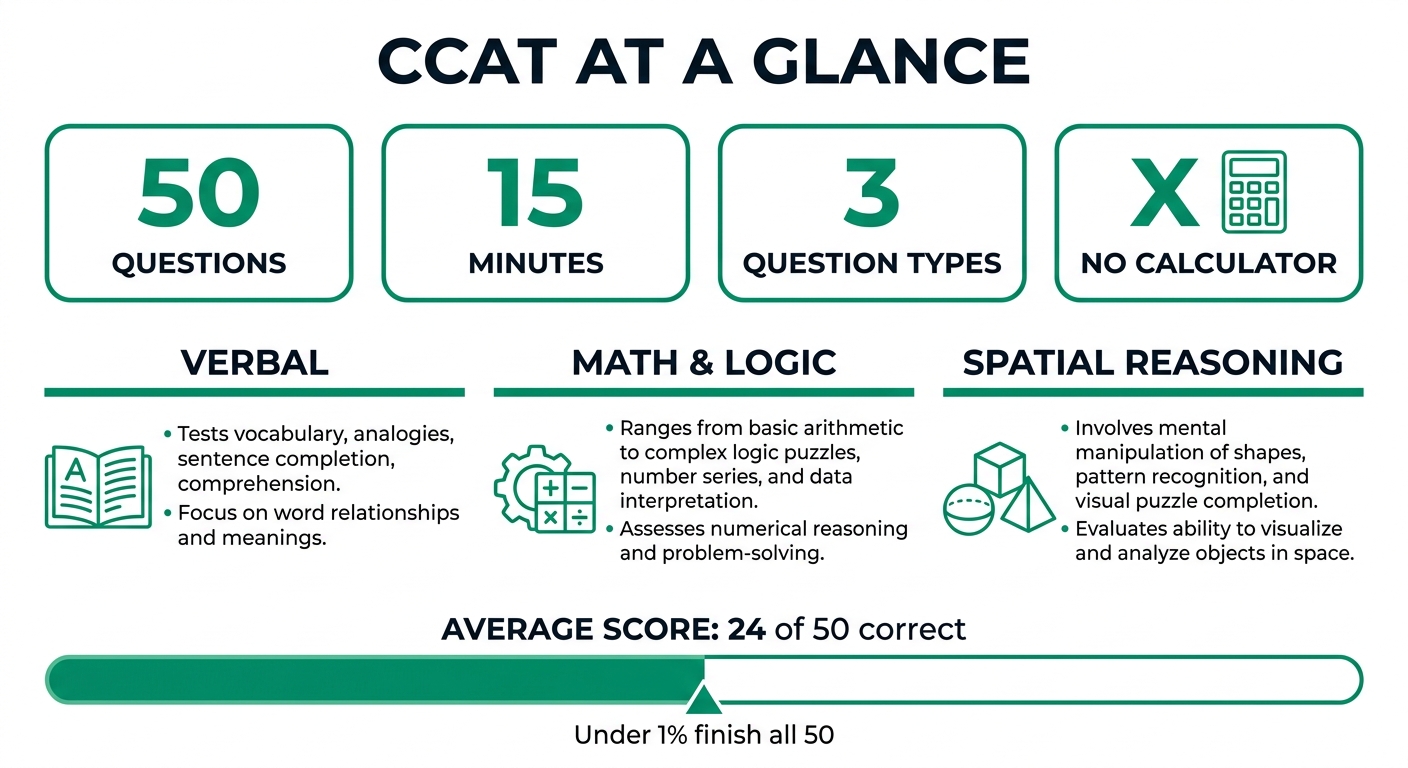
Here is what each type asks of you.
| Question type | What it tests | Examples of what you will see |
|---|---|---|
| Verbal | Vocabulary and language reasoning | Analogies, sentence completion, antonyms, word relationships |
| Math and logic | Numerical reasoning without a calculator | Word problems, number series, basic arithmetic, ratios, data interpretation |
| Spatial reasoning | Visual pattern recognition | Shape rotation, matrices, “which figure comes next” pattern questions |
The spatial-reasoning questions are the ones people underestimate most, because they rarely show up on other tests and they need genuine practice with real, CCAT-style images rather than generic filler. This is exactly why practicing on questions that look like the real thing matters more than practicing on any random aptitude quiz.
How the CCAT is timed (the 18-second reality)
Fifteen minutes across 50 questions works out to roughly 18 seconds per question. That number is the single most important fact about the test, because it changes how you should approach every question. You do not have time to labor over a hard one. If a question is going to eat 90 seconds, the smart move is often to guess and move on, because those 90 seconds could have earned you four or five other correct answers.
The test is timed for the whole thing, not per question, so you control your own pacing. That is both a gift and a trap. The gift is you can skip a brutal question and come back. The trap is that it is easy to sink two minutes into one stubborn problem and never notice the timer draining. A pacing plan, even a rough one like “I want to be at question 25 when I hit the 7-minute mark,” keeps you honest. There is more on this in our 15-minute time-management strategy.
How CCAT scoring works: raw score and percentile
When you finish, Criteria Corp sends the employer two numbers. Your raw score is simply the number of questions you answered correctly, out of 50. Your percentile shows how that raw score compares to other people who have taken the test: a 75th percentile means you scored higher than 75% of test-takers.
There is no universal “pass” mark. Employers set their own thresholds, sometimes a percentile, sometimes a raw-score cutoff, and those thresholds vary by role and company. A number that clears the bar for one job might fall short for another. The percentile is usually the more meaningful of the two, because it accounts for how hard the test is relative to everyone else, not just how many you personally answered. For a deeper breakdown, see how the CCAT is scored: raw scores vs percentiles.
One detail that trips people up: a question you never answer earns you nothing, exactly like a wrong one, and there is no extra penalty for guessing incorrectly. That leads to a simple piece of prep advice we give every reader: if you are running out of time, fill in an answer on every remaining question rather than leaving them blank. A blank is a guaranteed zero on that item, while a guess has a one-in-four-ish chance of landing. This is strategy, not a special scoring rule, but it reliably nets a few extra points.
What a realistic CCAT score looks like
Here is the honest part most prep sites skip. Forum threads about how to “defeat” the CCAT are full of one-off war stories and bravado, which makes the test sound either trivial or impossible depending on who is posting. It is more useful to look at what Criteria Corp actually publishes. According to Criteria Corp, the average test-taker gets 24 questions right, and less than 1% of candidates answer all 50. If you were expecting to breeze through every question, recalibrate now. Not finishing is normal and expected. The test is deliberately built so that almost nobody completes it.
Getting 24 out of 50 is not failing. It is average. The test is designed so that finishing is rare, not so that finishing is the goal.
That reframe matters for your nerves. Your job is not to answer all 50. It is to answer as many as you can correctly in the time you have, without freezing on the hard ones. If you feel like you left a chunk blank, that does not mean you bombed it. It is normal to not finish the CCAT, and recruiters know that. We wrote more about what recruiters actually expect in is it normal to not finish the CCAT.
How to prepare without wasting time
Preparation for a test like this is less about learning new facts and more about building speed and pattern familiarity. A few things that actually move the needle:
- Practice with realistic questions. The value is in getting used to the exact question styles, especially the spatial ones, so nothing on test day is a surprise. Generic aptitude quizzes recycled across a dozen test types will not do this.
- Drill your weak type. Most people are noticeably slower on one of the three categories. Finding that category and drilling it is where the biggest score gains hide.
- Practice pacing under a real clock. Answering questions with unlimited time teaches you nothing about a 15-minute test. Time yourself.
- Learn to let go of hard questions fast. The skill of guessing and moving on is trainable, and it protects your score more than solving any single tough problem.
You do not need to pay for anything to start. Taking a genuinely usable free practice test first tells you where you stand and which type is dragging you down, before you decide whether structured prep is worth it. And if the same hiring process has you facing more than one assessment, our sister platform PrepClubs covers 21 pre-employment tests with a money-back guarantee, so you can build reps for whatever else a company lines up alongside the CCAT.
FAQ
What is the Criteria Cognitive Aptitude Test?
It is a pre-employment cognitive aptitude test published by Criteria Corp, made up of 50 questions across verbal, math and logic, and spatial reasoning, with a 15-minute time limit. Employers use it to gauge how quickly a candidate can learn and solve problems. It is not the Canadian Cognitive Abilities Test, the school exam that shares the CCAT acronym.
How many questions are on the CCAT and how long do I have?
There are 50 questions and 15 minutes, which is about 18 seconds per question if you split the time evenly. The timer runs for the whole test, not per question, so you manage your own pacing.
What is a good score on the CCAT?
There is no fixed pass mark. The average test-taker gets 24 of 50 correct, and employers set their own cutoffs that vary by role and company. A percentile in the 70s or above is generally competitive for many roles, but the required score depends entirely on the job. See our full guide on what a good CCAT score looks like.
Can I use a calculator on the CCAT?
No. Criteria Corp does not allow calculators, so the math questions are designed to be solved with mental math, estimation, and quick arithmetic. Practicing without a calculator is important.
Do most people finish the CCAT?
No. Criteria Corp reports that less than 1% of candidates answer all 50 questions in the 15 minutes. Not finishing is the norm, not a sign you failed.
Is the CCAT the same as an IQ test?
Not exactly. Criteria Corp presents it as a cognitive aptitude test, not an IQ test. It measures general problem-solving and critical-thinking ability, which overlaps with what IQ tests measure, but it is built to predict how quickly you can learn a job rather than to produce an IQ number. We cover the distinction in is the CCAT an IQ test.
How is the CCAT scored?
Employers receive your raw score (the number of questions you answered correctly out of 50) and your percentile (how you rank against other test-takers). Unanswered questions count as incorrect, so guessing on anything you cannot reach is better than leaving it blank.
Related on CCAT Tests
- Guide. The complete CCAT test guide. A broader walkthrough of what the test is and how to approach it.
- Scoring. How the CCAT is scored: raw scores vs percentiles. What those two numbers actually mean for your application.
- Samples. CCAT sample questions and answers. See real question styles across all three types.
- Pillar. The CCAT test preparation guide. The hub for everything on preparing for the test.
- Practice. Free CCAT practice tests. Gauge where you stand before you pay for anything.
Try CCAT Tests
See the real format before test day, not a generic aptitude quiz
The fastest way to stop feeling anxious about the CCAT is to take one that looks like the real thing, including the spatial-reasoning questions most sites skip or fake. Our free tier is a genuinely usable practice experience, not a three-question teaser behind a paywall: enough questions across all three types to show you where you stand and which category is slowing you down. If you want the full picture, our paid plans are one-time, see pricing, and add heat-map analytics that pinpoint your weak areas, the kind of insight most tools reserve for enterprise dashboards.