You applied to a Crossover role, got an email pointing you to a cognitive aptitude test, and now you are trying to figure out exactly what you are walking into and what score you actually need. Crossover is one of the most visible employers that uses the CCAT, and yes, the test they send is the Criteria Cognitive Aptitude Test from Criteria Corp, the workplace hiring test, not the Canadian Cognitive Abilities Test for schoolchildren that shares the acronym. This is a closer look at where the CCAT sits in Crossover’s hiring funnel, whether every role really requires it, and what score tends to clear the bar.
The short answer: Crossover uses the CCAT as an early, near-universal screening step for its remote roles, and it sets a comparatively high bar. Crossover’s own CCAT guide describes a baseline that is often around 35 out of 50, with the exact passing score set per role by the hiring manager. That is well above the roughly 24 out of 50 average, which is why Crossover’s process has a reputation for being hard to get through.
Quick takeaways
- The test Crossover sends is the CCAT: 50 questions, 15 minutes, verbal, math and logic, and spatial reasoning, no calculator. Source: Criteria Corp.
- Crossover uses the CCAT as an early screen on most of its remote roles, so treat it as a step you will almost certainly face, not an optional one.
- Crossover’s own guide describes a baseline often around 35 out of 50, with the hiring manager setting the exact cutoff per role. More technical and senior roles tend to sit higher.
- The average CCAT score is about 24 out of 50, and only around 1 percent of all candidates answer every question, per figures Crossover cites. Crossover’s bar is set well above the average.
- Different roles can carry different cutoffs, so “what score do I need” depends on the specific position, not a single Crossover-wide number.
- The fastest prep gain is realistic, timed practice on CCAT-style questions, then drilling your weakest of the three sections.
Does Crossover require the CCAT for every role?
For practical purposes, assume yes. Crossover, which hires remote talent worldwide across engineering, management, sales, and support functions, leans heavily on the CCAT as an early filter in its funnel. Its public CCAT guide frames the test as a core part of how it screens, and candidate accounts across roles consistently describe hitting the CCAT early in the process. So while Crossover does not publish a role-by-role list saying “this exact job requires the CCAT,” the safe assumption is that if you are in a Crossover pipeline, the CCAT is coming.
Two nuances are worth holding in mind:
- The cutoff is not one fixed number. Crossover states that the hiring manager sets the passing score, and that different positions require different scores. So the requirement is real and near-universal, but the exact bar moves with the role.
- The CCAT is a screen, not the whole decision. Passing the CCAT gets you further into the funnel; it does not by itself land the job. Crossover’s process also includes skills assessments and interviews. The CCAT is the gate you have to clear to keep going.
For a deeper walkthrough of the full Crossover pipeline, our Crossover CCAT insider guide covers how the test fits alongside the rest of the stages.
What score does Crossover actually want?
Here is the honest version, with the sources attached so you can weigh them yourself.
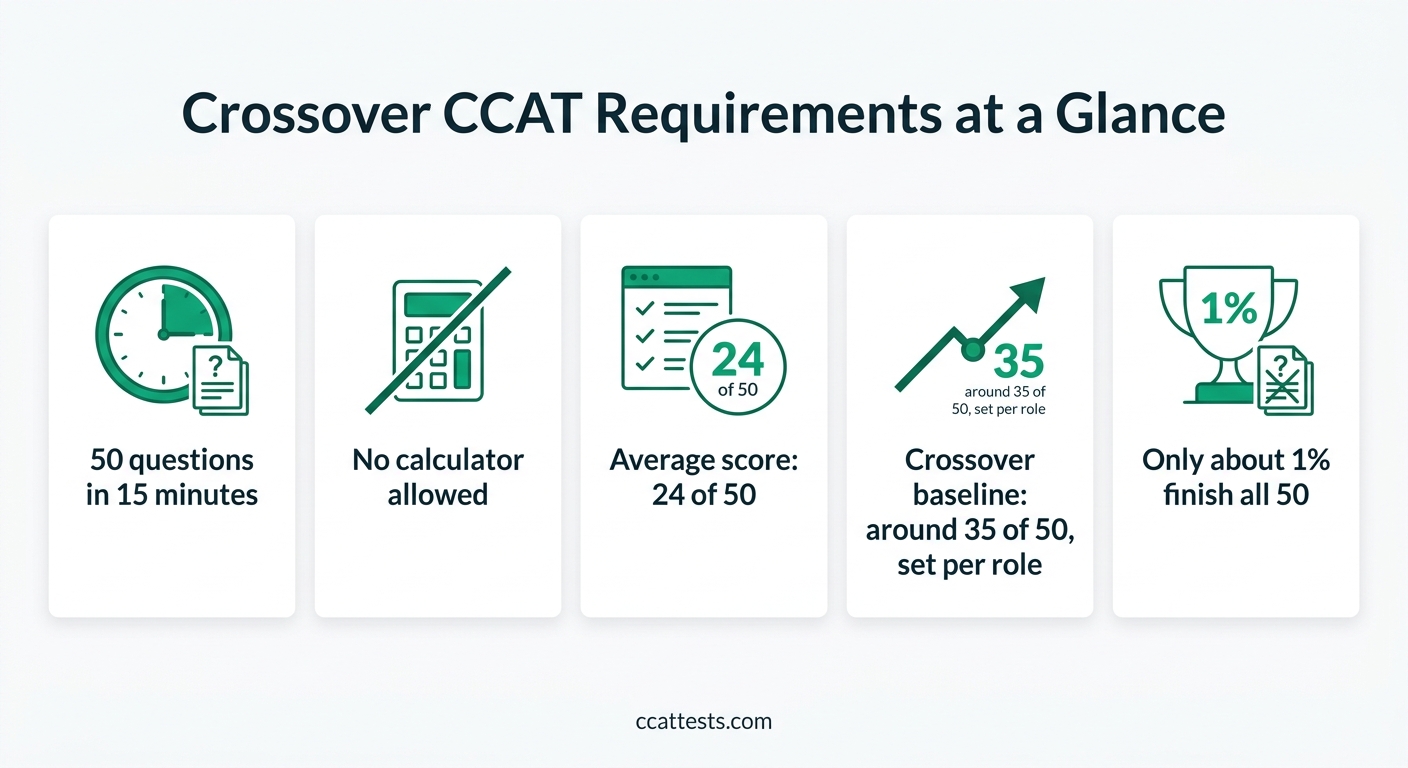
Crossover’s own CCAT guide points to a baseline that is often around 35 out of 50 as the lowest commonly accepted score, while stressing that the hiring manager sets the actual passing grade for each role. Set against the roughly 24 out of 50 average that Criteria Corp reports, a 35 is a strong score, comfortably above typical. That gap is the whole story of why Crossover feels tough: it is not that the questions are unusual, it is that the bar sits well above average and the clock is unforgiving.
A few practical implications:
- Aim higher than the baseline, not at it. If a role’s floor is around 35, targeting the high 30s in practice gives you a margin for test-day nerves and the questions you inevitably have to skip.
- Technical and senior roles tend to run higher. A software or data role in a competitive pipeline can expect a bar above the general baseline. When in doubt, prepare for the higher end.
- Do not treat any single number as a guarantee. Because the cutoff is set per role by a hiring manager, treat “around 35” as a well-sourced guide rather than a promised threshold. Our piece on what a good CCAT score looks like puts these numbers in fuller context.
Crossover’s bar is not mysterious. It is simply set well above the average, which is exactly why average preparation does not clear it.
Why Crossover’s CCAT feels so hard
Three facts, all traceable to the test’s own mechanics, explain the difficulty.
First, the pace. Fifty questions in fifteen minutes is about 18 seconds each. Crossover’s guide notes that only around 1 percent of candidates answer every question in the time given. If you do not finish, you are in the overwhelming majority, and that is fine: the score is based on correct answers, so finishing every question is not the goal. Our note on whether it is normal to not finish the CCAT explains why racing to the end usually costs points.
Second, no calculator. The CCAT’s math and logic questions are built for mental arithmetic and estimation. If you have leaned on a calculator for years, that is a specific skill to rebuild before test day.
Third, the range of question types. The CCAT mixes verbal (analogies, sentence logic), math and logic (word problems, number and letter series), and spatial reasoning (pattern and shape questions). Crossover’s pool draws across all of these, so a weakness in any one section drags your total. The spatial questions in particular catch people off guard because they look nothing like the numerical and verbal items around them.
How to prepare for Crossover’s CCAT specifically
Generic aptitude drills recycled across a dozen test types will not match the CCAT closely enough, and Crossover’s high bar leaves no room for that mismatch. Prepare for the exact format instead.
- Take one full, timed, 50-question practice test cold. Use a real 15-minute timer. The point is to see your honest starting score and, more importantly, which of the three sections is your weakest.
- Drill your weak section. For most people that is spatial reasoning or the word problems. Spend the bulk of your prep time here, not on retaking full tests that keep re-measuring the same gap.
- Rebuild mental math. Practice quick estimation and arithmetic without a calculator so the math questions stop eating your seconds.
- Practice pacing and skipping. Learn to recognize a question that will cost you 40 seconds and move past it. On a test where 35 is the bar, three well-chosen skips can be worth more than three stubborn attempts.
- Take a second full timed test near the end to confirm your weak section has improved and to re-acclimate to the mixed-section pace.
Because the practice questions in this kind of prep include real CCAT-style spatial and abstract images, not generic filler, they train you for what Crossover’s screen actually looks like. Our step-by-step guide to preparing for the Crossover test lays out a fuller schedule if you have a week or more.
Turning a practice score into a plan
Once you have a cold practice score, the fastest way to close the gap to 35-plus is to stop guessing about your weak spot and measure it. A raw score of, say, 28 does not tell you where the seven missing points went. A per-question-type breakdown does: maybe five of them were spatial questions and two were word problems you got right but slowly.
That is what the heat-map analytics in our paid tiers are for: instead of one number, you see exactly which question types are costing you points and where your pace breaks down under the clock, the kind of per-section insight that dedicated analytics tools charge hundreds of dollars a month for, packaged into a one-time purchase for a single test-taker. You do not need it to begin. Start with a free timed run and an honest review, and add the analytics if you want the shortcut to your weak areas.
FAQ
Does Crossover use the CCAT?
Yes. Crossover uses the Criteria Cognitive Aptitude Test (CCAT) from Criteria Corp as an early cognitive screen across its remote roles. It is a 50-question, 15-minute test covering verbal, math and logic, and spatial reasoning, with no calculator allowed. If you are in a Crossover hiring pipeline, expect the CCAT to be one of the first steps.
What CCAT score does Crossover require?
Crossover’s own CCAT guide describes a baseline that is often around 35 out of 50, with the exact passing score set per role by the hiring manager. That is well above the roughly 24 out of 50 average. More technical and senior roles tend to expect higher scores, so treat around 35 as a well-sourced floor rather than a fixed, guaranteed cutoff.
Is the Crossover CCAT hard?
It has a reputation for being hard, and the reason is the bar, not exotic questions. Crossover sets its passing score well above the average, and the CCAT’s 15-minute limit for 50 questions is punishing on pace. Crossover cites that only around 1 percent of candidates answer every question. With targeted, timed practice on the exact format, the difficulty is manageable.
Does every Crossover role require the CCAT?
Crossover does not publish a role-by-role list, but it uses the CCAT as a near-universal early screen, so the practical assumption is that most roles include it. The cutoff score, however, varies by position because the hiring manager sets it. Prepare as if your role requires it and aim above the general baseline.
Can I use a calculator on the Crossover CCAT?
No. The CCAT does not allow a calculator, so its math and logic questions are designed for mental arithmetic and estimation. If you are out of practice with quick mental math, that is a specific skill to rebuild before test day, because fumbling arithmetic burns the seconds you cannot spare.
What happens if I do not finish the Crossover CCAT?
Not finishing is normal. Crossover cites that only around 1 percent of all candidates answer every question in the time limit. Your score is based on correct answers, so it is usually better to answer carefully and skip time-eating questions than to rush and guess on everything. Focus on accuracy and smart pacing rather than reaching question 50.
Is the Crossover CCAT like an IQ test?
Not exactly. The CCAT measures general cognitive ability, so it overlaps with what an IQ test looks at, but it is a pre-employment aptitude test validated to predict job performance, not a clinical IQ measure. Crossover uses it to compare candidates on problem-solving speed and reasoning under time pressure, and it returns a score out of 50 rather than an IQ number. It is also not the children’s Canadian Cognitive Abilities Test, which is a different test that shares the acronym.
Can I retake the Crossover CCAT if I fail?
Retake policy depends on Crossover’s process and the specific role, and it is not guaranteed, so treat your first attempt as the one that counts and prepare accordingly. Some pre-employment processes allow a retake after a waiting period, others do not. The safest move is to prepare thoroughly before your first sitting rather than counting on a second chance.
Related on CCAT Tests
- Insider guide. Crossover CCAT insider guide. How the CCAT fits into Crossover’s full hiring funnel.
- Step by step. How to prepare for the Crossover test. A fuller preparation schedule.
- Scores. What is a good CCAT score. How to read your number against different role bars.
- Pillar. The CCAT test preparation guide. The full hub for preparing for the test.
- Practice. Free CCAT practice tests. Gauge where you stand before you pay for anything.
Try CCAT Tests
Prep for Crossover’s actual bar, not a generic quiz
Crossover sets its CCAT bar well above average, so the fastest way to clear it is to practice on questions that mirror the real thing, spatial reasoning included, at the real 15-minute pace. Our free tier is a genuinely usable practice experience, not a three-question teaser behind a paywall, so you can find your weakest section before spending a cent. Paid plans are one-time, see pricing, and add heat-map analytics that show exactly where your points are leaking. And if Crossover’s process pairs the CCAT with other assessments, or you are interviewing elsewhere too, our sister platform PrepClubs runs realistic practice across 21 pre-employment tests with a money-back guarantee, so you are ready for whatever else the funnel throws at you.