You took the CCAT a while ago, or you are about to take it and want to know whether the result has a shelf life. The short, honest answer: the CCAT score itself does not carry an official expiration date from Criteria Corp, but that is not the whole story, because employers usually want a fresh test for each new application anyway. This page separates the official rule (there isn’t a formal expiry) from the practical reality (how employers actually treat older scores), so you know exactly where you stand.
Quick note first: this is about the Criteria Cognitive Aptitude Test, the workplace hiring test built by Criteria Corp. It is not the Canadian Cognitive Abilities Test, the school exam for children that shares the acronym. Different test, different rules. You want this one.
Quick takeaways
- Criteria Corp does not publish an official expiry date for a CCAT score. The number does not “expire” on its own.
- In practice, employers almost always administer a fresh CCAT for each new application, so an old score rarely gets reused.
- A common rule of thumb is that a score older than about 12 months may be treated as stale, but this varies entirely by employer.
- Because cognitive ability is stable over time, your actual ability does not change much, but employers still prefer a current, verified result.
- If you are reapplying to the same company, ask whether they will accept a recent prior score before assuming you must retake.
- The safest assumption: plan to take the test fresh for each application, and treat any prior score as practice insight rather than a reusable credential.
The official answer: no fixed expiry date
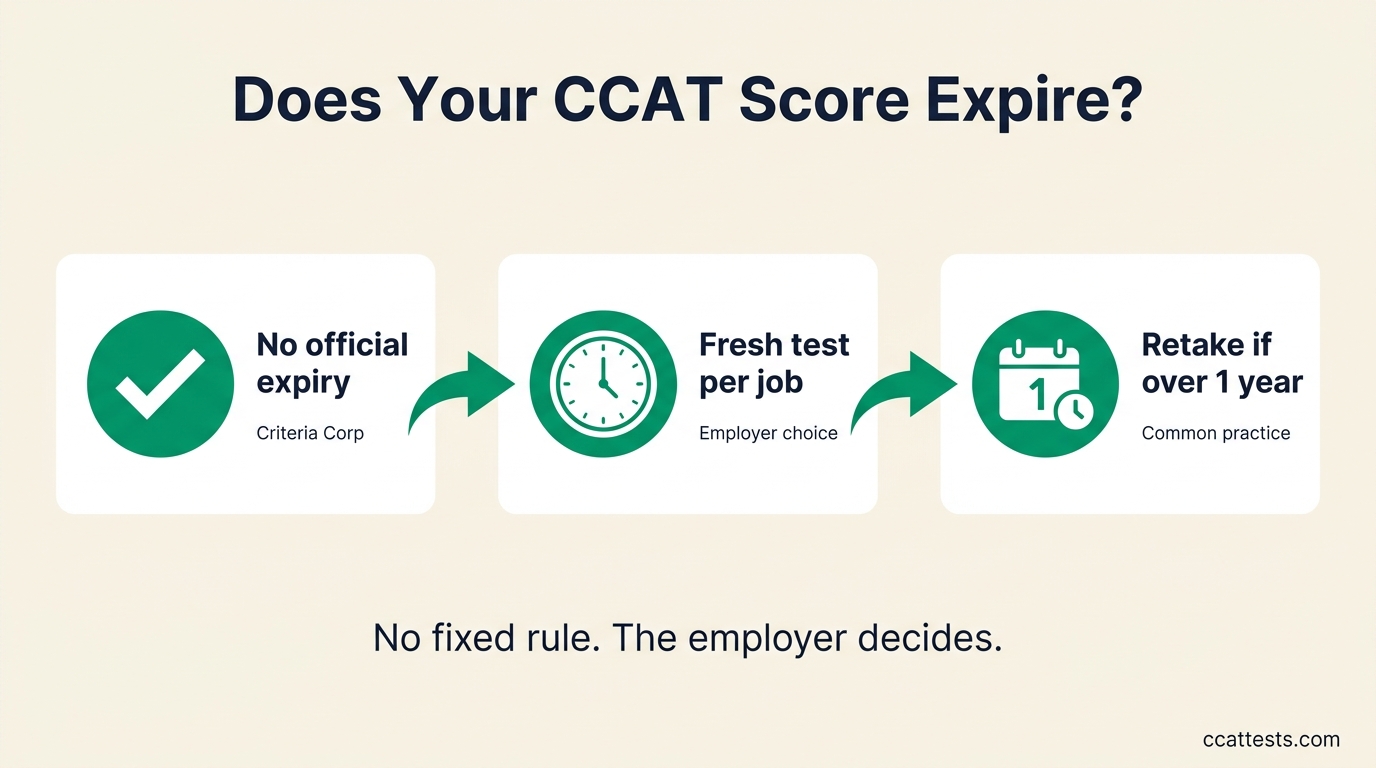
Criteria Corp, the company that builds and administers the CCAT, does not publish a formal expiration date for a score. Your raw score (the number of questions you answered correctly out of 50) and your percentile ranking do not automatically become invalid after a set period. In that narrow sense, a CCAT score does not expire.
This makes sense when you consider what the test measures. The CCAT is a cognitive aptitude test: it assesses general problem-solving and learning ability, which research consistently shows is stable in adults over time. Your score today and your score in two years would, in principle, be very similar. There is no built-in reason for the number itself to have a hard shelf life the way a certification that can go out of date would.
So if you are asking “will my CCAT score technically stop being valid on some date,” the answer is no. There is no timer counting down on the result itself.
The practical answer: employers usually want a fresh test
Here is the part that matters more than the official rule. Even though the score has no formal expiry, employers almost always administer the CCAT fresh as part of their own hiring process. When you apply for a role that uses the CCAT, you take it as a step in that company’s pipeline. The result belongs to that application.
That means an old score you earned for a different job, or even for the same company a year ago, usually is not something you can simply hand over and reuse. The employer sends you their own test link and expects you to sit it for this specific application. In most cases the question of expiry never even comes up, because you are taking a new test either way.
A commonly cited rule of thumb is that a score older than roughly 12 months may be treated as out of date by an employer that is deciding whether to reuse it. You will also see other numbers quoted online, anywhere from a few months to as long as five years, but none of those figures come from Criteria Corp, and they contradict each other precisely because there is no official rule to point to. Some organizations are stricter, some more lenient, and some have no policy at all because they simply retest everyone. There is no single industry-wide window. The honest summary is: there is no fixed rule, and the employer decides.
When an older score might still count
There are a few situations where a prior CCAT score could matter, and they are worth knowing.
If you are reapplying to the same company within a short window, it is worth asking whether they will accept your recent result rather than making you retake. Some employers will, especially if the previous test was recent and for a comparable role. It never hurts to ask the recruiter directly before assuming you have to start over.
If you took the CCAT through a staffing agency or an assessment platform that stores results, the agency may reuse a recent score across multiple client submissions. This is more common in high-volume recruiting. Again, the window and the policy are set by that agency, not by Criteria Corp.
Outside of those cases, assume each application means a fresh test. Treat any score you already have as useful information about where you stand, not as a credential you can carry from one employer to the next.
What this means for how you prepare
The practical takeaway changes how you should think about preparation. Because you will likely retake the CCAT for each new application, your prep is not a one-time cost you never revisit. It is a reusable skill.
That is actually good news. The work you put into learning the question formats, building pacing at the 15-minute limit, and drilling your weak sections does not expire either. If you prepared well for one application and take the test again six months later for a different role, you walk in already familiar with the format. The second sitting is almost always easier because the unfamiliarity, which is what rattles most first-timers, is gone.
It also means that if your first score was lower than you wanted, a retake for a new opportunity is a genuine second chance, not a black mark. For the full mechanics of improving on a repeat attempt, our CCAT retake strategy guide walks through exactly what to change between sittings.
Your CCAT score does not expire, but your familiarity with the test is the real asset, and that only grows every time you practice.
FAQ
How long is a CCAT score valid?
There is no official validity period set by Criteria Corp; the score does not formally expire. In practice, employers usually administer a fresh test per application, and a common rule of thumb is that a result older than about 12 months may be treated as stale. The exact window depends entirely on the employer.
Can I reuse my CCAT score for a different job?
Usually not. Most employers send you their own CCAT to take as part of their hiring process, so you take the test fresh for each application rather than submitting an old result. If you are reapplying to the same company recently, it is worth asking whether they will accept your prior score.
Does Criteria Corp delete or expire old scores?
Criteria Corp does not publish a policy of expiring a candidate’s score after a set time. The score itself remains a valid record of how you performed on that date. What changes is whether an employer chooses to use an older score or requires a new test, which is the employer’s decision, not an automatic expiry.
If I retake the CCAT, which score counts?
The score that counts is the one you take for the specific application in question. Employers use the result from the test they administered for that role. A prior score from a different application generally does not carry over unless that employer specifically agrees to reuse it.
Will my ability actually change if my score is old?
Not much. The CCAT measures general cognitive aptitude, which is stable in adults over time, so your underlying ability is roughly the same whether the score is one month or two years old. Employers still tend to prefer a current, verified result, which is why fresh testing is the norm.
Should I prepare again if I already took the CCAT before?
Yes, a quick refresher is worth it. Because you will likely sit a new test for each application, brushing up on the question formats and pacing before each attempt keeps you sharp. The good news is that your prior familiarity carries over, so re-preparing is faster the second time.
Related on CCAT Tests
- Next step. CCAT retake strategy. How to improve on a second or later attempt.
- Scoring. How the CCAT is scored: raw scores vs percentiles. What your two score numbers actually mean.
- Outcomes. What happens if you fail the CCAT. Retakes, rejections, and next steps after a low result.
- Pillar. CCAT scores and results guide. Everything about reading, comparing, and improving your CCAT results.
- Practice. Free CCAT practice tests. Stay test-ready for your next application.
Try CCAT Tests
Because you will likely take the CCAT again, make your prep count once.
Since employers usually want a fresh test per application, the smartest move is to build skills that carry from one sitting to the next. CCAT Tests gives you realistic practice across all three domains, including the spatial and abstract-reasoning images that generic sites skip, plus a heat-map that shows exactly which question types are costing you points. The free tier is a genuinely usable practice experience, not a three-question teaser, so you can gauge where you stand before deciding whether to pay for anything. Paid plans are one-time purchases, never a subscription. See pricing. And if your next application pairs the CCAT with other assessments, our sister platform PrepClubs runs realistic practice across 21 pre-employment tests with a money-back guarantee, so you stay ready for the whole hiring funnel, not just one test.