Your recruiter just said the CCAT results are in, or you are about to sit the test and want to know what the employer will see afterwards. Either way, a CCAT score report is not a single grade. It is a short document with a fixed set of fields, and once you know what each field is, the whole thing reads in about two minutes. This guide walks the report in the order it actually appears, using Criteria Corp’s own published score report guide as the reference. One quick disambiguation before you start: this is the Criteria Cognitive Aptitude Test used in workplace hiring, not the Canadian Cognitive Abilities Test given to schoolchildren that shares the same initials.
Quick takeaways
- The report opens with a candidate block (name, position applied for, test date) and a Test Event ID, then a Results Summary carrying two numbers: your raw score and your percentile.
- Your raw score is correct answers out of 50. Criteria Corp confirms there is no penalty for wrong answers, so a blank is never better than a guess.
- Your percentile ranks you against Criteria’s global norming group. It is not the percentage of questions you answered correctly.
- The three skill lines (Verbal Ability, Math and Logic, Spatial Reasoning) are reported as separate percentiles, which is why they never add up to your raw score.
- Page one also carries a distribution graph, with a suggested score range marked on it if your employer linked the test to a job before you sat it.
- A report can be flagged “Invalid Result” if the system concludes you had already seen that exact version of the test.
- Candidates are not sent the report automatically. Criteria sends results to the employer, who decides what, if anything, to pass on.
What is actually on a CCAT score report
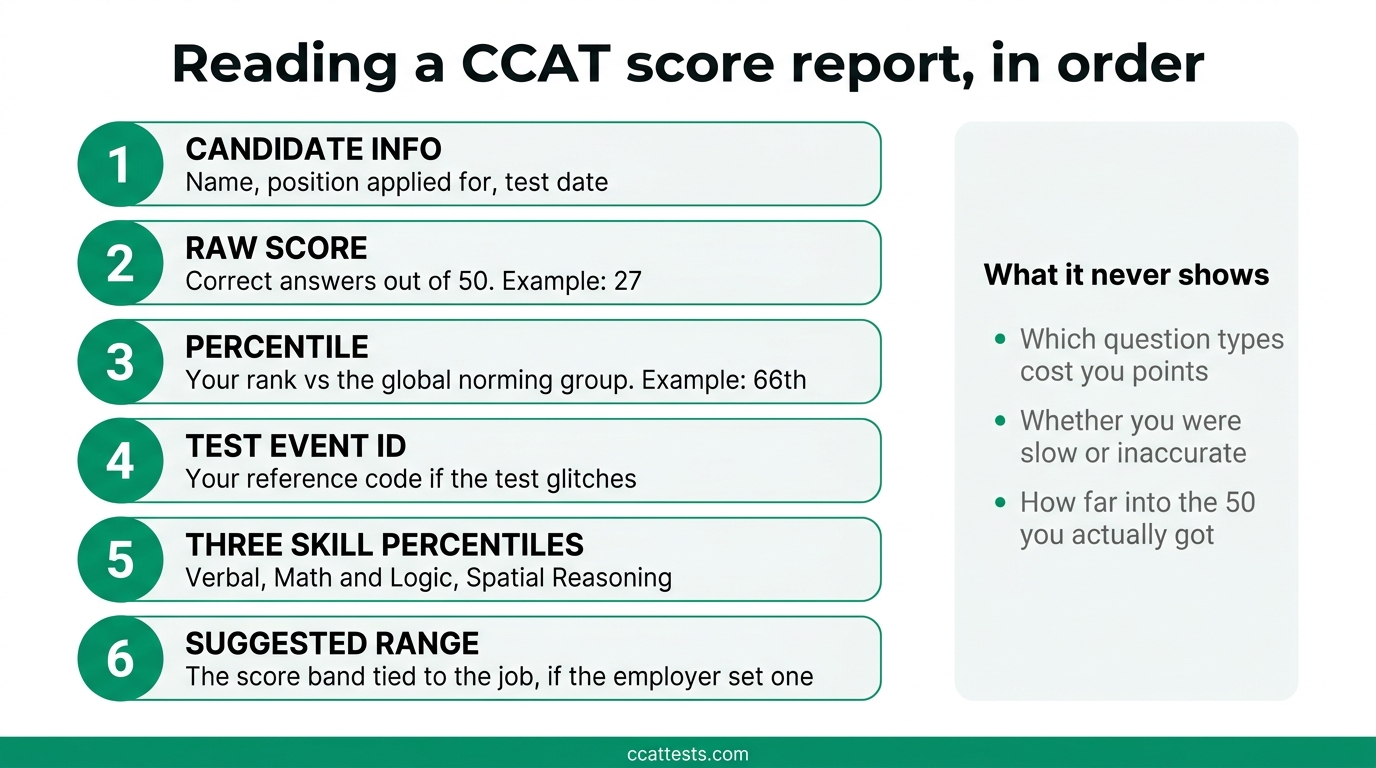
A CCAT score report is a two-page document: page one holds your identifying details, two headline numbers, three skill percentiles and a distribution graph, and page two holds a table of suggested score ranges by job family. Nothing on it is a pass or fail mark, because the CCAT does not have one. Here is the whole document in reading order.
| Line on the report | What it literally is | What to do with it |
|---|---|---|
| Candidate information | Your name, the position you applied for, the date you took the assessment | Check the position listed is the role you actually applied to |
| Test Event ID | A reference code issued to you at the start of the test | Save it before you start; it is your only handle if something breaks |
| Raw score | The number of questions you answered correctly, out of 50 | Compare against the average of 24, not against 50 |
| Percentile | Your rank against Criteria’s global norming group | This is the number most employers compare to their target |
| Verbal Ability | A separate percentile for reading comprehension, vocabulary and word comparison | Treat a low line here as a vocabulary and careful-reading problem |
| Math and Logic | A separate percentile for arithmetic, numerical reasoning and logic | A low line here is usually mental-arithmetic speed, not math ability |
| Spatial Reasoning | A separate percentile for visualizing objects, patterns and shapes | The most trainable of the three for most people |
| Distribution graph | A bell curve with your raw score marked, plus a suggested range if the job was linked | Shows whether you sit inside the target band for the role |
The candidate block, the Event ID, and your two headline numbers
The top of page one is administrative, then the Results Summary gives you the only two numbers most employers ever look at. The candidate block lists your name, the position applied for, the date you sat the assessment, and the Test Event ID. It is worth a glance: if the position listed is not the job you applied to, that is a genuine thing to raise with your recruiter.
The Test Event ID is the line nobody explains, and it is the most useful one on the page if you have not sat the test yet. It is a reference code issued to you at the start of your assessment so you can recover from a technical fault: per Criteria’s score report guide, a candidate who hits a problem returns to the test platform, enters that Event ID, and resumes from where they left off. So write the Event ID down before question one. If your browser crashes at minute nine with the clock running, that code is the difference between resuming and opening a support conversation with nothing to reference.
The Results Summary underneath holds the raw score and the percentile. The raw score is the count of questions you got right out of 50. Criteria Corp states plainly that there is no penalty for wrong answers on the CCAT, which means an unanswered question and a wrong answer are worth exactly the same: nothing. The average test taker answers 24 correctly, and fewer than 1% of candidates answer all 50 within the 15 minutes.
The percentile sits next to it and is the number people misread most often. It is a rank, not a percentage correct. A raw score of 24 is 48% of the questions, but because it is roughly average it lands near the 50th percentile, meaning you outperformed about half the norming group. For the full conversion, we keep a CCAT percentile chart with the raw-to-percentile mapping, and a deeper breakdown of how the CCAT is scored.
Your three skill percentiles, and why they never add up
The CCAT reports Verbal Ability, Math and Logic, and Spatial Reasoning as three separate percentile rankings, not as raw sub-scores, which is why they cannot be summed into your total. This trips up nearly everyone reading a report for the first time. Seeing 61, 38 and 55 does not mean you scored 154 out of 150. It means you beat 61% of the norming group on verbal, 38% on math and logic, and 55% on spatial.
Criteria defines the three lines as follows. Verbal Ability measures reading comprehension, logic and attention to detail through sentence completion, vocabulary and word comparison questions. Math and Logic measures problem solving, arithmetic, logic and numerical reasoning. Spatial Reasoning measures the ability to visualize objects in physical space, make spatial judgments, and solve object and pattern problems.
This is the most actionable line on the report, because an uneven profile tells you where to spend your next study hours. A verbal line well below the other two usually means vocabulary, not intelligence, and vocabulary is memorizable. A low spatial line is often just unfamiliarity: most adults have not looked at a rotated-shape puzzle since school, and that gap closes faster than the other two with practice. A low math and logic line is more often about mental-arithmetic speed under a clock than about the math itself, since the CCAT does not allow a calculator.
The distribution graph and the suggested score range
Page one closes with a bell curve showing the standard distribution of CCAT raw scores, with your own score marked on it, and, in some cases, a shaded band showing the suggested range for the job. Criteria’s guide explains that most scores cluster near the middle of that curve, with rarer scores at both ends, so your marker shows where you fall relative to the global norming group.
The shaded band only appears if the employer associated the test with a specific job before you took it. In the example Criteria uses in its own score report guide, a test linked to a Management position carries a suggested range of 20 to 50, and a candidate who scored 24 falls inside that band. If no job association was made, the graph shows your score alone with no range at all, which is why two candidates for different roles can receive visually different reports.
Page two carries the fuller table: suggested raw score ranges for different job families, flagged for whether the candidate scored within, above, or below each one. Criteria states those ranges were calculated from the results of over 700,000 CCAT assessments. Two honest caveats. A suggested range is guidance to the employer, not a pass mark, and employers routinely set their own bar higher or lower. And scoring above a range is not automatically a win, since some employers screen for fit within a band rather than for the maximum. For role-by-role context, our guide to what a good CCAT score is covers the targets people actually report by job type.
The “Invalid Result” flag, and how people trigger it by accident
An “Invalid Result” appears when Criteria’s system concludes that a candidate has already taken that particular version of the CCAT, judged from the speed and accuracy pattern of the answers. Move through the assessment unusually fast and with almost no errors, and the system reads that as prior exposure to the exact items rather than as raw talent. The warning then shows in the Results Summary on page one and again on the graph, so the employer sees it immediately.
This matters for how you prepare. Hunting down leaked copies of real CCAT items is the one prep strategy that can actively damage your report, because the pattern it produces is the pattern the flag looks for. Practicing on realistic CCAT-style questions built to the same format, timing and difficulty gives you the same familiarity and pacing without ever answering a live item you have memorized. That is why our question bank is written as CCAT-style material, spatial and abstract images included, rather than scraped from real test forms.
Wait: is this even the right report?
If your report shows a score around 100 to 160, a stanine from 1 to 9, or a line labelled Age Percentile Rank or Grade Percentile Rank, you are looking at the wrong test. Those are features of the Canadian Cognitive Abilities Test, a school assessment used to identify gifted students, which shares the CCAT acronym and nothing else.
This is not a hypothetical mix-up. Search for how to read CCAT results today and a real share of the page-one answers, including some of Google’s own suggested questions, return the school test’s scale: 130 to 160 labelled “Very Superior”, 90 to 109 labelled “Average”. Applied to a hiring CCAT those numbers mean nothing, because the Criteria CCAT reports a raw score out of 50 and a percentile. If a recruiter sent you the test link, you are taking the Criteria version.
What your report will never tell you
The score report tells you where you lost points, never why, and that gap is the reason a report alone makes a weak study plan. Four things it deliberately does not show:
- Which question types cost you. A 38th percentile in Math and Logic could be word problems, number series, percentages, or all three. The report does not separate them.
- Whether you were slow or wrong. A blank and a wrong answer look identical in the raw score, but they need opposite fixes. One is a pacing problem, the other an accuracy problem.
- How far into the 50 you got. Since most people never finish the CCAT, the number of questions you reached is a critical diagnostic, and it appears nowhere on the page.
- Whether the errors were careless. Misreading a question under time pressure and genuinely not knowing an answer produce the same mark on the report.
A worked example makes it concrete. Two candidates both score 27 out of 50, near the 66th percentile, with identical-looking Math and Logic lines. The first answered 30 questions and got 27 right: highly accurate, far too slow, and the fix is pacing drills plus faster guess-and-move decisions. The second answered all 50 and got 27 right: fast enough, accurate barely half the time, and the fix is slowing down on the question types being missed. The same report. Opposite study plans. Nothing printed on the page separates them, which is exactly what a per-question-type breakdown of your own practice attempts is for.
FAQ
How do I read my CCAT results?
Read them in this order: the position and date in the candidate block, your raw score out of 50, your percentile, the three skill percentiles, then where your marker sits on the distribution graph relative to any suggested range. The percentile is the number an employer compares against their target, and the three skill lines are where your study plan comes from.
Is 26 out of 50 good for the CCAT?
A 26 sits slightly above the average of 24, so a little above the middle of the pack. Whether that is good depends on the role: it is comfortable for many general and support positions and short of the mark for competitive engineering, analytics, consulting and private equity roles, where candidates commonly aim for the low-to-mid 30s and above.
What is the average score on a CCAT test?
Criteria Corp reports that the average test taker answers 24 of the 50 questions correctly, which sits around the 50th percentile. The same source notes that fewer than 1% of candidates answer all 50 within the 15-minute limit, so a raw score well below 50 is completely normal.
How is the CCAT score calculated?
Your raw score is the count of questions answered correctly out of 50, with no deduction for wrong answers. That raw score is then converted into a percentile comparing you against Criteria’s global norming group, and the same comparison is run separately for each of the three skill areas.
Do my three section percentiles add up to my raw score?
No, and they are not meant to. Each skill line is a percentile ranking against the norming group on that skill alone, so adding them produces a meaningless number. Only the raw score counts questions.
Can I see my own CCAT score report?
Not automatically. Criteria sends the report to the organization that administered the assessment, normally the employer or recruiter, and that organization decides whether to share anything with you. Some recruiters will give you your raw score or percentile if you ask, many will only say whether you are progressing, and some follow a policy of not sharing results at all.
What does an “Invalid Result” mean on a CCAT report?
It means the system determined, from the speed and accuracy pattern of your answers, that you had already taken that specific version of the CCAT. The flag appears in the Results Summary and again on the graph. It is not a scoring error you can correct afterwards, so the practical takeaway is to prepare on CCAT-style material rather than on leaked copies of live test items.
Why does my report show a score around 120?
Because it is almost certainly not a Criteria CCAT report. Scores near 100, bands like 120 to 129, stanines, and Age or Grade Percentile Ranks all belong to the Canadian Cognitive Abilities Test, the school assessment that shares the acronym. A hiring CCAT report gives a raw score out of 50 and percentiles.
Related on CCAT Tests
- Scoring mechanics. How the CCAT is scored: raw scores vs percentiles. The conversion logic behind your two headline numbers.
- Conversion table. CCAT score percentile chart. Turn any raw score into its percentile in one lookup.
- Benchmarks. What is a good CCAT score. Role-by-role targets, so you know what your number needs to be.
- Pillar. CCAT scores and results explained. The hub for reading, comparing and improving your results.
- Practice. Free CCAT practice tests. Get your own breakdown before an employer ever generates one.
Try CCAT Tests
See the breakdown your official report leaves out.
The employer’s report tells you which of the three skills is weakest. It stops there. CCAT Tests gives you the layer underneath: a heat-map of the exact question types costing you points, whether you lost them to pacing or to accuracy, and drills aimed at the specific weak spot that turns up. That class of analytics normally sits behind a subscription costing hundreds a month; here it comes with a one-time purchase, and the free tier is a real practice run across all three domains rather than a three-question teaser, so you can find your weakest section before deciding whether to pay for anything. Paid tiers are one-time, see pricing. The same approach backs our companion Udemy course, which has taught 1,200+ students at a 4.5 out of 5 rating. And if the CCAT is only the first hurdle, with personality, situational or other cognitive assessments queued behind it in the same process, our sister platform PrepClubs covers the whole gauntlet in one place, with 21 pre-employment tests, more than 3,700 students, and a money-back guarantee.
Format and score report details in this guide come from Criteria’s own candidate CCAT preparation page and its published CCAT score report guide. CCAT is a registered trademark of Criteria Corp. ccattests.com is an independent study resource and is not affiliated with, endorsed by, or sponsored by Criteria Corp.