Your CCAT is tomorrow. Maybe a recruiter sent the link this morning with a 48-hour window, maybe you scheduled it and the date snuck up on you, but either way you are here tonight wondering what you should actually do. The honest, slightly counterintuitive answer: the most valuable thing you can do the night before the CCAT is not more studying. It is protecting your sleep, setting up your logistics, and doing one short warm-up so the format feels familiar. This guide gives you an hour-by-hour plan for tonight and tomorrow morning so you walk in calm instead of frazzled.
One quick disambiguation first. This is the Criteria Cognitive Aptitude Test from Criteria Corp, the workplace hiring test, not the Canadian Cognitive Abilities Test given to schoolchildren for gifted-program admissions. Same acronym, two entirely different tests. If your recruiter or a hiring portal sent you here, you are taking the workplace one. Do not let a search result about the children’s test confuse your prep tonight.
Quick takeaways
- Do not cram the night before. Cognitive aptitude does not move overnight, and last-minute studying mostly raises your anxiety.
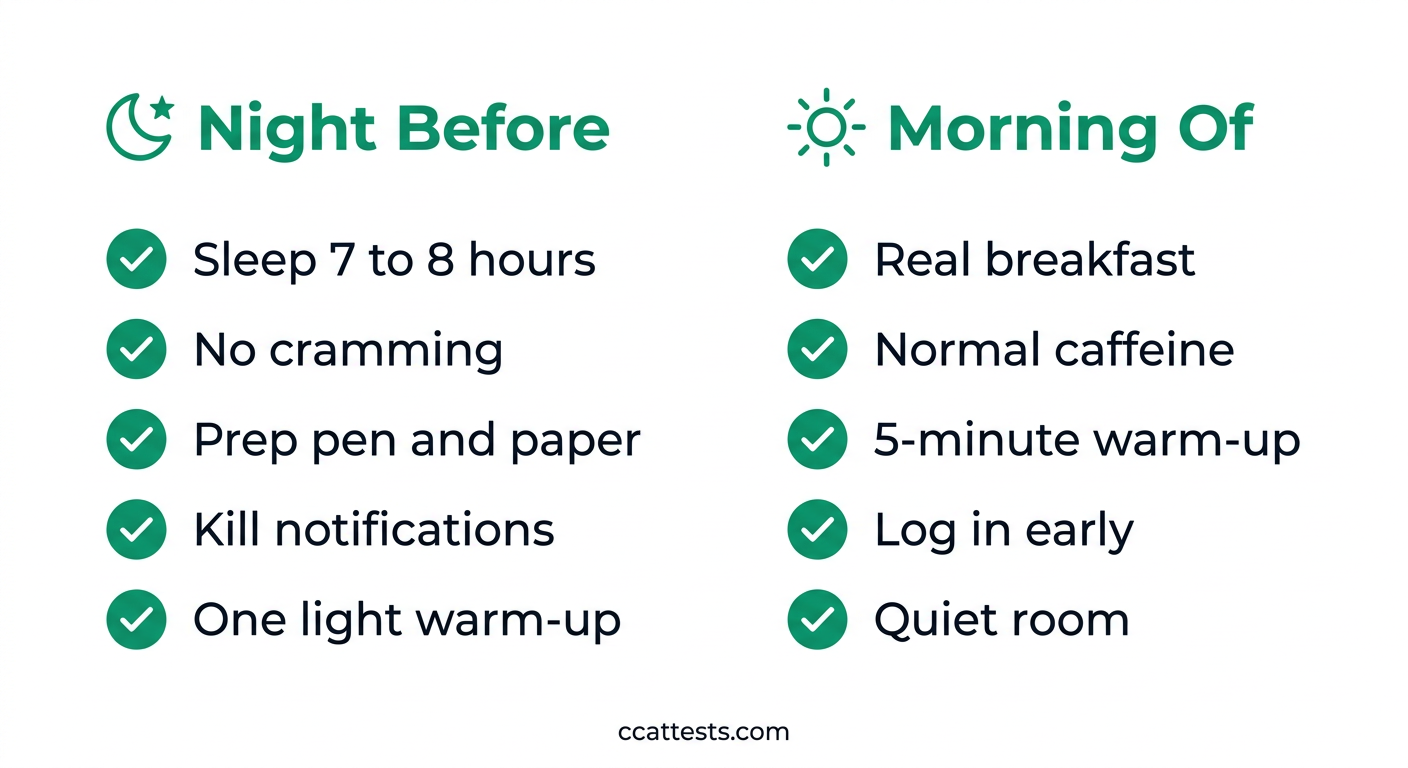
- Sleep is the highest-leverage thing you can do tonight. Aim for 7 to 8 hours and set two alarms.
- The CCAT is 50 questions in 15 minutes, no calculator, three question types: verbal, math and logic, and spatial reasoning. Pen and paper are typically allowed.
- Set up your space tonight: quiet room, stable internet, pop-ups and notifications killed, pen and scratch paper ready.
- Do one short, timed warm-up for familiarity, not a full study session. Stop early enough to wind down.
- In the morning, eat a real breakfast, take your normal amount of caffeine (not more), and log in a few minutes early.
First, know exactly what tomorrow holds
Half of pre-test anxiety is uncertainty. So before anything else, here is the shape of the test you are sitting. The format facts come from Criteria Corp, the company that makes the CCAT.
- 50 questions, 15 minutes. That is roughly 18 seconds per question on average.
- No calculator allowed. You will do the math by hand, which is why scratch paper matters.
- Three question types: verbal reasoning, math and logic, and spatial reasoning. They are interleaved, not grouped.
- Very few people finish all 50, and the average score is commonly reported at around 24. Not finishing is normal and expected, so do not aim to answer every question; aim to answer as many as you can accurately.
Sit with that last point tonight, because it is the single biggest source of test-morning panic. You are not supposed to finish. The test is built so almost nobody does. Your job is accuracy per question and smart pacing, not a sprint to question 50.
The night before: an hour-by-hour plan
Think of tonight in three blocks. The goal is to arrive at bedtime calm, prepared, and not wired from cramming.
Block 1: A short warm-up (about 20 to 30 minutes, done early in the evening)
Do one short, timed practice set. Not to learn anything new, but so the format is fresh and your brain is not seeing the question style cold tomorrow. Keep it light: one round, timed, then stop. If it goes badly, that is fine. A rough warm-up the night before is not a prediction; it is a rehearsal.
Crucially, set a hard stop. Studying late into the night trades a few extra practice questions for worse sleep and higher anxiety, and that is a bad trade on the CCAT specifically, because the test rewards a rested, fast-moving brain far more than a crammed one.
Block 2: Set up your logistics (about 15 minutes)
Most CCAT sittings are remote and timed, so a technical hiccup mid-test is a real risk. Handle it tonight, not tomorrow:
- Pick and prep your room. Somewhere quiet where you will not be interrupted for the full 15 minutes.
- Kill distractions. Close background apps, silence your phone, and turn off pop-ups and notifications. On a remote proctored test, a stray pop-up or a dropped connection mid-test is a headache you do not want, so a clean, stable environment protects both your focus and your run.
- Test your internet. A stable connection matters more than a fast one for a short test.
- Lay out pen and scratch paper. Pen and paper are typically allowed and are essential for the mental math, since there is no calculator. Put them on the desk now.
- Have water ready. One glass within reach.
Block 3: Wind down and sleep (the rest of the night)
Stop screens a bit before bed if you can. Set two alarms with enough buffer that you are not jolting awake and rushing. Then aim for 7 to 8 hours. This is not soft advice: on a test that measures speed and clarity of thinking under pressure, a well-rested brain is a measurably better test taker than a tired, crammed one.
Why cramming genuinely does not work here
This is worth its own section because it is the instinct almost everyone fights the night before. On a knowledge test, cramming can help; you can stuff facts into short-term memory. The CCAT is not a knowledge test. It measures reasoning speed and problem-solving, which are stable traits that do not improve in one evening.
What cramming the night before actually does is raise your stress and cost you sleep, both of which lower your score. The time to build CCAT ability is the weeks before, through timed, targeted practice. The night before, your ability is essentially set. Your job now is to show up rested enough to use all of it.
The morning of the CCAT
A calm morning protects the calm you built last night. Keep it simple:
- Wake with buffer time. Do not schedule the test for the moment you roll out of bed. Give yourself time to get alert.
- Eat a real breakfast. Something with protein so your energy does not crash mid-test. A test on an empty stomach is a test with a distracting stomach.
- Take your normal caffeine, if you drink it. Test morning is not the day to double your coffee or try it for the first time. A normal amount, timed maybe 30 to 45 minutes before, is fine. More just adds jitter.
- Do a 5-minute warm-up. A few practice questions to get your brain into gear, the same way an athlete warms up before competing. Then stop.
- Protect your window. Tell anyone in your space that you need 15 uninterrupted minutes. Put a note on the door if you have to.
- Log in early. Sort out any login or setup friction before the clock starts, not during it.
Managing the nerves tonight
If your stomach is in knots, that is normal, and it is a sign you care about the outcome, not a sign you will do badly. Two reframes actually help.
First, the “18 seconds per question” math sounds terrifying, but you are not trying to spend exactly 18 seconds on each one. You will spend two seconds skipping a question that is not landing and 30 seconds on one you can nail. Skipping fast is a strategy, not a failure. Knowing you are allowed to skip takes a surprising amount of pressure off.
Second, remember the average is 24 and almost nobody finishes. You are not being measured against a perfect score. You are being measured against other real, time-pressured humans. That framing alone helps a lot of people sleep.
You are not supposed to finish the CCAT. Almost nobody does. Aim to be accurate and calm, not complete.
FAQ
Should I study the night before the CCAT?
Only a short, light warm-up, not a full study session. Cognitive aptitude does not improve overnight, and heavy studying the night before mainly costs you sleep and raises anxiety, both of which hurt your score. One timed practice set for familiarity, then wind down.
How much sleep should I get before the CCAT?
Aim for 7 to 8 hours. Because the CCAT measures speed and clarity of thinking under time pressure, sleep is one of the highest-leverage things you control the night before. Set two alarms and give yourself buffer time in the morning.
Is 26 out of 50 good for CCAT?
A 26 is slightly above the roughly 24 average, so it beats the median test taker, but whether it is “good” depends on the cutoff for your specific role. Competitive technical, finance, and leadership roles often expect the low 30s or higher.
How difficult is the CCAT test?
It is widely considered one of the harder pre-employment tests, but the difficulty is the speed, not the content. The questions start easier and get harder, and with only 15 minutes for 50 questions, pacing is what separates scores. Almost no one finishes.
Can you fail the CCAT test?
There is no official pass or fail. You “fail” only relative to the cutoff an employer sets for a specific role, and you can score below it. Some employers also enforce a waiting period, often around six months, before a retake.
Do most people finish the CCAT?
No. Fewer than 1 percent of candidates answer all 50 questions in the time limit. The test is designed so almost no one finishes, which is exactly why racing to the end at the cost of accuracy is a mistake.
What should I eat before the CCAT?
A normal, protein-forward breakfast so your energy holds through the test. Avoid heavy or unfamiliar foods on test morning, and take only your usual amount of caffeine, timed 30 to 45 minutes before, if you drink it at all.
Related on CCAT Tests
- Start here. The first-time CCAT taker’s complete checklist. Everything to line up in the days before, so tonight is just fine-tuning.
- Nerves. Psychology-backed techniques for CCAT test anxiety. If the nerves are the real problem tonight, start here.
- Pillar. The complete CCAT test preparation guide. The full hub for format, scoring, and prep.
- Practice. Free CCAT practice tests. Use one for tonight’s short warm-up.
Try CCAT Tests
The best night-before warm-up is a real, timed practice round, not a random quiz.
For tonight’s short warm-up and for the weeks of prep that actually move a CCAT score, CCAT Tests gives you realistic practice across all three domains, including the spatial and abstract-reasoning images generic sites skip, so tomorrow’s format feels familiar instead of foreign. The free tier is a genuinely usable practice experience, not three sample questions and a paywall, so you can do a proper warm-up tonight without paying for anything. When you have more time before your next test, the heat-map analytics show exactly which question types are slowing you down, so your practice targets your real weak area. Paid plans are one-time purchases, see pricing, not a subscription that renews behind you. If your job hunt has you facing several assessments across applications, our sister platform PrepClubs runs the same free-first, analytics-driven practice across 21 pre-employment tests with a money-back guarantee.