A recruiter sent you a CCAT link, your test window closes in about a week, and you have a full-time job in between. You do not have time for a month of prep, and you do not need it. One focused week, at 30 to 45 minutes a day, is genuinely enough to walk in familiar with the format, comfortable with the clock, and confident about your weakest question type. This is the plan, laid out day by day, built specifically for someone who can only carve out a small block each evening.
First, one disambiguation so you are prepping for the right test. This is the Criteria Cognitive Aptitude Test from Criteria Corp, the workplace hiring test used by employers. It is not the Canadian Cognitive Abilities Test given to schoolchildren, and it is not the Indian C-DAC CCAT entrance exam, both of which share the acronym and pollute search results. Everything here is about the workplace Criteria test.
Quick takeaways
- The CCAT is 50 questions in 15 minutes, about 18 seconds each, across three question types.
- One week at 30 to 45 minutes a day is enough to fix the two things that sink most people: format-shock and pacing.
- Day 1 is a timed diagnostic. It tells you which domain to spend your midweek on.
- Days 2 to 6 each focus on one question type, plus a short timed pacing drill.
- Day 7 is a full timed 50-question simulation and review, done at least a day before the real test.
- No calculators are allowed and there is no penalty for wrong answers, so pacing and guessing matter more than deep study.
Before Day 1: know what you are training for
Ten minutes of orientation saves you hours of misdirected study. Here is what Criteria Corp, the test’s publisher, confirms about the format:
- The CCAT has 50 questions and a 15-minute limit, which is roughly 18 seconds per question.
- There are three question types: verbal reasoning, math and logic, and spatial and abstract reasoning.
- No calculators are allowed. All arithmetic is mental or on scratch paper.
- There is no penalty for wrong answers, so you should never leave a blank.
- Less than 1 percent of candidates finish all 50 questions, and the average score is about 24.
That last point reframes the whole week. You are not training to answer all 50 perfectly. You are training to answer as many as possible, accurately, before the clock ends. Speed and familiarity, not raw brilliance, are what this week builds.
The 7-day CCAT study plan at a glance
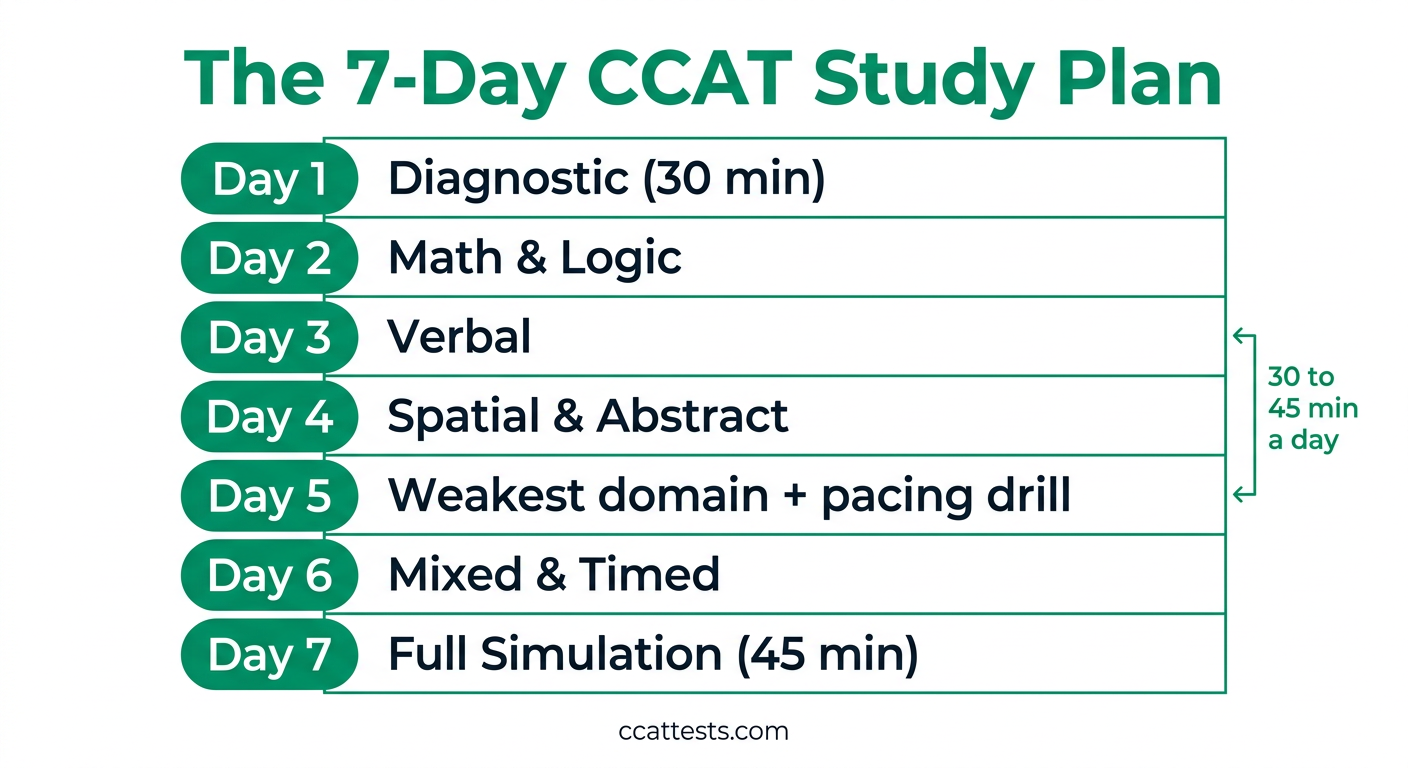
Here is the full week in one view. Each day is designed to fit in a single evening block, so you can prep around work.
| Day | Focus | Task | Time |
|---|---|---|---|
| Day 1 | Diagnostic | One full timed 50-question test to find your weak domain | 30 min |
| Day 2 | Math and logic | Untimed drills: percentages, ratios, averages, word problems | 40 min |
| Day 3 | Verbal | Untimed drills: analogies, antonyms, sentence completion | 40 min |
| Day 4 | Spatial and abstract | Untimed drills: rotations, matrices, odd-one-out, number series | 40 min |
| Day 5 | Your weakest domain | Re-drill the area Day 1 flagged, then a 20-questions-in-6-minutes pacing drill | 45 min |
| Day 6 | Mixed and timed | Two short mixed sets under the clock, working on skip-and-guess triage | 40 min |
| Day 7 | Full simulation | One full timed 50-question test, then review every miss | 45 min |
If you only have three days, do Day 1, then Day 5, then Day 7. If you have only two hours total, do Day 1 and Day 7 back to back on separate evenings. The diagnostic and the final simulation are the two non-negotiable sessions.
Day 1: the diagnostic (30 minutes)
Do not start by studying. Start by taking one full, timed, 50-question practice test, cold. This feels counterintuitive when you barely know the format, and that is exactly the point. The diagnostic does two jobs at once.
First, it delivers the format-shock in a low-stakes setting, so the real test is not the first time you feel the clock. Second, and more important, it tells you where your points are actually leaking. Almost nobody is equally weak across all three domains. You might cruise through verbal and stall on spatial, or handle math fine but freeze on number series. The diagnostic turns “I should study everything” into “I should spend my midweek on this one thing,” which is the single biggest efficiency gain in a one-week plan.
Write down your raw score and, more usefully, note which question types you got wrong or skipped. That list is your syllabus for the rest of the week.
Days 2 to 4: one question type per evening
With a full week, you have time to touch each domain once before doubling down on your weak one. Keep these three sessions untimed. The goal here is pattern recognition, not speed. Speed comes later.
- Day 2, math and logic. These are word problems, percentages, ratios, averages, and basic algebra, all done without a calculator. Drill the mental-math shortcuts: converting percentages to fractions, estimating to eliminate wrong options, and translating a word problem into one clean equation. This is the domain where a little technique goes a long way.
- Day 3, verbal. Analogies, antonyms, and sentence completion. The trick is spotting the relationship type fast (opposite, category, degree) and eliminating the obvious distractor. Verbal is where strong technical candidates often lose easy points by rushing, so slow down enough to read the whole question.
- Day 4, spatial and abstract. Rotations, matrices, odd-one-out, and number series. This is the domain people have seen least, so it benefits most from raw exposure. The more real CCAT-style figures you see, the faster your eye learns to spot the one feature that breaks a pattern.
Each evening, aim for enough questions that the format stops feeling foreign. You are building recognition, so that on test day these look like problems you have met before, not surprises.
Day 5: attack your weakest domain (45 minutes)
Now the diagnostic pays off. Spend the first half of this session re-drilling whichever domain Day 1 flagged as your weakest. This is your highest-leverage evening of the week, because closing a gap in your worst area lifts your score more than polishing your best one.
Then, in the second half, do your first pacing drill: 20 questions in 6 minutes, timed. That works out to the real 18-seconds-per-question rhythm. Do not worry about your accuracy on this drill. Worry about the feeling of the clock, and about building the reflex to guess and move rather than freeze. If you consistently run over on this drill, the fix is not “solve faster,” it is “skip sooner,” which is the core pacing skill covered in our 15-minute CCAT time management strategy.
Day 6: mixed and timed (40 minutes)
Real tests do not serve you one question type at a time, so today you practice switching. Do two short mixed sets under the clock, with all three domains interleaved the way the real CCAT presents them. The skill you are training is triage: reading a question, deciding in a few seconds whether to solve it, eliminate-and-guess, or blind-guess and flee, and then executing without hesitation.
Pay attention to your transitions. A lot of lost time on the CCAT hides in the half-second of hesitation between finishing one question and committing to the next. Smooth those out today.
Day 7: full simulation and review (45 minutes)
Close the week the way you opened it: one full, timed, 50-question test. Do it in a quiet room, no phone, scratch paper ready, exactly like test day. Then, and this is the part people skip, review every single question you missed or guessed. Ask why. Was it a knowledge gap, a careless error, or a pacing failure where you ran out of time? Each cause has a different fix, and naming it is how a review session actually raises your score.
Schedule Day 7 at least a full day before your real test. The night before the actual CCAT you should rest, not cram. A tired brain loses more points to careless errors than a slightly-less-drilled one gains from a last-minute session.
What if you have less than a week?
The plan compresses cleanly, because two sessions carry most of the value.
- Three days: Day 1 diagnostic, Day 5 weak-domain attack plus pacing drill, Day 7 full simulation.
- Two evenings: the diagnostic on the first evening, a full simulation with thorough review on the second.
- One evening only: take one timed full test, then review every miss and drill the two question types that hurt you most.
Even the one-evening version beats walking in cold, because most CCAT failure is format-shock and pacing panic, both of which a single realistic timed run defuses. If you have the opposite problem and more runway, our 2-week CCAT study plan uses the extra time to build deeper accuracy on each domain.
Why realistic practice is the whole plan
Notice that every day in this plan is built on one thing: real, timed, CCAT-style questions. That is deliberate. A study plan is only as good as the material it runs on, and generic aptitude questions recycled across a dozen different tests will not prepare you for the specific rhythm and question styles of the CCAT, especially the spatial and abstract items that people see least.
That is the gap we built CCAT Tests to fill. The question bank is genuinely CCAT-style across all three domains, and the free tier is a real practice experience rather than three teaser questions behind a wall. The part that makes a one-week plan work, though, is the analytics: after your Day 1 diagnostic, the heat-map shows you exactly which question types are costing you points, so you spend your scarce midweek evenings on the right weak area instead of guessing at it. If you are preparing for more than just the CCAT, the broader PrepClubs platform offers that same free-first practice-then-analytics approach across a range of pre-employment tests, with a money-back guarantee. Start free, find your weak spot, and only pay once you know it is worth improving systematically.
FAQ
Can you really prepare for the CCAT in one week?
Yes, if you use the time well. One week is not enough to raise your raw cognitive ability, but it is more than enough to fix the two biggest score-killers: unfamiliarity with the format and panic at the clock. A diagnostic plus five short focused sessions plus a full simulation reliably moves scores, because most people underperform on the CCAT for reasons that a week of realistic, timed practice directly solves.
How many hours do you need to study for the CCAT?
For a one-week plan, about 30 to 45 minutes a day, or roughly four to five hours total, is plenty for a busy professional. Beyond that, returns diminish quickly, because the CCAT rewards familiarity and pacing more than volume. Quality matters more than hours: one honest timed simulation with a real review is worth more than three hours of casual, untimed practice.
What should you study first for the CCAT?
Start with a timed diagnostic test, not with studying. Taking one full 50-question test cold shows you which of the three question types is your weakest, so you can aim your limited study time at the area that will move your score most. Studying “everything” evenly is the least efficient way to prep in a week.
What if you only have two or three days to prepare?
Prioritize the diagnostic and the full simulation, and squeeze a weak-domain drill in between if you can. Day 1 (diagnostic), Day 5 (attack your weakest area plus a pacing drill), and Day 7 (full timed test with review) is a strong three-day compression. Even two evenings, one diagnostic and one full simulation, meaningfully beats walking in unprepared.
Is the CCAT hard to pass in a short time?
The CCAT is genuinely challenging because of its speed, but “passing” is relative to the role, since scores are reported as percentiles. What a short prep window can absolutely do is stop you from underperforming your real ability, which is what happens when format-shock and clock-panic drag a capable person’s score down. A focused week closes most of that gap.
How many practice tests should you take in a week?
At least two full timed tests: one on Day 1 as a diagnostic and one on Day 7 as a simulation, plus several shorter timed drills midweek. Taking too many full tests back to back leads to fatigue and sloppy review. The value is in reviewing each test carefully, not in racking up attempts.
Should you memorize formulas for the CCAT?
A handful help, mainly percentage-to-fraction conversions, basic ratio and average setups, and the common number-series patterns. But the CCAT is not a formula exam, it is a reasoning-under-time exam. Your Day 2 through Day 4 sessions should build recognition of question types far more than rote memorization, because speed of pattern-spotting is what the clock actually tests.
Related on CCAT Tests
- More runway. The 2-week CCAT study plan. If you have more than a week, this deepens accuracy on each domain.
- Pacing. The 15-minute CCAT time management strategy. The clock skill your Day 5 and Day 6 drills are building.
- Pillar. The CCAT test preparation guide. The full hub of format, strategy, and prep.
- Practice. Free CCAT practice tests. Where you run your Day 1 diagnostic and Day 7 simulation.
Try CCAT Tests
A one-week plan needs the right week of practice.
This plan lives or dies on realistic, timed questions and a clear read on your weak spot. CCAT Tests gives you a genuinely usable free practice tier across all three domains, and after your Day 1 diagnostic the heat-map analytics point you straight at the question type costing you the most points, so your midweek evenings go to the right place. Start free, find your gap, and improve where it counts.