Your CCAT report came back lower than you hoped, or you are about to sit the test and you want to know how bad is bad. Either way, the honest answer is not a single number. A “bad” CCAT score is the one that falls below the cutoff for the specific role you applied to, and that cutoff moves depending on the job. This page gives you the low-end raw scores and percentiles in plain terms, tells you what actually happens if you score low, and shows you how to turn a weak result into a concrete plan instead of a dead end.
Quick note first: this is about the Criteria Cognitive Aptitude Test, the workplace hiring test from Criteria Corp. It is not the Canadian Cognitive Abilities Test, the school exam for children that shares the acronym. Different test, different scores. You want this one.
Quick takeaways
- The average CCAT raw score is about 24 out of 50, which is the 50th percentile. Anything meaningfully below that is below average.
- A “bad” score is relative: it is whatever falls under the cutoff for your specific role, not a fixed universal number.
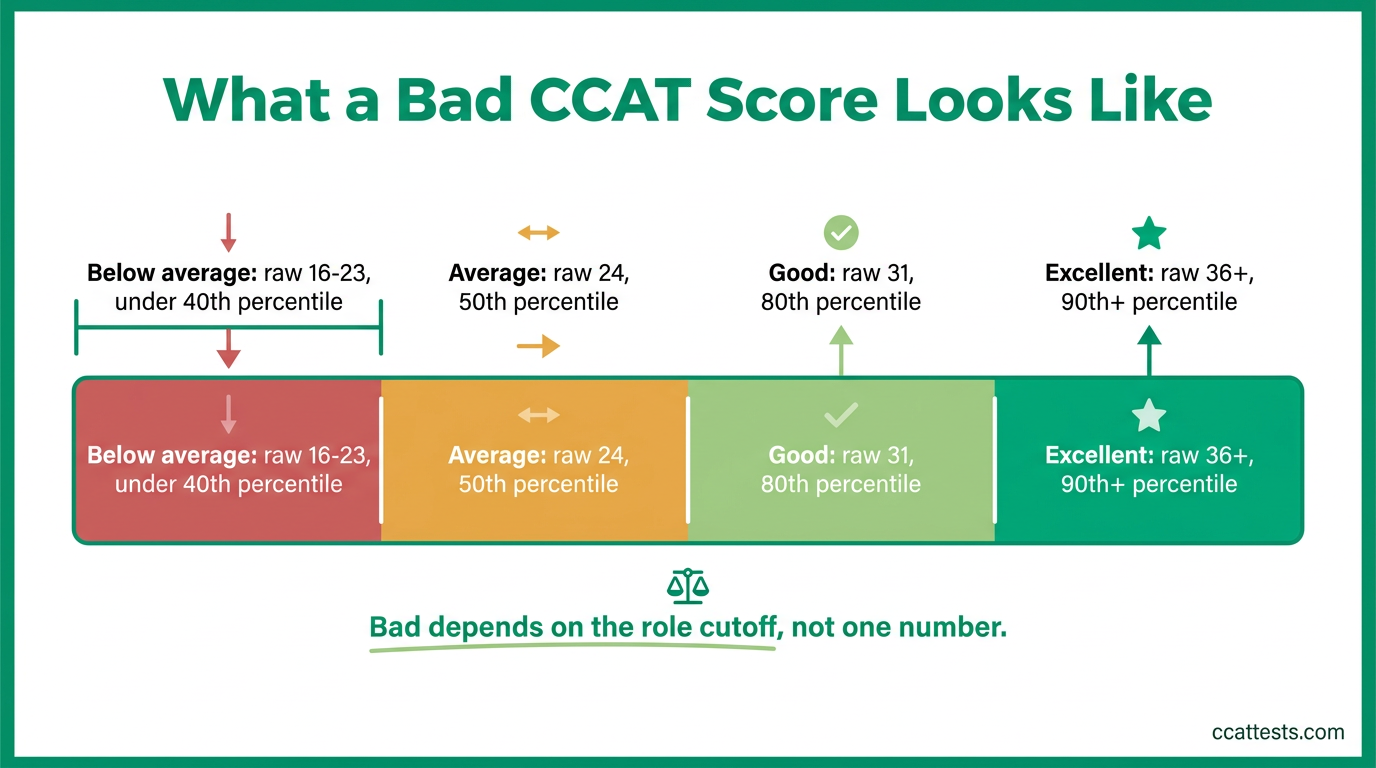
- Raw scores in the roughly 16 to 23 band (under about the 40th percentile) are where most people start calling a score low.
- For analytical roles like engineering, data, and consulting, a score that would pass for a support role can be a fail, because those cutoffs sit much higher.
- There is no penalty for wrong answers, so many low scores come from pacing and blanks, not from getting questions wrong, which is fixable.
- A low score is rarely the end. Retakes exist, and a bad score you understand is far more useful than a good one you got by luck.
What the average and the low end actually look like
Start with the anchor: the average raw score on the CCAT is around 24 out of 50, and by definition that sits at the 50th percentile. Your percentile is the percentage of past test-takers you outscored, so a 50th-percentile result means you did better than about half of everyone who has taken the test. A raw score of 31 lands near the 80th percentile, which most employers treat as strong.
So where does “bad” begin? There is no official failing line, but in practical terms a score that drops below the average, into roughly the 16 to 23 raw range (under about the 40th percentile), is where the word “low” starts to apply for most roles. Below the 25th percentile, you are in territory that clears the bar for very few professional positions.
Here is the important nuance, and the thing almost no other score guide says plainly: the same raw score can be a pass at one company and a fail at another. A 22 might be perfectly fine for an entry-level support role and well short for a software engineering role at a company that sets a high cutoff. “Bad” is defined by the gap between your score and the role’s target, not by the number alone.
Low-end scores by role
Employers set a suggested score range per role based on the cognitive demands of the job. The more analytical the role, the higher the expected score, which means the threshold for a “bad” result rises with it. These are commonly cited ranges, not guarantees for any one company, so treat them as a guide.
| Role type | Typical target raw score | What reads as “low” for this role |
|---|---|---|
| Administrative / support | 20 to 24 | Below about 18 |
| Sales / customer-facing | 22 to 27 | Below about 20 |
| Marketing / operations | 24 to 29 | Below about 22 |
| Engineering / software | 28 to 33 | Below about 26 |
| Data science / analytics | 31 to 35 | Below about 29 |
| Consulting | 31 to 35 | Below about 29 |
| Senior manager / executive | 32 to 42 | Below about 30 |
Read that table sideways and the point lands: a raw score of 27 is a solid, above-average result for a sales role and a below-target result for a data science role. If you are aiming at a tech or analytics job, you are being measured against a higher bar than the raw “average” suggests, and a 50th-percentile score is often not enough. One well-known example: some sources report that Crossover, a company known for demanding CCAT scores, treats a baseline near 35 out of 50 (about the 85th percentile) as the lowest passing grade for certain roles. That is a high bar, and against it, a perfectly respectable general-population score would count as low.
What actually happens if you score low
A low score usually means one of three things, and it helps to know which.
First, for many roles, the CCAT is a screen, not the whole decision. A below-cutoff score can end your candidacy for that specific job, which is the hard truth. But it does not go on a permanent record that follows you, and it does not bar you from applying elsewhere or, in many cases, from retaking.
Second, some employers set a soft preference rather than a hard wall. A slightly-below-target score paired with a strong resume and interview can still move forward, especially outside the most competitive analytical roles. The cutoff is the employer’s tool, and employers weight it differently.
Third, and most usefully: a lot of “bad” CCAT scores are not ability problems, they are pacing problems. The CCAT gives you 15 minutes for 50 questions, roughly 18 seconds each, and very few people finish all 50. Because there is no penalty for wrong answers, blank questions at the end (from running out of time) count exactly the same as wrong ones: zero. That means a real chunk of low scores come from leaving too many questions unanswered, not from getting the answered ones wrong. That is a fixable problem, and it is often the fastest single improvement available.
How to tell if your low score is fixable
Before you assume a low score means the CCAT is not for you, diagnose why it was low. Ask three questions.
Did you run out of time and leave questions blank? If yes, your issue is pacing, not reasoning, and pacing is the most trainable thing on this test. Practicing at the real 15-minute pace, and learning to guess-and-move on hard items instead of stalling, often adds several raw points on its own.
Was your accuracy fine but concentrated in one section? Maybe your verbal and math were solid but spatial reasoning dragged you down. That is a targeted weakness, and targeted weaknesses respond well to focused drills on that one question type.
Or were you genuinely losing points across the board, evenly? That is the case that takes the most work, but even then, the CCAT rewards familiarity with its question formats, and structured practice reliably moves scores upward.
The difference between “I need to be better” and “I lose four points a test to spatial questions and three more to blanks I ran out of time for” is the difference between a vague worry and an actual plan.
Turning a bad score into a plan
This is where a diagnostic beats a raw number. A score tells you where you stand; it does not tell you why, and the why is what you can actually change.
On CCAT Tests, your practice results come back as a heat-map of exactly which question types are costing you points (verbal, math and logic, or spatial and abstract), plus drills aimed at your weak areas. That is the same kind of weak-area analytics that team-focused assessment tools charge hundreds of dollars a month for, built into a one-time purchase. Instead of a discouraging number, you get a targeted list of what to fix first.
And if you are staring down a specific cutoff and the anxiety of a hard deadline, the paid tiers are one-time purchases that let you keep drilling the exact question types standing between you and the threshold you are aiming for. The practice bank mirrors the real CCAT, including the spatial images generic sites skip, and you can start on the free tier to see your first heat-map before deciding whether to pay for anything.
A bad CCAT score you understand beats a good one you got by luck. The first is a plan. The second is a coin flip you might not win twice.
FAQ
Is 20 out of 50 a bad CCAT score?
A 20 sits below the average of 24 and lands around the low-to-mid 30s in percentile. It clears the bar for some entry-level and support roles but falls short for most professional and analytical positions. Whether it is “bad” depends entirely on the role you applied to, but for engineering, data, or consulting jobs, yes, it would be below target.
What is the lowest passing CCAT score?
There is no universal passing score. Each employer sets its own cutoff per role, so the lowest passing score for one job might be 18 and for another 35. Some sources report that companies known for high standards use a baseline near 35 out of 50 for demanding roles. Always aim to clear the target range for your specific job, not a generic number.
What percentile is a bad CCAT score?
Roughly speaking, below the 40th percentile starts to read as low for most roles, and below the 25th percentile clears the bar for very few professional positions. But “bad” is set by the role’s cutoff, so a 45th-percentile score can be a pass for a support job and a fail for an analytics job.
Does a low CCAT score go on a permanent record?
No. A low CCAT score can end your candidacy for the specific job you applied to, but it is not a permanent mark that follows you between employers. You can generally apply elsewhere, and in many cases retake the test for a future application.
Can you fail the CCAT?
You cannot “fail” the CCAT in the sense of a fixed passing line, because there is not one. But you can score below an employer’s cutoff for a role, which functions as a fail for that application. The good news is that many below-cutoff scores come from pacing and blanks, which are fixable with practice.
Why is my CCAT score low if I got the answers right?
Usually because you did not answer enough questions. The CCAT is a race: 50 questions in 15 minutes, and blank questions count as zero just like wrong ones. If you were accurate but slow, your raw score reflects the questions you never reached, not the ones you got wrong. Practicing at the real pace fixes this faster than anything else.
Related on CCAT Tests
- Companion. What is a good CCAT score. The full breakdown of average, good, and elite scores with role context, the flip side of this page.
- Score chart. CCAT score percentile chart. Convert any raw score into a percentile and see exactly where you land.
- Next step. CCAT retake strategy. How to improve a low score on a second attempt.
- Pillar. CCAT scores and results guide. Everything about reading, comparing, and improving your CCAT results.
- Practice. Free CCAT practice tests. See where your score actually stands before test day.
Try CCAT Tests
Turn a low score into a targeted plan, not a dead end.
A bad CCAT score is only useful if you know why it happened. CCAT Tests gives you a heat-map of the exact question types costing you points and drills aimed at your weak spots, the kind of analytics that usually costs hundreds a month, in a one-time purchase. The free tier is a real practice experience across all three domains, not a three-question teaser, so you can find your weakest section before deciding whether to pay. If you are facing a hard cutoff, the paid tiers are one-time purchases that give you the full question bank to keep drilling until you clear your target. And if your hiring process pairs the CCAT with other assessments, our sister platform PrepClubs runs realistic practice across 21 pre-employment tests with a money-back guarantee, so a low score on one test does not derail the whole process.