A recruiter sent you a link, you clicked it, and the screen said 50 questions, 15 minutes. Since then you have been running worst-case scenarios at midnight about something that takes less time than your commute. If you are asking yourself why am I nervous about the CCAT, here is the direct answer: you are nervous because the test is deliberately built so that almost nobody finishes it, and your brain reads “I cannot finish this” as “I am about to fail.” One quick disambiguation before you start: this is the Criteria Cognitive Aptitude Test used in workplace hiring, not the Canadian Cognitive Abilities Test given to schoolchildren that shares the same initials. The nerves are normal, they are predictable, and most of what feeds them is information you simply do not have yet.
Quick takeaways
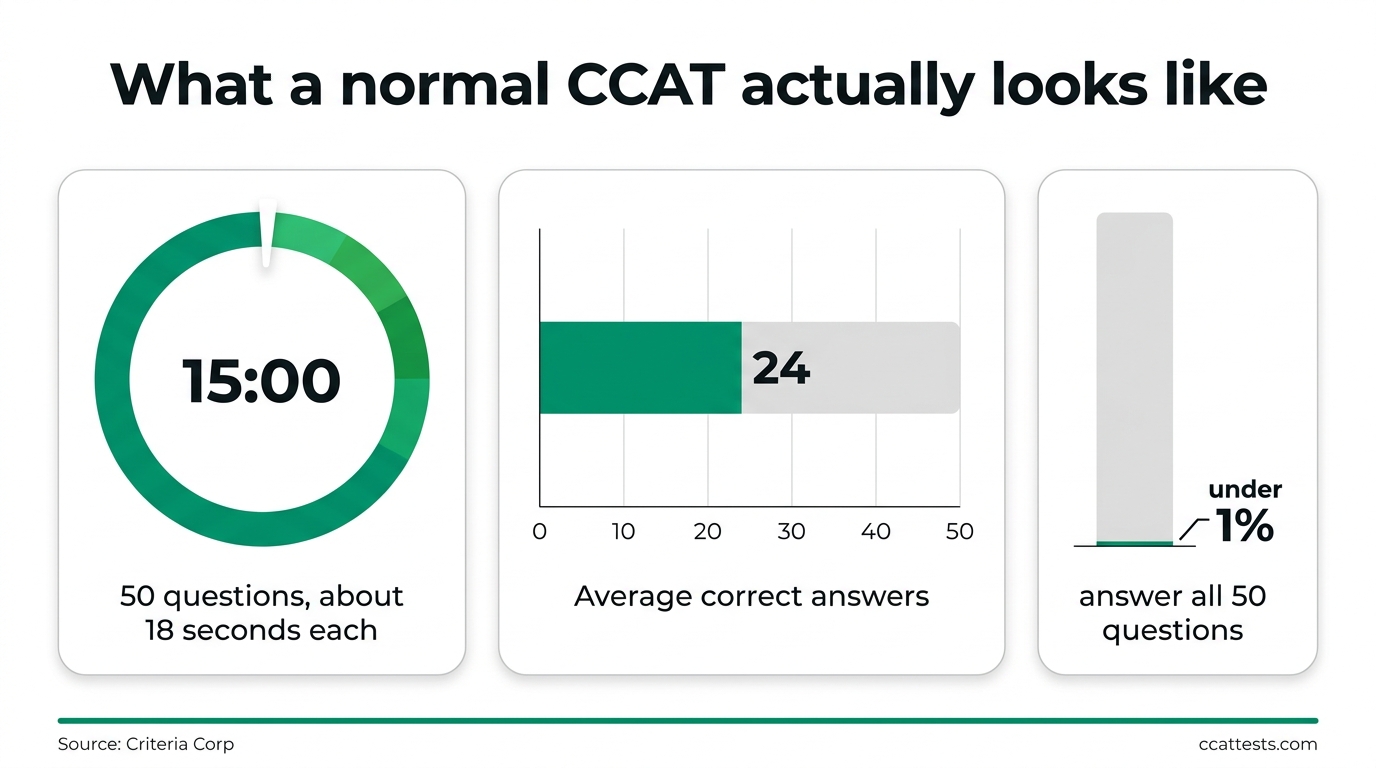
- The CCAT is 50 questions in 15 minutes. Criteria Corp puts that at under 20 seconds per question, so the time pressure is not a side effect, it is the test.
- Criteria Corp reports that the average test taker gets 24 questions right and that fewer than 1% of candidates answer all 50. Not finishing is the designed outcome.
- Short tests feel scarier than long ones because there is no room to recover. A bad 90 seconds is 10% of your entire test.
- Most CCAT dread is uncertainty, not difficulty. You do not know the cutoff, the question types, or how fast 15 minutes actually moves.
- Anxiety hurts your score through one specific route: worry takes up working memory, which is exactly the resource this test measures.
- The fear shrinks when unknowns become knowns. One honest timed practice run does more for your nerves than an evening of breathing exercises.
The short answer: the test is engineered to feel unsurvivable
You are nervous because the CCAT is openly designed to exceed what a human can complete in the time given. Criteria Corp, the publisher, says on its own candidate prep page that the test has 50 questions and 15 minutes, that the average test taker only gets 24 questions right, and that fewer than 1% of candidates answer all 50. Criteria even opens that page by acknowledging the test looks intimidating and telling candidates not to panic.
That reframes the whole thing. The test is not a checklist you are supposed to complete, it measures how far you get under pressure. Your instinct that you will run out of time is not anxiety talking, it is an accurate prediction that comes true for nearly everyone. What your nervous system gets wrong is attaching a catastrophe to a standard outcome.
A second design feature catches people off guard. Crossover, an employer that uses the CCAT and publishes its own candidate guide, tells applicants that the questions graduate in difficulty as you move through the test. So the wall you hit two thirds of the way in is scheduled, not evidence that your brain shut down. Everybody meets it somewhere.
Five design choices that manufacture CCAT dread
Every part of the CCAT that frightens people is a deliberate design decision, and each one has a fact attached that defuses it.
| Design choice | Why it spikes your nerves | The part nobody tells you |
|---|---|---|
| 50 questions in 15 minutes | Under 20 seconds per question means no time to check your work, and checking work is how most people feel safe | Partial completion is the expected result. Criteria Corp reports the average is 24 correct |
| Difficulty ramps as you go | You hit a wall and read it as proof you are not smart enough | The ramp is built in. Where you stall says more about pacing than ability |
| Three unrelated domains in one stream | Verbal, math and logic, and spatial questions rotate, so you switch mental gears constantly | You are allowed to skip. Playing to your strengths is explicit advice from the publisher |
| One number, ranked against strangers | Employers receive a raw score and a percentile, which feels like a verdict on you as a person | Employers compare you to a range for that specific role, not to a universal pass mark |
| It usually gates the job before a human sees you | A 15-minute window feels like it decides your career | It decides one application. Retakes, other employers, and better preparation all exist |
The pattern is consistent: every source of dread comes from something you do not know yet, and every one has a knowable answer.
Why 15 minutes is scarier than three hours
A short test frightens people more than a long one because it removes the recovery window. In a three-hour exam, ten bad minutes cost you about 6% of the paper and you can steady yourself afterwards. On the CCAT, ninety seconds of panic is 10% of your entire test and roughly five questions you will never see. The stress surge that arrives when the timer starts can still be fading at question 20, with no time left for it to pass.
There is one more difference. Most exams you have sat measured something you studied. The CCAT measures reasoning speed, which feels like it measures you, and that is why a 15-minute hiring test can produce more dread than a semester final.
What anxiety actually does to your CCAT score
Anxiety does not make you less intelligent. It borrows the exact mental workspace the CCAT measures, which is why the effect feels so unfair.
Psychologists describe this as choking under pressure: worry runs as a background process, and that process competes for working memory. Working memory is the short-term mental desk where you hold a number series while you test a pattern, or keep three ruled-out shapes in mind while you evaluate the fourth. On the CCAT, worry occupies the exact resource the test is scoring.
In practice it shows up as four specific behaviors:
- Rereading the same verbal question two or three times without the meaning landing.
- Losing your place in a number series and restarting the arithmetic from scratch.
- Forgetting which answer options you already eliminated on a spatial question.
- Checking the timer, which costs a second each time and resets your concentration.
Be honest about the size of this effect, though. Anxiety is not why most people score below a cutoff. Unfamiliarity with the format and never having practiced at speed do far more damage. If you have never seen a CCAT-style abstract reasoning grid before test day, that is a preparation gap rather than an anxiety problem, and it has a simpler fix. Our guide to why overthinking wrecks CCAT questions covers the in-test half.
Normal nerves versus the kind that costs you points
Most CCAT nerves are ordinary and cost you nothing. A smaller pattern genuinely does lower scores, and the two are easy to tell apart.
| Signal | Ordinary pre-test nerves | Anxiety that is costing you points |
|---|---|---|
| Sleep | One restless night before the test | Several lost nights, and the test is still days away |
| During the test | Heart rate spikes, settles by question five | Still spiraling at question 20, rereading the same line |
| Preparation | Checking the format, taking a practice run | Avoiding practice entirely because starting a timer feels awful |
| Self-talk | “I hope I do well on this” | “This is going to prove I am not smart enough” |
| Afterwards | Relief, then you move on | Days of replaying it before results even arrive |
The third row is the one that matters. Avoidance is the only anxiety symptom that reliably lowers a CCAT score, because it removes the single thing that works. If starting a 15-minute timer makes you close the tab, solve that first, by making the first practice run consequence-free rather than by waiting to feel ready.
For the technique layer rather than the explanation layer, we have a full set of psychology-backed techniques for CCAT test anxiety covering breathing, reframing, and attention control.
Two candidates, the same score, a completely different week
Picture two candidates who both answer 27 of 50 questions correctly on the CCAT for the same operations role. Maya has run four timed practice sessions, so she already knows 24 correct is around average and that leaving 20 or so blank is what almost everyone does. She reads 27 as slightly above average and goes to dinner. Devin has never used a timer, fixates on his 23 blanks, and spends four days convinced he bombed it.
Same raw score, opposite week, and nothing separated them except a reference frame. That gap closes after one honest practice session. If leaving questions blank is your specific worry, we wrote a whole piece on whether it is normal to not finish the CCAT.
What actually shrinks the fear, and it is not relaxation
The fastest way to reduce CCAT anxiety is to convert unknowns into knowns. Relaxation helps on the day; information helps for the whole week before it. Five unknowns do almost all of the emotional work, and each has a concrete closer:
- How fast does 15 minutes actually move? Take one timed run start to finish. The pace stops being abstract after a single attempt, which is usually the biggest drop in dread you will get.
- What do the questions look like? The spatial and abstract-reasoning items are the ones most people have never seen in their lives, which is why they feel like ambush questions. Seeing twenty removes the surprise, and our CCAT question types breakdown covers all three domains.
- Where am I losing time? Nervousness stays vague until it has a location. Once you know you lose 90 seconds on number series and almost nothing on verbal analogies, the worry becomes a task.
- What score is even good? A number with no context is frightening by default, so learning what employers actually look for changes how you read your own result. What counts as a good CCAT score covers the ranges.
- What happens if I do badly? The real answer usually involves retakes, other employers, and a second attempt with better preparation, which takes the catastrophe out of the scenario.
One honest caveat: preparation reduces the fear you can control, and that is most of it. It will not remove nerves entirely, and you would not want it to, because a moderate amount of arousal helps on a test scored by speed. The goal is not calm. The goal is familiar.
FAQ
Is it normal to be this nervous about the CCAT?
Yes, and the intensity surprises people precisely because the test is so short. The CCAT compresses a high-stakes hiring decision into 15 minutes with no recovery window, and it is built so almost nobody completes it. Dread about a test designed that way is a reasonable response, not a personal weakness.
How difficult is the CCAT, really?
The individual questions are not unusually hard. The difficulty comes almost entirely from speed: Criteria Corp gives you under 20 seconds per question and reports the average test taker answers 24 of 50 correctly. Most people who prepare improve on pacing, not on raw reasoning ability.
Is 26 out of 50 a good CCAT score?
It is slightly above the average of 24 correct that Criteria Corp reports. Whether it is good enough depends on the role, since employers set their own ranges and analytical positions typically expect more than customer-facing ones. Treat 24 as the benchmark for average and judge your result against the specific role, never against a cutoff number you read online.
Does test anxiety actually lower your CCAT score?
It can, through one mechanism: worry consumes working memory, the same capacity you need to hold a number series or track eliminated shapes. That said, unfamiliarity with the format costs most candidates far more points than nerves do. Avoiding practice because it feels stressful is the version of anxiety that genuinely damages scores.
How do you beat the CCAT test?
Pace deliberately, skip anything that stalls you for more than about 20 seconds, guess rather than leave anything blank since there is no penalty for wrong answers, and practice the question types you have never seen. Beating it is mostly a triage skill, and our CCAT time management strategy breaks the 15 minutes into a workable plan.
Is the CCAT accurate, and is it the same test Canadian schoolchildren take?
They are two different tests that share an acronym, and search results mix them constantly. The Criteria Cognitive Aptitude Test is a workplace hiring assessment from Criteria Corp; the Canadian Cognitive Abilities Test is a school screening tool for gifted programs. Any statistic about tens of thousands of Canadian students in grades K to 12 belongs to the other test and tells you nothing about yours.
Should I take a practice test if I am too anxious to start one?
Start with an untimed run through a handful of questions. The purpose of the first session is not a score, it is removing the strangeness, so give yourself permission for it not to count. Once the question types stop being unknown, turning the timer on is a much smaller step.
Can I retake the CCAT if nerves ruined my first attempt?
Retake policy is set by the employer, not by you, so it depends on the company and some allow a second attempt after a waiting period. Ask the recruiter directly rather than assuming the door is closed. What you control is the preparation before the next opportunity, at this employer or the next one.
Related on CCAT Tests
- Pillar. The complete CCAT test preparation guide. The full hub for format, pacing, scoring, and a real study plan.
- Nerves. Psychology-backed techniques for CCAT test anxiety. The technique layer, once you understand where the dread comes from.
- Normalize it. Is it normal to not finish the CCAT?. The single fact that calms most people down.
- Scoring. What counts as a good CCAT score. Context for the number you are afraid of.
- Practice. Free CCAT practice tests. Run the real 15-minute timer once and watch the fear shrink.
Try CCAT Tests
The cure for CCAT dread is familiarity, and familiarity is free to start.
Almost every part of this anxiety comes from an unknown, so CCAT Tests closes those unknowns in order. The free tier is a genuinely usable timed practice run rather than three sample questions and a paywall, and it includes the real spatial and abstract-reasoning imagery that generic prep sites skip, which is the material most candidates have never seen and fear most. On a paid plan the heat-map analytics show which of the three domains is actually costing you time, so the worry becomes a specific drill instead of a mood. Plans are one-time payments, not a subscription, see pricing, so you can buy one block of serious practice instead of lying awake about the one-shot feeling. All of it is backed by our companion Udemy course with 1,200+ students and a 4.5/5 rating. And if this employer has several assessments lined up after the CCAT, our sister platform PrepClubs runs the same free-first practice across 21 pre-employment tests with a money-back guarantee.