A recruiter sent you a CCAT link, and you already know the shape of your problem. You are not bad at this material, you are slow with it. You read each question twice, you check your work, and the moment a countdown appears your brain goes quiet for seconds you cannot afford. Here is the direct answer: on the CCAT, “slow” is not one problem, it is three, and only one of them is fixed by trying to go faster. One quick disambiguation before you start: this is the Criteria Cognitive Aptitude Test used in workplace hiring, not the Canadian Cognitive Abilities Test given to schoolchildren that shares the same initials.
Quick takeaways
- The CCAT is 50 questions in 15 minutes, under 20 seconds each, so it is a speed test wearing a reasoning test’s clothes.
- Feeling slow has three separate causes: slow decoding, freezing, and perfectionist re-checking. Prep aimed at the wrong one wastes your week.
- Freezing is a stress response, not a lack of ability, and it responds to a rehearsed reset far better than to more studying.
- Criteria Corp reports that fewer than 1% of candidates answer all 50 questions and the average test taker gets about 24 right, so your target was never “finish”.
- Train pace on a ladder: untimed accuracy first, then a generous timer, then the real pace, then a full simulation. Jumping straight to full speed just rehearses panic.
- A hard per-question cap is the single change that helps slow test takers most. Criteria Corp’s own ceiling is one minute, and you want to be well under it.
- If a documented condition affects your processing speed, extra time is a real route, and the request goes to the employer, not to Criteria Corp.
Why the CCAT is harder on slow test takers than almost any other hiring test
The CCAT punishes slowness more than difficulty, and that is a design choice rather than an accident. According to Criteria Corp, the company that publishes the test, the CCAT is 50 questions in 15 minutes across three kinds of questions: verbal, math and logic, and spatial reasoning, with no calculators. That works out to under 20 seconds per question, and Criteria states plainly that less than 1% of candidates answer all 50 while the average test taker gets about 24 right.
Read what that means for you specifically. On most assessments a careful person trades time for accuracy and comes out even. Here you cannot. There is no per-question timer to bank seconds from, no section breaks, and no credit for being right in a way that took longer. Employers receive your raw score plus your percentile, and questions you never reached score exactly like questions you got wrong.
So the points you are losing are almost certainly not on the page in front of you. They are on the questions at the end you never saw. That is uncomfortable to hear and it is also good news, because throughput is one of the most trainable things on this test.
Being slow and freezing are two different problems
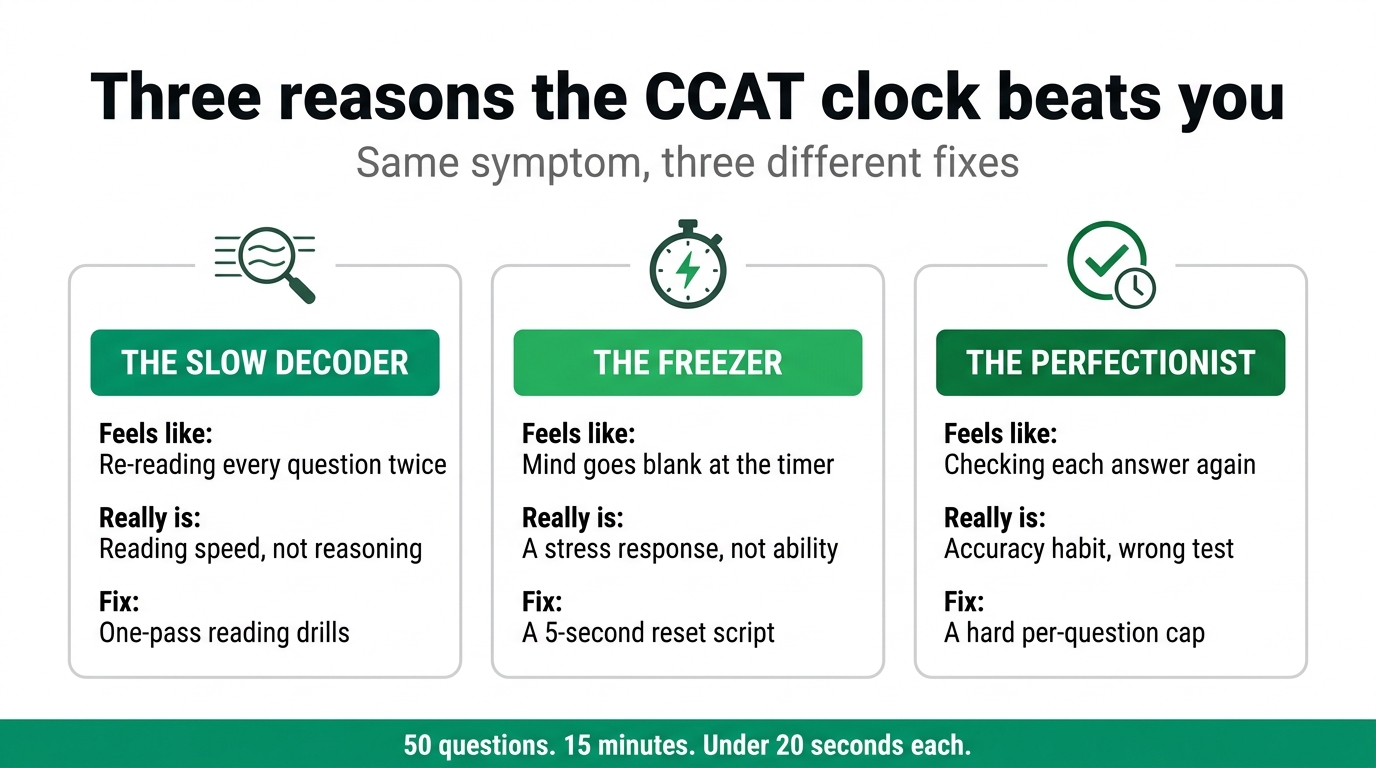
“I am a slow test taker” is a symptom, and it has three common causes that need three different fixes. Spend a single practice session working out which one is yours before you spend a week on the wrong drill.
| What it feels like | What it actually is | What to change | How you know it worked |
|---|---|---|---|
| You read each question twice before you can start | Decoding speed, not reasoning ability | One-pass reading: read once, start solving, re-read only if you stall | You attempt more questions at the same accuracy |
| The timer starts and your mind goes blank | A stress response, not a lack of ability | A five-second rehearsed reset, plus exposure to a real 15-minute clock | The blank stretch shrinks on each timed run |
| You solve it, then check it again before moving on | An accuracy habit that was right on untimed exams and is wrong here | A hard per-question cap and a rule against revisiting anything | Attempts rise while accuracy barely moves |
Most people recognise themselves in one row immediately. Some are a blend of the freezer and the perfectionist, which makes sense, because both are driven by the fear of being wrong. If you are not sure, run one timed practice set and watch the clock rather than the score: where the seconds disappear tells you which row you are in. If they vanish into second-guessing answers you had already chosen, how to stop overthinking CCAT questions goes deeper on that pattern.
The speed ladder: four rungs that build pace without wrecking accuracy
Build speed in stages, and never start your prep at full test pace. Going straight to a 15-minute simulation on day one is how careful people teach themselves that the clock means panic.
Rung 1: untimed accuracy, one question type at a time. No clock at all. The job is to prove the content is not the problem. Most slow test takers score very high here, and that result is diagnostic: it means every point you lose on the real test is a pace problem, not a knowledge problem.
Rung 2: a generous timer, about 30 seconds per question. Still one type at a time. Thirty seconds sits comfortably above real pace, so you can practise moving without spiralling while your accuracy holds steady.
Rung 3: real pace, about 18 seconds per question, mixed types. That is the actual arithmetic of the test. Mix the three domains so you also rehearse the switching cost, because moving from a word problem to a spatial pattern has a tax that single-type drilling hides.
Rung 4: a full 50-question, 15-minute simulation in one sitting. Same conditions you will face: no calculator, no pausing, no going back. Do at least one before test day and review every miss afterwards instead of just reading the score.
Move up a rung only when your accuracy at the current one stops sliding. If your test is in three days rather than three weeks, do rung 1 once to confirm the content is fine, then spend everything else on rungs 3 and 4. For the test-day rules that sit on top of this training, the 15-minute CCAT time management strategy covers how to spend the clock once you are in it.
What to do in the five seconds when your mind goes blank
A freeze ends when your attention has somewhere concrete to go, so decide in advance where that is. Trying to calm down mid-question does not work, because calming down is not an action you can take in four seconds.
Rehearse this reset during practice so it runs automatically on test day:
- Name it, silently and briefly. “This is the freeze. It lasts seconds.” Recognising the state stops you adding a second layer of panic about the panic.
- Move your eyes off the question stem and onto the answer options. A blank mind cannot generate an answer from nothing, but it can react to something on screen.
- Eliminate one obviously wrong option. Making one small decision restarts problem solving, and it improves your odds if you end up guessing.
- Hit your cap, then guess and go. Criteria Corp’s own guidance is to make an educated guess and move on once you have spent more than a minute on a problem, which only makes sense because wrong answers are not penalised. Our CCAT guessing strategy covers how to make those guesses better than random.
Expect the freeze at two predictable moments: the very first question, and somewhere in the back half where the questions get harder. Knowing the ambush is coming takes most of its force away.
A worked example: why more attempts beats more accuracy
Numbers make this concrete, so here is an illustrative case built from the profile above rather than a real candidate.
Maya is a careful analyst. Untimed, she gets 46 of 50 CCAT-style questions right. Under a real 15-minute clock she reaches question 26 and gets 23 of them right, so her raw score is 23, just under the average of about 24, despite untimed accuracy near the top of the range.
Do the arithmetic on her clock. Reaching 26 questions in 900 seconds means she averaged roughly 35 seconds each, about double the pace the test is built around. Suppose training gets her to 22 seconds, still slower than the 18-second design pace. She would reach roughly 41 questions, and even if the extra speed cost her real accuracy, dropping from 88% to 78% correct on what she attempts, she lands around 32 right.
Going faster and getting less accurate moved her from 23 to about 32. That is the counterintuitive part for careful people, and it is the whole strategy. If you are slow and accurate, your score is capped by throughput rather than correctness, so trading some accuracy for attempts still leaves you well ahead. The trade only stops paying when accuracy collapses, which is why the ladder exists. If your last practice run ended with a pile of unreached questions, is it normal to not finish the CCAT puts that in context.
When “slow” is a documented condition, not a habit
If a diagnosed condition affects your processing speed, extra time on the CCAT is a real route, and the request goes to the employer that sent you the test rather than to Criteria Corp. Under the ADA in the US, employers must provide reasonable accommodations for a documented disability, decided case by case, and extra time is the most commonly requested CCAT adjustment. Ask the same day the invitation arrives and before you open the test, and name the specific adjustment rather than describing the difficulty in general terms. The step-by-step version is in our guide to CCAT test accommodations.
Be honest about which situation you are in, though. An accommodation levels the conditions, it does not change the scoring, and it is no substitute for pacing practice. Most people reading this are habitually careful rather than clinically slow, and for them the ladder is the answer.
FAQ
Is the CCAT test hard?
Yes, and the difficulty comes almost entirely from speed rather than content. The questions sit at a level most adults handle given time, but you get under 20 seconds each and they get harder as you go. Criteria Corp reports fewer than 1% of candidates answer all 50, so struggling with the clock is the standard experience, not a personal failing.
How do you do well on the CCAT if you are a slow test taker?
Increase how many questions you attempt rather than trying to be more correct on the ones you already reach. Set a hard per-question cap, never revisit an answer, and train with a timer in stages instead of jumping straight to full pace. For a careful reader, throughput is almost always the limiting factor.
Is 26 out of 50 good for the CCAT?
A 26 sits just above the commonly cited average of about 24, so it lands mid-pack, and whether that is good depends on the role because each employer sets its own cutoff. Competitive technical, finance, and consulting positions often look higher. If you score around 26 with strong untimed accuracy, that gap is pace, which is the most improvable part of the test.
What is the best CCAT test prep if I keep running out of time?
The prep that shows you where your seconds go, not just what you scored. A final number cannot tell you whether you lost the test to slow reading, a freeze, or re-checking. Look for timed practice under real conditions plus a per-question-type breakdown, so your next session targets the thing actually costing you.
Can you get extra time on the CCAT?
Sometimes, if you have a documented disability. The request goes to the employer or recruiter who sent the test link, not to Criteria Corp, and each one is decided case by case under the ADA in the US. Ask before you start the test and name the specific adjustment you need.
Why does my mind go blank as soon as the CCAT timer starts?
A visible countdown triggers a stress response, and working memory is the first thing that response takes offline. It is not a sign you do not know the material, which is why studying more content does not fix it. Repeated exposure to a real 15-minute timer plus a short rehearsed reset shrinks the blank stretch faster than extra revision does.
How long does it take to get faster at the CCAT?
Pacing responds quickly compared with most test skills, usually within a handful of timed sessions, because you are changing a habit rather than learning new material. Two weeks of short sessions is a comfortable runway. If your test is in a few days, prioritise one full timed simulation and a strict per-question cap over everything else.
Related on CCAT Tests
- Pillar. The complete CCAT test preparation guide. The full prep picture that the speed ladder plugs into.
- Timing. CCAT time management: the 15-minute strategy. How to spend the clock once you are actually in the test.
- Mindset. How to stop overthinking CCAT questions. For the re-checking version of slow.
- Accommodations. CCAT test accommodations and extra time. Who to ask, when, and what to send.
- Practice. Free CCAT practice tests. Run the real 15-minute timer before it counts.
Try CCAT Tests
Find out which kind of slow you are, then fix that one
Start with a real timed run rather than more reading. The free tier at CCAT Tests is genuinely usable on its own, not a seven-day trial: take a CCAT-style practice test across all three question domains, watch where your seconds disappear, and you will know within one sitting whether you are a slow decoder, a freezer, or a re-checker. To train the ladder properly, the paid tiers, all one-time, see pricing, add repeated full-length timed simulations with real CCAT-style questions, including the spatial and abstract items that are hardest to practise anywhere else, plus a heat-map showing which question type is eating your clock. That is the class of per-question-type insight analytics tools normally sell for hundreds of dollars a month, here as a one-time purchase. It matters most if you are a slow test taker facing a hard company cutoff or a retake, because one focused block of practice is what actually moves the number. All of it is backed by our companion Udemy course, with 1,200+ students and a 4.5/5 rating.
If the CCAT turns out to be one stage of a hiring process that also throws personality questionnaires, situational judgement, or a second cognitive test at you, prepping the whole sequence in one place saves a lot of scrambling. The wider paid platform for that is PrepClubs, covering 21 pre-employment tests with more than 3,700 students and a money-back guarantee.