A recruiter sent you a CCAT link, you searched for a prep course, and the first page of Google handed you five checkout pages with five different prices. Here is the short answer before you spend anything: most of what a CCAT prep course sells you is available free, and the narrow slice that genuinely deserves your money costs less than a takeaway lunch. One quick disambiguation, because the acronym is a trap: this is the Criteria Cognitive Aptitude Test used in workplace hiring, not the Canadian Cognitive Abilities Test given to schoolchildren that shares the same initials. Below are the real market prices as of August 2026, the three things worth paying for, and the pricing traps that turn a cheap plan into an expensive one.
Quick takeaways
- CCAT prep courses on page one of Google run from about $30 to about $49, and one practice service was reported by a candidate at around $65 per week.
- The most valuable resource in CCAT prep, one full-length run against a real 15-minute clock, is available free. Never pay for a baseline.
- The CCAT is 50 questions in 15 minutes across verbal, math and logic, and spatial reasoning, no calculator allowed (source: criteriacorp.com). A short speed test caps what a course can be worth.
- Three things are worth money: a realistic question bank with rendered spatial images, weak-area analytics, and repeatable timed simulations.
- Compare access windows, not sticker prices. A $48.90 course that expires in 30 days is not cheaper than a lower-priced one-time tool if your test date slips.
- Read the pass-guarantee conditions. One page-one course requires 80% or higher on every one of its own practice exams before its guarantee applies.
What a CCAT prep course actually costs right now
A CCAT prep course typically costs between $30 and $50 for a fixed access window, though the live range runs from free to roughly $65 per week. Every figure in the table below comes from one exercise: on 1 August 2026 I opened the first page of Google results for “ccat prep course” and wrote down every price and access window that each page actually published. Published prices and access windows are reproduced as shown, and the six-week costs in the last column are calculated from them. That last column is the comparison the sales pages never make for you.
| What you find on page one | Published price | Access window | Real cost if your test is six weeks out |
|---|---|---|---|
| One-time question bank and analytics | see pricing | One-time, fixed access window | see pricing |
| Mid-tier prep course, core plan | $29.99 | 3 months | $29.99 |
| Same vendor, pro plan | $39.99 | 3 months | $39.99 |
| “Discounted” course (list price $99) | $48.90 | 30 days | $48.90, or about $98 if you rebuy |
| Weekly practice-test service | about $65, per candidate report | 1 week | roughly $390 |
| Big-brand prep pack | not published on the page | not published | unknown until you are in the funnel |
The spread is enormous for what is fundamentally the same product, practice questions and a timer. And the cheapest-looking option here is not the cheapest option here: a weekly plan and a 30-day window both bill you again if your hiring process runs long, which hiring processes often do.
One number is missing on purpose. JobTestPrep, the best-known brand ranking on that page, publishes no price and no access duration on its CCAT page at all, so you cannot compare it against anything until you are already in the funnel. Treat an undisclosed price as a data point, not a detail.
Why the test itself caps what a course is worth
The CCAT is a 15-minute speed test, and that single fact puts a ceiling on what any course can do for you. Criteria Corp, the company that publishes the test, states the format plainly on its candidate prep page: 50 questions, 15 minutes to answer as many as you can, no calculators, and three question types (verbal, math and logic, and spatial reasoning). Criteria also publishes two numbers that should change how you shop: fewer than 1% of candidates answer all 50 questions, and the average test taker gets about 24 correct.
Criteria also defines the raw score as the number of questions you answered correctly, which means an unanswered question and a wrong one cost you the same thing. Almost nobody finishes. What is being measured is speed of thinking under pressure, not knowledge you can buy, so a course can only give you more reps and better feedback. Both are useful, and neither is worth $65 a week for a test that lasts a quarter of an hour.
Should you pay at all? A three-gate decision
Work through three gates in order and stop at the first “no”. Most readers stop at gate one or two and spend nothing.
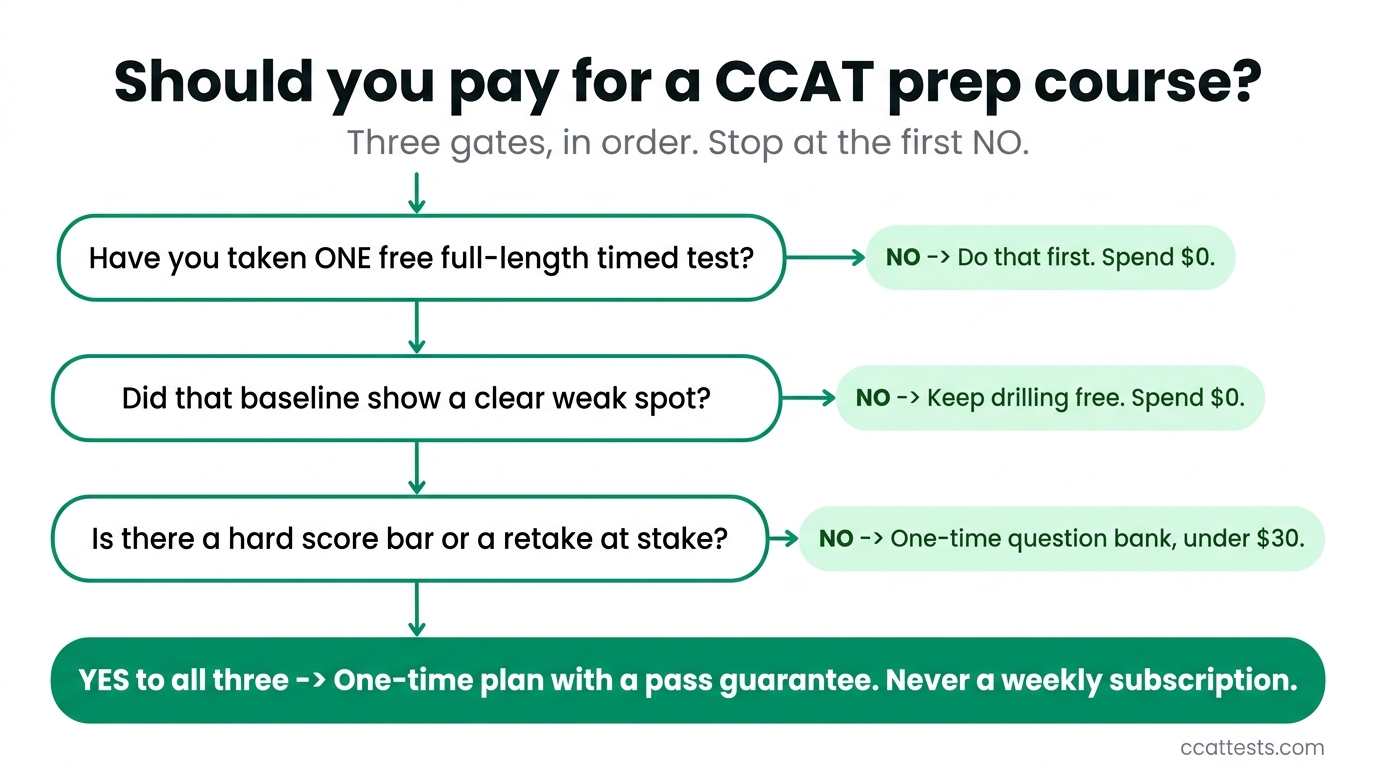
Gate one: have you taken one free full-length timed test? If not, do that before you open a single checkout page. A timed run gives you a raw score and, more usefully, tells you how many questions you reached before the clock died. That discovery costs nothing.
Gate two: did the baseline show a clear weak spot? An overall score is not a reason to buy. A specific pattern is: you reached only 30 questions, or you were fine on verbal and collapsed on spatial. If nothing clear showed up, more free reps beat a purchase.
Gate three: is there a hard score bar or a retake at stake? A specific company threshold or a second attempt changes the maths, and it is the only situation where paying for a guarantee beats paying for practice.
What to get free, and where free is genuinely enough
Free comfortably covers the two jobs that matter first: learning the format and finding your weak spot.
A full-length timed simulation is the highest-value free item in CCAT prep and the one thing you should never pay for first. Fifty questions against a real 15-minute countdown teaches you the test’s difficulty in a way no untimed sample can.
The official Criteria Corp prep page walks through the format and shows one sample question of each type. Not a practice bank, but the one source you can trust on format facts without a second opinion.
Free sample questions and practice PDFs beat another full test once you know your weak domain, though a PDF cannot time you and renders spatial-reasoning items badly.
For a ranked breakdown of the no-cost options, see our guide to the free CCAT resources worth using before you pay for anything. That plus one timed run is the entire prep budget for a lot of readers.
Where free runs out: the three things worth paying for
Free is excellent at diagnosing and weak at fixing. Three things justify a small one-time payment, in this order.
1. A realistic question bank, especially spatial reasoning. In practice, free banks tend to recycle the same handful of items, and spatial and abstract-reasoning questions are the hardest to find good free versions of because they need properly rendered images. If your baseline flagged spatial as your weak domain, this is the upgrade most likely to move your score.
2. Weak-area analytics. One overall score tells you to “study more”, which is not a plan. A breakdown by question type tells you exactly where points are leaking so you can drill the right thing and retest. Enterprise assessment tools sell this caliber of insight to teams for around $497 a month. On a budget the value is not the dashboard, it is the wasted study hours it saves you.
3. Repeatable timed simulations. One free run gives you a baseline, fixing pace usually takes several more, and free versions often cap you or gate the spatial section.
| What you need | Can free do it? | Worth paying for? | Why |
|---|---|---|---|
| Learn the format | Yes, fully | No | criteriacorp.com covers it in five minutes |
| Get a baseline score | Yes, fully | No | One free timed run is all you need |
| Find your weak domain | Roughly | Sometimes | Free tells you roughly, analytics tells you exactly |
| Spatial-reasoning practice | Barely | Yes | Free banks skip or fake the rendered images |
| Repeatable timed simulations | Often gated | Sometimes | Worth it if the free version caps you |
| Weak-area heat map | No | Yes | Turns “study more” into a targeted plan |
| Video lecture course | Not needed | Rarely | You need reps and feedback, not lectures |
The pattern holds at every price point: pay for depth and diagnosis, never for a baseline or the format.
Three pricing traps to check before you buy
Trap one: the access window. Almost every CCAT course sells time, not content. Thirty days sounds generous until your interview loop slips two weeks and you are buying it again. Find the expiry date, then compare it against your test date plus a buffer for a possible retake.
Trap two: weekly billing. You are preparing for one 15-minute exam, not building a study habit, so recurring billing is structurally working against you. Six weeks of a $65-a-week plan is nearly $400 for a test where the average score is 24 out of 50.
Trap three: the guarantee fine print. “100% pass guarantee” is a common badge, and the conditions decide whether it means anything. One course ranking on page one honors its guarantee only if you scored 80% or higher on all of its own practice exams and claim within 30 days with documentation. That is not a scam, but it is a very different promise from what the badge implies.
Overpaying is only one way to waste a prep budget. Our guide to the most common CCAT prep mistakes covers the rest, most of which cost time rather than money.
A worked example: prepping well on the smallest possible budget
Day one, $0. Read the Criteria Corp format page, then take one free full-length timed test. Say you reach 34 of the 50 questions and get 22 correct. That baseline already tells you something specific: your accuracy was fine, you simply never saw 16 questions. Your problem is pace.
Day two, $0. Find where the clock died. If math word problems ate your time, drill 15 to 20 of them untimed from a free set, hunting for the fastest solution path rather than the right answer alone. Then take a second timed run and watch whether your reached-question count moves.
Day three, a small paid step if the gap is real. Say the second run points at spatial reasoning, the gap free struggles to fill. A single one-time payment for a realistic bank plus a weak-area breakdown does more here than a third free test would. Total spend: one entry tier, aimed at the exact thing costing you points.
Most people run out of time before they run out of questions, which is why the smartest budget move is spending on diagnosis and targeted reps rather than on a course that re-explains what an analogy is.
FAQ
How much does a CCAT prep course cost?
Published prices on the first page of Google in August 2026 ran from $29.99 for three months to $48.90 for 30 days, with one service reported by a candidate at around $65 per week. Some of the biggest brands publish no price at all. One-time question banks with analytics sit lower than any of those.
Is a paid CCAT prep course worth it?
Sometimes, and only for specific things: a realistic question bank, analytics that show which question type is costing you points, and repeatable timed simulations. It is not worth paying for a baseline, the format, or video lectures. Take a free timed test first, then decide.
Is there a free CCAT prep course?
There is no full free course, but the pieces that matter most are free. Criteria Corp publishes the format and sample questions, and full-length timed practice tests are available at no cost. What free rarely gives you is a deep spatial-reasoning bank or a proper weak-area breakdown.
Where can I find a free CCAT practice test?
Start with a full-length timed simulation rather than untimed samples, since the clock is the actual difficulty. Our free CCAT practice tests run 50 questions against a 15-minute timer across all three question domains, and Criteria Corp offers free practice material on its candidate site.
Is 26 out of 50 a good CCAT score?
It is above average. Criteria Corp reports that the average test taker answers about 24 of the 50 questions correctly and that fewer than 1% answer all 50. Whether 26 clears the bar depends on the role, since employers set their own benchmarks and technical or consulting roles typically expect more.
How difficult is the CCAT test?
It is hard because of the clock, not the content. Taken one at a time, the individual questions are far less challenging than getting through enough of them inside the limit. Answering 50 in 15 minutes, about 18 seconds each, with no calculator, is what makes it difficult, and it is why Criteria Corp reports that fewer than 1% of candidates finish.
Are CCAT prep course pass guarantees real?
They are real and conditional. One course ranking on page one honors its guarantee only if you scored 80% or higher on every one of its own practice exams and claim within 30 days with documentation. A guarantee is worth a premium when you face a hard score bar or a retake, but read the exact conditions first.
Why do I keep seeing CCAT scores for gifted students?
Because two different tests share the acronym. The Canadian Cognitive Abilities Test is a school assessment given to children and reported on a scale where 130 and above is “very superior”. That has nothing to do with the Criteria Cognitive Aptitude Test your employer sent you, which is scored out of 50 questions in 15 minutes. If a page starts talking about gifted programs, you are on the wrong test.
Related on CCAT Tests
- Practice. Free CCAT practice tests. Get a real timed baseline across all three domains before you spend anything.
- Free resources. 7 free CCAT resources worth using before you pay. The no-cost options ranked, and what each one actually gives you.
- Mistakes. The most common CCAT prep mistakes. The habits that waste your prep time even when you spend nothing.
- Score context. What is a good CCAT score?. What your baseline number actually means before you decide to buy anything.
- Pillar. The complete CCAT preparation guide. The full roadmap from first search to test day.
Try CCAT Tests
Budget-first prep, in the order that actually works
Most CCAT sites show you three questions and then ask for a card, or bill you again next week. Ours does neither. The free tier is a real, usable practice experience across all three question domains, enough to see where you stand before you spend anything. When your baseline shows a genuine gap, the paid tiers add a heat map of the question types slowing you down and a CCAT-style bank with real spatial and abstract-reasoning images, all one-time and never a subscription, see pricing. A companion Udemy course with more than 1,200 students at 4.5 out of 5 covers the taught walkthrough. If the CCAT is one hurdle in a pipeline that also throws personality, situational, or other cognitive assessments at you, the wider PrepClubs platform covers that whole gauntlet, with 21 pre-employment tests, more than 3,700 students, and a money-back guarantee.
CCAT is a registered trademark of Criteria Corp. ccattests.com is an independent study resource and is not affiliated with, endorsed by, or sponsored by Criteria Corp.