You applied to a private equity firm, or to a software company you later realized is owned by one, and the next email said you need to take the CCAT. If your first thought was “why does a finance firm want me to solve pattern puzzles in 15 minutes,” you are asking the right question. Private equity firms use the CCAT because their entire operating model runs on hiring people who can learn fast and think under pressure, and this test is a cheap, quick proxy for exactly that. This guide explains why PE leans on the CCAT, where it sits in the hiring process, what score you realistically need, and how to prepare, with Vista Equity Partners as the marquee example because it is the most public case.
One quick disambiguation first. This is the Criteria Cognitive Aptitude Test from Criteria Corp, the workplace hiring test, not the Canadian Cognitive Abilities Test used for gifted-program school admissions. They share the acronym CCAT and get tangled in search results, but they are different tests. The one a PE firm sends you is the workplace one.
Quick takeaways
- Private equity firms use the CCAT because their model demands people who learn fast and problem-solve under time pressure, and the CCAT is a fast proxy for both.
- The CCAT is 50 questions in 15 minutes, no calculator, across three domains: verbal, math and logic, and spatial reasoning.
- Vista Equity Partners is the best-known PE user, and it pairs the CCAT with a personality test (the EPP).
- If you apply to a Vista-owned portfolio company, you will likely face the same CCAT-plus-personality screen, even though you are not applying to the PE firm directly.
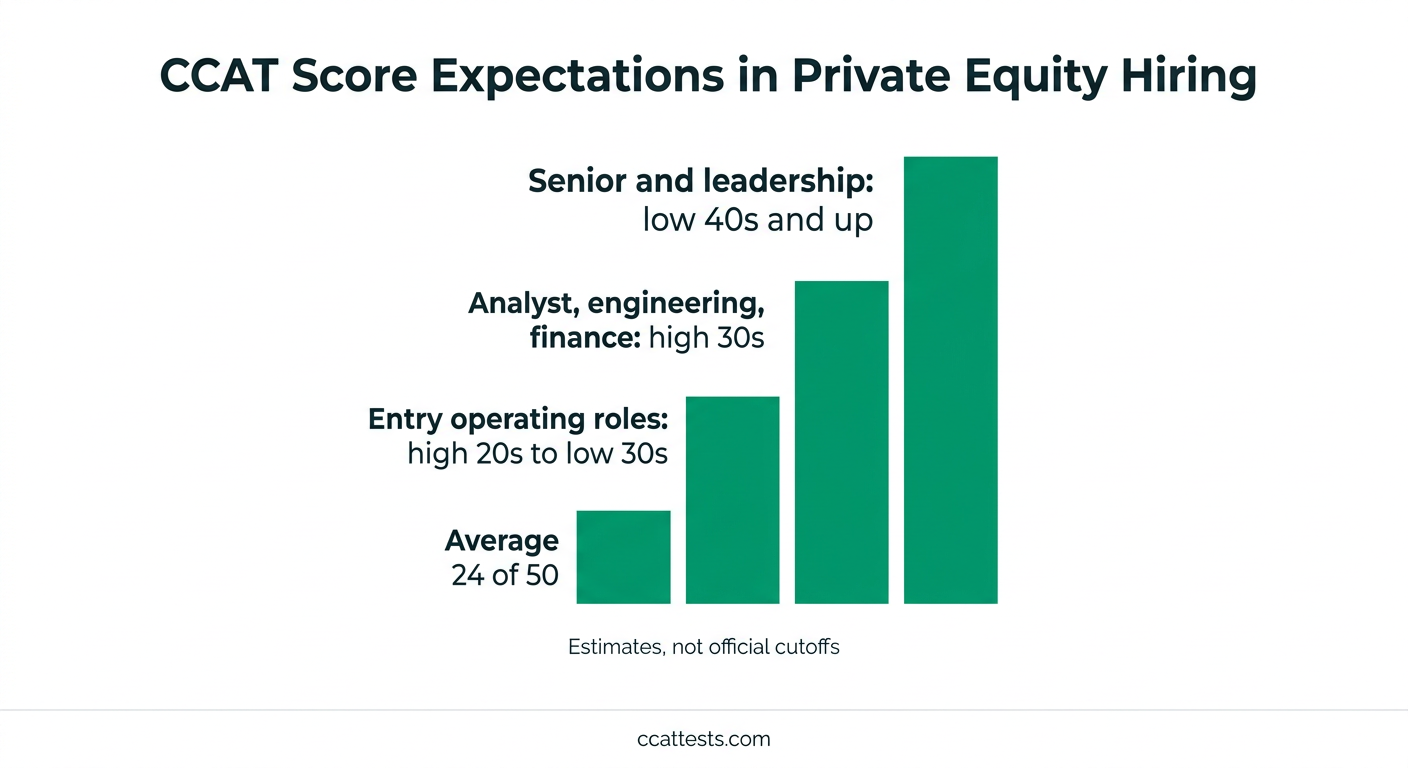
- The average CCAT score is about 24 out of 50. Competitive PE and portfolio-tech roles generally expect meaningfully higher, often the high 30s to low 40s, though these are prep-industry estimates, not published cutoffs.
- Neither Vista nor Criteria Corp publishes an official pass mark, so treat any specific number you see, including in this article, as a directional estimate, not a guarantee.
Why private equity firms use the CCAT
To understand the test, understand the business. A private equity firm buys companies, installs or backs operators to run them, and works to grow their value quickly, on a fund clock, before selling or recapitalizing. That model puts a premium on one trait above almost all others: raw learning speed.
In a PE-owned company, roles change fast. Someone hired for one job is often asked to take on a broader or different one within a year as the company reorganizes and scales. There is rarely time to slowly “grow into” a role. So the firm screens hard, early, for people who can pick up new domains quickly and reason well under pressure, rather than only for people who already know a specific stack or process. The CCAT measures exactly that kind of general problem-solving speed in 15 minutes, at almost no cost to the employer. That is why it shows up so often at the front of a PE hiring funnel, and why it propagates across a firm’s portfolio companies too.
Where the CCAT sits in a PE hiring process
Across the Vista-focused prep content that ranks for this topic, the sequence is consistent. The CCAT is an early screen, not a final round.
- Apply / submit resume. Standard first step.
- Cognitive and personality screen. This is where the CCAT lives, usually paired with a personality assessment. At Vista, that pairing is the CCAT plus the Employee Personality Profile (EPP). You generally need to clear both to advance.
- Recruiter and hiring-manager interviews. Once you pass the screen.
- Case studies, technical rounds, and final interviews, depending on the role and seniority.
Some candidates report that a firm may re-administer the CCAT in a more observed or proctored setting later in the process to confirm a first-round score. Treat that as “some candidates report,” not universal policy, but it is a good reason not to game the first attempt: a wildly inconsistent second score is a red flag.
The Vista example (and why its whole portfolio uses it)
Vista Equity Partners is the clearest public case of a PE firm using the CCAT, and it is worth understanding because it explains a pattern you will hit across dozens of companies.
Vista requires candidates to take the CCAT as an early screening step, paired with the EPP personality test. This is well documented across prep sites and candidate forums. Here is the part that surprises people: Vista owns Criteria Corp, the company that makes the CCAT. That ownership is a real, citable fact, and it is a straightforward reason the test appears consistently across Vista’s world. (You will see forum speculation about motives beyond that; the ownership itself is the concrete fact, the motives are opinion.)
Because of that, if you apply to a Vista-owned portfolio company, a SaaS business you might not even associate with private equity, you will very likely meet the same CCAT-plus-EPP screen. Companies that have appeared across prep-site coverage as Vista-portfolio or CCAT-using include Finastra, PowerSchool, Cvent, TIBCO, Vertafore, Aptean, Infoblox, Ping Identity, Mitratech, and Relias, among others. Beyond Vista’s portfolio, prep vendors also maintain dedicated CCAT pages for employers like Crossover. The practical takeaway: if the company that contacted you is owned by a PE firm, do not be surprised by a cognitive test early in the process.
What CCAT score you need for a PE or portfolio role
Here is the honest version, because the salesy prep pages tend to throw out a single number and move on. Neither Vista nor Criteria Corp publishes an official cutoff. What follows are directional estimates based on how prep vendors describe competitive scores and on the test’s known norms, not promises.
| Role type | Rough score expectation (estimate) | Why |
|---|---|---|
| General / entry operating roles | Solidly above the ~24 average, roughly high 20s to low 30s | You need to clear the screen and show above-median reasoning speed. |
| Analyst, engineering, product, finance | High 30s | These roles lean hardest on the exact reasoning the CCAT measures, so bars run higher. |
| Senior and leadership roles | Low 40s and up | Expectations climb with seniority and the analytical demands of the role. |
For reference points: the average CCAT score is around 24 out of 50, and a 42 is well above average, landing in roughly the top few percent of test takers. Fewer than 1 percent of candidates answer all 50 questions, so a high score is about accuracy and pacing, not finishing. Use the table to set a target, then confirm nothing as a hard cutoff, because these firms deliberately do not publish one.
How to prepare for a PE-administered CCAT
The prep is the same test regardless of who sends it, but the stakes at a competitive PE or portfolio role mean you want to aim high, not just clear the average.
- Practice timed, always. The CCAT’s difficulty is the clock: roughly 18 seconds per question. Untimed practice builds a confidence that collapses on test day.
- Drill all three domains, especially your weakest. Verbal, math and logic, and spatial and abstract reasoning are interleaved. Most people neglect spatial because it feels least familiar, and that is exactly where PE-caliber candidates lose points.
- Get fast at mental math. No calculator is allowed, so the arithmetic has to be quick and clean on scratch paper.
- Learn to skip. Getting stuck on one hard item can cost you three easy ones. Recognizing a time sink and moving on is worth more than any single answer.
- Prepare for the personality test too. If you are applying to Vista or a portfolio company, the EPP is part of the screen. Answer it honestly and consistently rather than trying to reverse-engineer a “right” personality.
FAQ
What is the CCAT for Vista Equity Partners?
It is the Criteria Cognitive Aptitude Test: 50 questions in 15 minutes across verbal, math and logic, and spatial reasoning. At Vista it is an early screening step, paired with the EPP personality test, and you generally need to clear both to move forward. Vista also owns Criteria Corp, the company that makes the CCAT.
What companies use the CCAT?
Vista Equity Partners and many of its portfolio companies (Finastra, PowerSchool, Cvent, TIBCO, Vertafore, Infoblox, and others have appeared in prep coverage), plus tech and SaaS employers like Crossover. If a company you are applying to is owned by a private equity firm, a cognitive screen early in the process is common. See our full list of companies that use the CCAT.
What is a good CCAT score for private equity?
The average is about 24 out of 50, so a “good” score for a competitive PE or portfolio-tech role is meaningfully above that, commonly the high 30s to low 40s in prep-vendor estimates. There is no published official cutoff, so treat those numbers as targets, not guarantees, and aim as high as your practice allows.
What is a 42 on the CCAT?
A 42 is well above the roughly 24 average, placing you in approximately the top few percent of test takers. It is a strong, competitive score for demanding PE, finance, and technical roles. The exact percentile is approximate and drawn from prep-industry norms rather than an official Vista figure.
Do most people finish the CCAT?
No. Fewer than 1 percent of candidates answer all 50 questions in the 15-minute limit. The test is built so almost no one finishes, which is why accuracy per question and smart pacing matter far more than racing to the end.
Do portfolio companies use the same test as the PE firm?
Often, yes. A private equity firm’s operating and portfolio companies frequently use the same cognitive screen. Vista-owned companies in particular tend to use the CCAT-plus-EPP combination, so applying to a PE-owned SaaS business can mean the same test you would face applying to the firm directly.
Related on CCAT Tests
- Companies. Which companies use the CCAT test. The full, verified list and what each expects.
- Pillar. The complete CCAT test preparation guide. Format, scoring, and prep in one hub.
- Practice. Free CCAT practice tests. Time yourself against the real 15-minute clock.
Try CCAT Tests
A PE screen expects well above the average, so practicing against the real clock is not optional.
Clearing a private equity CCAT screen means beating the average by a wide margin, and that comes from realistic, timed practice, not casual quizzes. CCAT Tests gives you genuine CCAT-style questions across all three domains, including the spatial and abstract-reasoning images generic sites skip, so nothing on test day is unfamiliar. The free tier is a genuinely usable practice experience, not three sample questions and a paywall, so you can gauge where you stand against a PE-caliber bar before paying for anything. The heat-map analytics then show exactly which question types are costing you points, so a time-poor candidate drills the domain that will move the score instead of re-practicing a strength. Paid plans are one-time purchases, see pricing, which suits a candidate working to a high, non-negotiable bar. The same approach backs our companion Udemy course, which has taught more than 1,200 students at a 4.5 out of 5 rating. And because a PE process often stacks the CCAT with a personality test and other assessments, our sister platform PrepClubs runs the same free-first, analytics-driven practice across 21 pre-employment tests with a money-back guarantee, so you are ready for the whole screen, not just one part of it.