You saw “series completion” on a practice test or in a prep site’s question list, and you want to know what it is before your assessment link expires. Here is the direct answer: series completion is any question that shows part of a sequence and asks what comes next, and on the CCAT it turns up in three costumes, as numbers, as letters, and as shapes or symbols. They look nothing alike on screen, but one procedure cracks all three in about 10 seconds each: name what is changing, test the cheapest rule that could explain it, then verify that rule on one more step before you answer.
One quick disambiguation before you start. This is the Criteria Cognitive Aptitude Test used in workplace hiring, not the Canadian Cognitive Abilities Test given to schoolchildren that shares the same initials. Plenty of the “CCAT series” material online is quietly about the children’s test.
Quick takeaways
- Series completion is not one CCAT question type. It shows up as number and letter series in the Math and Logic area, and as shape or symbol series in Spatial Reasoning.
- Sentence completion is a verbal question, not a series question, and matrix completion is the 3x3 grid variant. Do not buy practice material for the wrong one.
- “Series completion” is prep-site shorthand, not an official Criteria Corp label, which is why different sites define it differently.
- The method is identical for all three flavors: name the dimension that changes, test the cheapest rule first, verify that rule on one more step before answering.
- The CCAT is 50 questions in 15 minutes, about 18 seconds each, so a series item you cannot crack in roughly 10 seconds is a guess-and-move situation.
- Letter series become easy the moment you convert letters to alphabet positions, because then they are just number series.
- Shape series only ever change six things: rotation, reflection, shading, count, size, or position.
What “series completion” actually means on the CCAT
Series completion is a family of question formats, not an officially named section. Criteria Corp, which publishes the CCAT, describes the test as 50 questions in 15 minutes across Verbal, Math and Logic, and Spatial Reasoning questions, with no calculator allowed. It does not publish a per-type question count, so any site quoting you an exact number of series items is estimating. What you can rely on is where each flavor lives.
| Term you might see | What it actually is | Where it sits on the CCAT |
|---|---|---|
| Number series | A run of numbers with the next value missing | Math and Logic |
| Letter series | Single letters or letter pairs following an alphabet rule | Math and Logic |
| Shape or symbol series, “next in series” | Figures that change step by step across a row | Spatial Reasoning |
| Matrix completion | A 3x3 grid of figures with one cell blank | Spatial Reasoning |
| Sentence completion | A sentence with a missing word | Verbal, not a series question at all |
That last row trips people up constantly. If you searched for CCAT series completion and landed on a page about context clues and grammar, you were reading about sentence completion, a different skill entirely. The other mix-up is bigger: the school-level Canadian Cognitive Abilities Test also has a number series section, so a share of search results, and a share of AI-written answers, describe a test built for eleven-year-olds. If a page mentions grade levels, stanines or a child’s score report, close it.
The 10-second rule: a three-step procedure
Every series question, in any format, is solved by the same three moves in the same order.
- Name the dimension that changes. Ask what is different from one term to the next. With numbers it is size and direction, with letters it is alphabet position, with shapes it is one of six visual properties. Give this about two seconds.
- Test the cheapest rule first. Cheap means fewest mental operations: add or subtract before multiply or divide, one rule before two interleaved rules, single change before combined change. Most CCAT series run on a cheap rule.
- Verify on one more step. A rule that explains term one to term two is a guess. A rule that also explains term two to term three is an answer. People skip this step, and it is where most wrong answers come from.
Why 10 seconds? Fifty questions in fifteen minutes is roughly 18 seconds each, and series items are meant to be your fast points, the ones that bank time for word problems and longer verbal items later. Criteria Corp notes that fewer than 1 percent of candidates answer all 50 questions, so the test is built to run you out of clock. Ten seconds is a budget, not a target.
Numbers: the checking order that finds the rule fastest
For a number series, run these checks in a fixed order and stop at the first one that holds twice.
- Constant difference. Subtract each term from the next; if the gaps match, you are done.
- Constant ratio. Divide each term by the previous one. Doubling, tripling and halving are common.
- Pattern in the differences. Write the gaps out. If the gaps form a simple run like 2, 4, 6, 8, that is your rule.
- Two interleaved series. Read the odd positions only, then the even positions only. Two simple rules hiding in one row look impossible until you split them.
Worked example: 4, 9, 19, 39, ? The differences are 5, 10, 20, not constant, and the ratios are not clean, so this is not a pure geometric run. But the differences are doubling, which points at an operate-then-add rule. Test the cheapest candidate, multiply by 2 and add 1: 4 times 2 plus 1 is 9. Verify on the next step: 9 times 2 plus 1 is 19. The rule holds twice, so the answer is 39 times 2 plus 1, which is 79.
For the full pattern catalogue, our five CCAT number series patterns piece is the companion to this one, and the older number sequences deep dive covers mixed operations.
Letters: convert to positions, then it is a number series
A letter series is a number series in disguise. Write A equals 1, B equals 2, through to Z equals 26, and the alphabet gaps become arithmetic you already know how to check.
Worked example: C, F, J, O, ? The positions are 3, 6, 10, 15. The differences are 3, 4, 5, so the next gap is 6. Position 15 plus 6 is 21, which is U.
Two things to watch. Series often run in pairs, like AZ, BY, CX, where the first letter walks forward while the second walks backward, so split the pair and treat each position as its own series. And some series wrap past Z back to A, so if your arithmetic gives position 28, subtract 26 and take position 2, which is B. Neither is hard, but both cost time if you meet them first on test day.
Shapes and symbols: six things that can change
Shape series feel harder because there is no arithmetic to fall back on, but the search space is smaller than it looks. A figure in a CCAT-style series is changing one of six properties, and your whole job in step one is to name which.
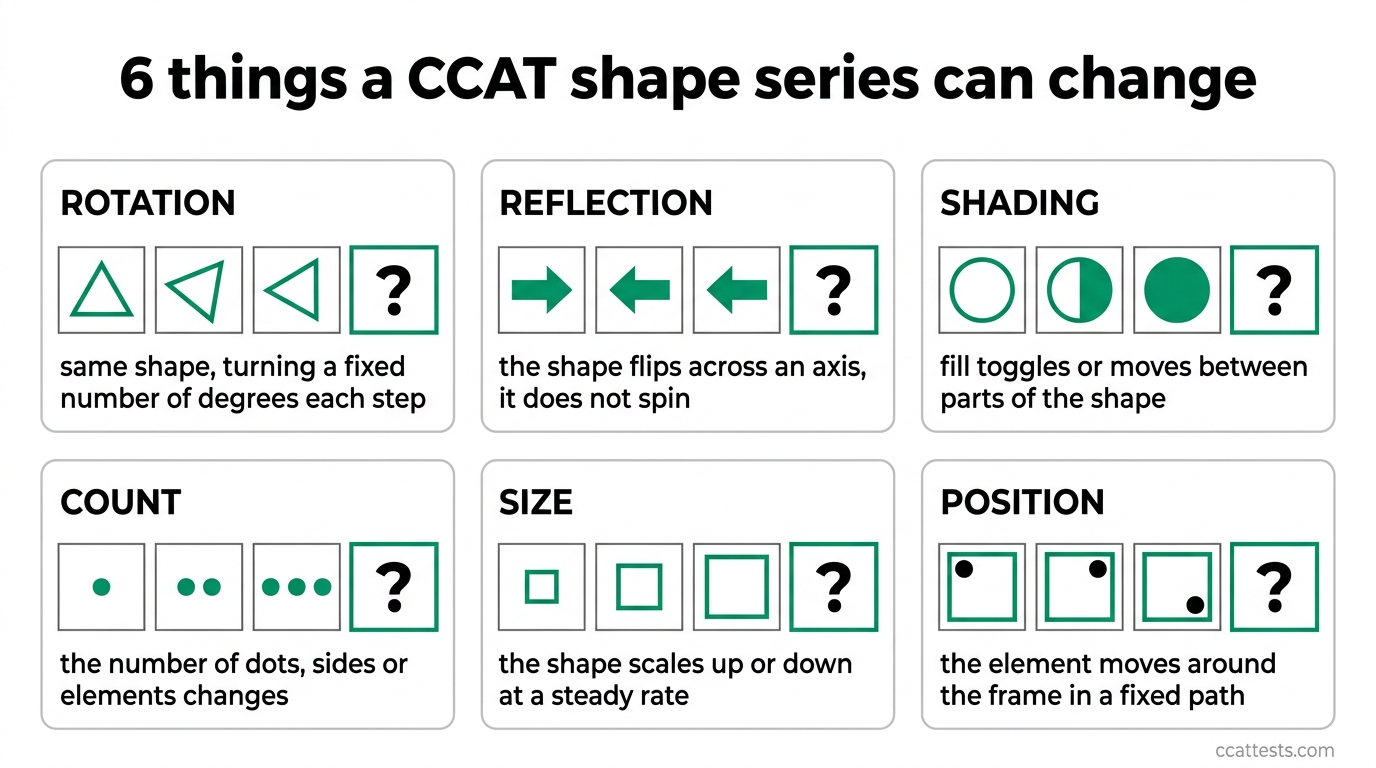
Worked example, described the way you would see it on screen. Box one: a triangle pointing up with a black dot in the top-left corner. Box two: the same triangle rotated 90 degrees clockwise, dot now top-right. Box three: rotated another 90 degrees, dot bottom-right.
Two properties are moving, so handle them separately. The triangle turns 90 degrees clockwise per step, putting the fourth figure 270 degrees from the start. The dot moves one corner clockwise per step, so it lands bottom-left. Both rules hold across both jumps, so scan the options for the single figure that satisfies both. When two properties change at once, at least one distractor will get exactly one of them right. The same scan works on matrix questions, read across the rows first and then down the columns, and our CCAT abstract reasoning guide covers those variants.
Three traps, and when to bail
Nearly every series mistake is one of three specific errors, and all three are avoidable once you can name them.
The half-right distractor. On multi-property shape questions, one option matches the rotation but not the shading, and another matches the shading but not the rotation. Spot only one changing property and you will pick one of these feeling confident. That is what step three is for.
Mirror versus turn. A reflected shape and a rotated shape look identical for symmetric figures and completely different for asymmetric ones. If a figure has a distinguishing mark, like a notch or a dot, track the mark, not the outline. The outline lies, the mark does not.
Forcing a rule. If nothing resolves after two failed checks, you probably have an interleaved series rather than a hard single rule. Split the row before spending a third guess on it.
If splitting does not help either, guess and move on immediately. Your CCAT result is a raw score, the number of questions you answered correctly, plus the percentile that puts it in context, per Criteria Corp. An unanswered question and a wrong one land in the same place on your report, while the seconds you spent deciding do not come back. Our guessing strategy piece has the fuller framework, and the 15-minute pacing guide covers where those seconds go.
How to practice so it holds up under the clock
Practice all three flavors in one timed sitting rather than separately. Most people drill number series because they are easy to find as plain text online, then meet a shape series on the real test and lose thirty seconds to surprise. The formats share a procedure but not a feel, and the switching cost is real. Two habits pay off: keep a visible timer from your first session, since the difficulty of the CCAT is pace rather than content, and after every set, sort your misses by flavor. If seven of your ten misses are shape series, that is not an aptitude problem, that is one afternoon of targeted work. Material quality decides whether that afternoon helps, because generic aptitude banks recycle the same items across a dozen different tests and text-only banks skip shape series entirely. If your practice never shows you a rotating asymmetric figure with a shading change, you have not practiced the hardest thing the CCAT will put in front of you.
FAQ
What is series completion on the CCAT?
Series completion is any CCAT question that gives you part of a sequence and asks what comes next. It appears as number and letter series in the Math and Logic questions, and as shape or symbol series in Spatial Reasoning. Criteria Corp does not use it as an official section name, so prep sites apply the label a little differently.
How many series completion questions are on the CCAT?
There is no published figure. Criteria Corp confirms 50 questions in 15 minutes across three areas but releases no per-type breakdown, so any exact count you see is an estimate from candidate reports. Number and letter series are generally a small handful of items, while Spatial Reasoning, where shape series live, is a larger block.
Is series completion the same as sentence completion?
No. Sentence completion is a verbal question asking you to pick the word that fits a sentence. Series completion asks what comes next in a sequence of numbers, letters or figures. They share a word and nothing else, so check which one your practice set covers.
Is 26 out of 50 good for the CCAT, and what is an average score?
The average test taker gets 24 questions right, according to Criteria Corp, so 26 is slightly above average. Whether that is good depends on the employer, since there is no universal pass mark and Criteria Corp does not set one. Candidates often report higher bars for competitive technical and consulting roles, and Crossover publishes 35 out of 50 as its own baseline. Our what is a good CCAT score guide breaks it down by role.
What is a 42 on the CCAT, and what is the 85th percentile?
A 42 out of 50 is a very high score, far above the average of 24. Crossover’s public CCAT guide describes 35 out of 50 as roughly the 85th percentile and its usual baseline for advancing, which is one company’s guidance rather than a universal conversion. Criteria Corp does not publish a raw-to-percentile chart, so treat any specific percentile figure as an approximation.
How difficult is the CCAT test?
The content is not advanced, the clock is what makes it hard. There is no calculus, no obscure vocabulary and no calculator, but 50 questions in 15 minutes is about 18 seconds each, and Criteria Corp reports that fewer than 1 percent of candidates answer all 50. Most people who feel they failed ran out of time rather than out of ability.
How long does it take to get CCAT results?
Scoring is automatic. Criteria Corp states that once the test is completed the employer is sent your raw score and your percentile, so the wait you experience is the company’s hiring timeline, not marking time. If you have read that results take a few weeks and arrive with grade-level percentiles and stanines, that source was describing the Canadian Cognitive Abilities Test taken by schoolchildren.
Where can I find CCAT series completion practice questions or a PDF?
Free PDFs are a mixed bag: some are for the children’s test, many have no answer explanations, and almost none include rendered shape series. Timed on-screen practice is closer to the real thing anyway, because scrolling a PDF at your own pace trains none of the pacing that decides your score. Start with our free CCAT practice tests, then work type by type through the CCAT practice questions hub.
Related on CCAT Tests
- Numbers. 5 CCAT number series patterns.
- Deep dive. CCAT number sequences pattern mastery.
- Shapes. CCAT abstract reasoning, including odd-one-out and matrices.
- Pacing. CCAT time management in 15 minutes.
- Pillar. CCAT practice questions, every question type in one hub.
Try CCAT Tests
Drill all three series flavors, on a timer, in one place
Reading a procedure and running it in 10 seconds with 40 questions still ahead of you are different skills, and only timed practice closes the gap. Our free tier is a genuinely usable practice experience rather than a three-question teaser, with real CCAT-style items across all three question areas, including rendered shape and symbol series instead of text-only filler. Paid plans are one-time, see pricing, and add heat-map analytics that show whether number, letter or shape series are the ones costing you points, so you drill the one that matters instead of all three equally. If the CCAT is only the first hurdle in a process that also throws personality, situational and other cognitive assessments at you, the wider PrepClubs platform covers that whole gauntlet with 21 pre-employment tests, more than 3,700 students, and a money-back guarantee.
CCAT is a registered trademark of Criteria Corp. ccattests.com is an independent study resource and is not affiliated with, endorsed by, or sponsored by Criteria Corp.